By Staff Reporter
ISLAMABAD: Pakistan is prepared to deploy troops as part of an international stabilisation force in Gaza under a United States-brokered peace plan, but it will not participate in any effort to disarm the Palestinian group Hamas, Deputy Prime Minister and Foreign Minister Ishaq Dar said on Saturday.
The announcement, made during a wide-ranging news conference at the Ministry of Foreign Affairs, comes as officials in Islamabad signal that a formal decision on the country’s involvement could be imminent. It shows Pakistan’s cautious approach to the fragile accord aimed at ending two years of devastating conflict in the Gaza Strip, which has left much of the Palestinian enclave in ruins.
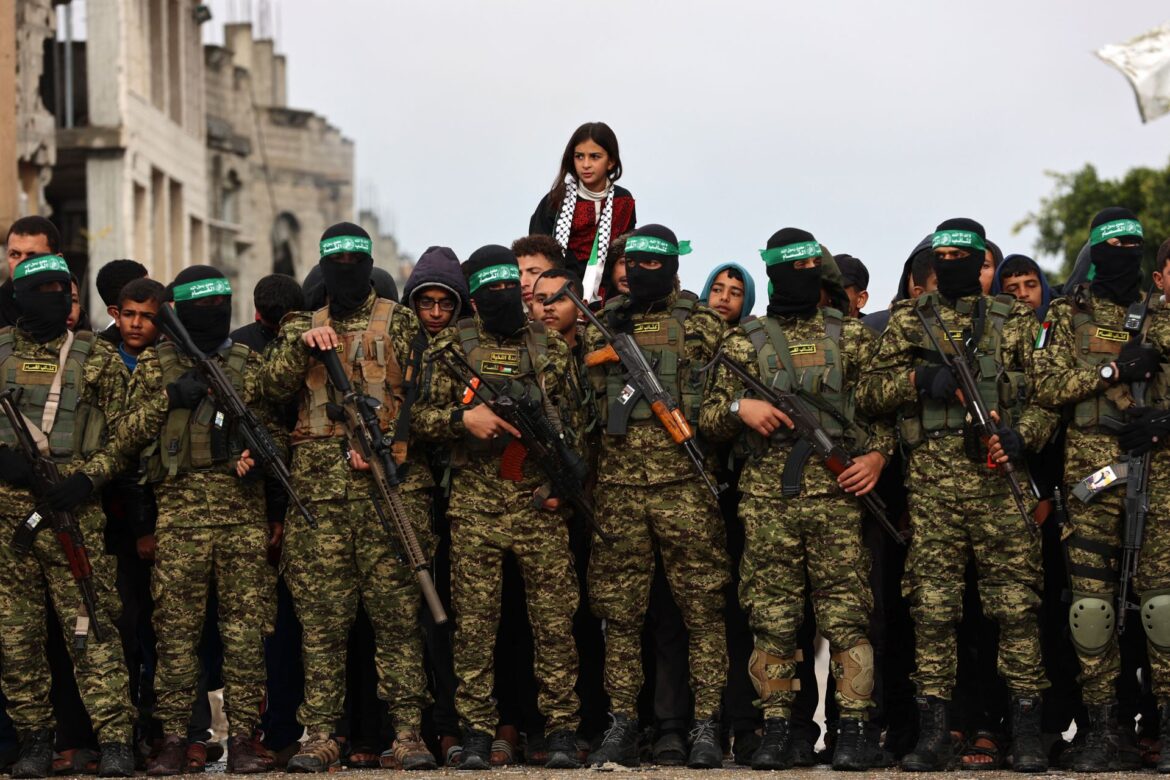
A cornerstone of the Gaza Peace Agreement, brokered by the United States, is the establishment of the International Stabilisation Force, composed primarily of troops from Muslim-majority countries. The force is authorised under a United Nations Security Council resolution adopted this month, which endorses President Donald J. Trump’s plan to resolve the conflict. Thirteen council members, including Pakistan, voted in favour, while Russia and China abstained. But Hamas swiftly rejected the resolution, denouncing the proposed international force for its mandate that includes the “disarmament” of Palestinian resistance groups in Gaza.
Dar distanced Pakistan from that aspect of the mission, emphasising that his country’s role would be limited to peacekeeping. “We are not ready for that,” he said of disarming Hamas. “This is not our job, but of the Palestinian law enforcement agencies. Our job is peacekeeping, not peace enforcement.”
He added: “We are definitely ready to contribute to the force, the prime minister has in principle already announced after consultation with the field marshal that we will contribute, but this decision cannot be taken until it is decided what its [ISF] mandate and TOR (terms of reference) will be.”
Officials said discussions within the government and military establishment were at an “advanced stage.” The tone of those internal consultations, they said, suggests that Islamabad is inclined to participate.
Dar said the issue of Hamas’s disarmament first arose during a meeting in Riyadh on the two-state solution. He noted that he was present at the initial talks when the force was discussed, and that Indonesia had offered 20,000 troops while Prime Minister Shehbaz Sharif had signalled “in principle” that Pakistan would positively consider joining.” As per my information, if it will include disarming Hamas, then even my Indonesian counterpart has informally expressed his reservation,” Dar said.
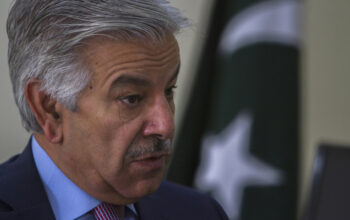
The matter has stirred controversy within Pakistan. Last month, Defence Minister Khawaja Asif expressed anger over remarks by a government spokesman, Danyal Chaudhry, who suggested the force’s mandate would include disarming Hamas. Asif rubbished and strongly condemned those comments. At the United Nations, Pakistan’s permanent representative, Ambassador Asim Iftikhar Ahmad, stressed during the Security Council vote that the force could stabilise Gaza only if it operated under a clear mandate consistent with UN principles. Disarmament, he said, must occur through a negotiated political process under a unified Palestinian National Authority. The resolution’s text authorises the ISF. to ensure the demilitarisation of Gaza, including by decommissioning weapons and destroying military infrastructure. It also allows member states to join a transitional Board of Peace to oversee Gaza’s reconstruction and economic recovery.
Trump’s 20-point plan is annexed to the resolution. The text further states that “conditions may finally be in place for a credible pathway to Palestinian self-determination and statehood” once the Palestinian Authority completes a reform program and Gaza’s redevelopment progresses — a prospect already firmly rejected by Israel.
Dar’s remarks on Gaza were part of a broader discussion of Pakistan’s foreign policy challenges. He spoke at length about the recent deterioration in relations with Afghanistan, amid a flare-up in cross-border tensions. Referring to retaliatory actions by Pakistan after terror attacks carried out by Afghan nationals, Dar said it was a mistake for the Taliban authorities to assume Pakistan could not handle the situation unilaterally. “The country had ample kinetic capabilities,” he said, but invading a “brotherly country” to neutralise threats would not be “desirable.” “The situation was possibly leading to that stage when this issue began,” he added. “Qatar is a country whose foreign ministry was contacting me hourly at that time.”
He recounted that Qatar’s prime minister and foreign minister were in touch with him “every hour.” “They found out that we were about to take kinetic action,” Dar said. “They requested that ‘please stop your side and we will mediate, take responsibility and get the issue resolved.'”
The foreign minister expressed gratitude to Prime Minister Sharif and the army chief for accepting his stance, noting that “the cleanup operation that was about to happen that night, that would have surely taught them a lesson, was stopped.” Despite mediation efforts by Qatar and Turkey, Dar said, “nothing was gained from the negotiations,” and the mediators themselves grew frustrated by the lack of progress.
He urged Kabul’s authorities to embrace “dialogue and diplomacy” as the only path forward and called on the Afghan Taliban regime to reflect on its “weaknesses and faults.” Dar described a divide within the Taliban between “peacemakers and the warmongers.”
Citing recent incidents, including the shooting of two United States National Guardsmen by an Afghan national and attacks on Chinese workers in Tajikistan originating from Afghanistan, he warned: “The time is not far when Muslims and non-Muslims will unite to eliminate this terrorism.” He advised regional players to purge the area of terrorism before that point arrives.
On a humanitarian note, Dar said he was working to restore deliveries of relief goods, food and essential aid to Afghanistan “for the sake of the Afghan people,” at the United Nations’ request. He had secured the army chief’s approval, he added, and awaited Prime Minister Sharif’s nod.
Shifting to economic ties, Dar addressed the ongoing visit by a seven-member European Union delegation for the fifth Biennial Review of Pakistan’s GSP+ trade scheme, which grants preferential tariffs. “Nearly all of our matters have been satisfactorily handled; around six items are pending, of which it is hoped that three legislative actions will be completed in the ongoing Parliament and Senate sessions,” he said.
He told EU officials in Brussels that the review group would “give a very positive report” upon returning from Pakistan, and expressed hope for a successful outcome.
Dar also tackled restrictions on visas from the United Arab Emirates, assuring that the issue had been raised multiple times. “We are not sleeping,” he said. “This issue has been raised many times. They’ve also shown evidence that of the different nationalities involved in crime in the UAE, Pakistanis are at the top, unfortunately.”
The problem had escalated to the point where “even visas of officials and ministers were refused,” he added.
Dar said he had sent reports of mass offloading of passengers to Interior Minister Mohsin Naqvi and would pursue the matter with him, though he noted the actions were not occurring “without reason.” He pointed to the involvement of Pakistanis in begging rackets, including in Saudi Arabia, and said such issues must be tackled and eliminated before relations could improve.
Copyright © 2021 Independent Pakistan | All rights reserved