By Staff Reporter
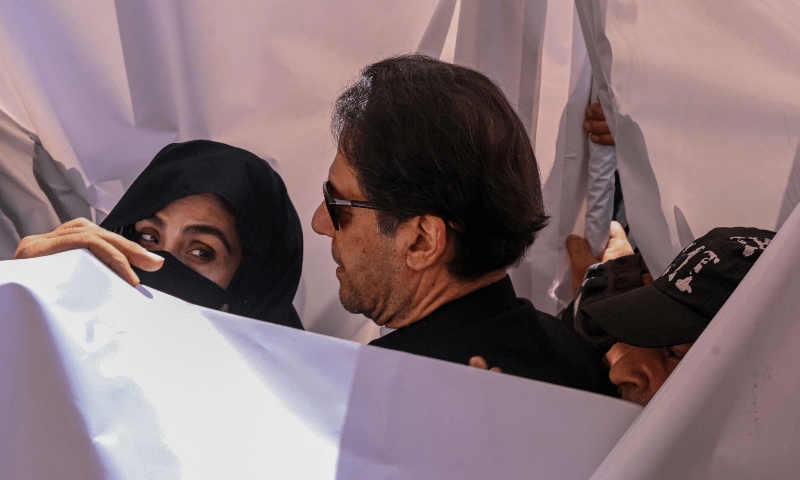
ISLAMABAD: Imran Khan, the imprisoned founder of Pakistan Tehreek-e-Insaf and the country’s former prime minister, and his wife, Bushra Bibi, filed separate appeals on Monday in the Islamabad High Court challenging their convictions in a high-profile corruption case involving state gifts, known as Toshakhana 2.
The appeals seek to overturn a Dec. 20 ruling by a special court that sentenced the couple to 17 years in prison each for acquiring an expensive Bulgari jewelry set at a steeply discounted price. The set, a gift from Saudi Arabia’s crown prince during Khan’s official visit in May 2021, was valued at over Rs71 million, according to records from the Federal Investigation Agency. Prosecutors said the couple retained it after paying only Rs2.9 million.
The case is the latest in a cascade of legal battles that have kept Khan behind bars since August 2023 and sidelined him from Pakistan’s turbulent political scene. His supporters have long described the prosecutions as a vendetta orchestrated by his rivals, including the military establishment and the current government, to bar him from returning to power. Khan, who was ousted in a no-confidence vote in 2022, denies all charges and insists they are fabricated to disqualify him from politics.
In their petitions, assigned diary numbers 24560 for Khan and 24561 for Bibi, the couple argued that the trial was marred by procedural flaws and political bias. “The overarching objective of the present prosecution appears to be the continued incarceration of the appellant, thereby preventing his participation in national politics and curtailing his political role and influence,” the appeals stated.
They contended that the investigation, initially handled by the National Accountability Bureau before being transferred to the Federal Investigation Agency, was rushed and incomplete. The agency submitted a challan, or charge sheet, within two days of starting the probe, leaving little time for a thorough inquiry. “Instead, both the investigating agency and the Trial Court proceeded in a cursory manner,” the appeals said. “This is evident from the absence of any FIR on the record.”
The couple also claimed the conviction amounted to double jeopardy, as it was the fourth prosecution stemming from Toshakhana-related matters, involving overlapping allegations about state gifts. Prosecutors had bifurcated what should have been a single trial into multiple proceedings, the appeals argued, “with the ulterior motive of ensuring the continued incarceration of the present appellant.” They noted that while Toshakhana 1 and 2 involved different gifts, the National Accountability Bureau had selectively pursued some while deferring others, a tactic they called impermissible under the law.
At the heart of the defence is the assertion that the couple adhered to the 2018 Toshakhana policy, which requires gifts to be reported and deposited in the state repository. The policy allows recipients to keep items valued above Rs30,000 by paying 50 percent of the excess value. “The gifts were deposited and fees to retain the gifts were paid,” the appeals said, adding that the policy contains no criminal provisions for breach of trust or misconduct, rendering the charges unlawful. “The learned trial judge misread and misapplied the relevant Toshakhana Policy/Rules governing retention of gifts.”
The prosecution had argued that the jewelry — including a necklace, bracelet, ring and earrings — was undervalued through undue influence. A private appraiser, Sohaib Abbasi, assessed it at Rs5.9 million, far below the Foreign Ministry’s estimate. Abbasi was later made an approver, or state witness, in the case, a move the appeals described as unlawful. They also faulted the trial court for relying on his testimony as the basis for conviction.
Under the Dec. 20 verdict by Special Judge Central Shahrukh Arjumand, delivered after some 80 hearings at Adiala jail, Khan and Bibi were sentenced to 10 years each under Sections 34 and 409 of the Pakistan Penal Code, for common intention and criminal breach of trust by a public servant, plus seven years each under Section 5 of the Prevention of Corruption Act of 1947. They were fined Rs16.4 million in total.
The appeals challenged the application of these laws, arguing that criminal breach of trust requires proof of entrustment, dishonest misappropriation and, in the case of Section 409, status as a public servant — elements they said were absent. “There was no dishonest misappropriation or conversion, as the gifts were duly retained strictly in accordance with the Toshakhana Policy and Rules after payment of the requisite assessed amount,” the documents stated.
They added that Khan did not qualify as a public servant under Section 21 of the penal code, criticising the trial court’s reliance on outdated precedents from 1957 and 1961 as “flawed, incorrect, and legally unsustainable.” Bibi’s appeal emphasised her status as “a housewife who has never held, occupied, or performed the functions of any public office,” rendering the court’s jurisdiction over her invalid and the ruling “coram non judice, without lawful authority, and liable to be set aside in its entirety.” The prosecution failed to prove guilt beyond a reasonable doubt, the appeals concluded, urging the high court to set aside the judgment and acquit the couple.
The Toshakhana 2 case began in July 2024, when the National Accountability Bureau arrested Khan and Bibi at Adiala jail. After 37 days in custody, the bureau filed a reference in an accountability court. Following a Supreme Court ruling on bureau amendments, the matter shifted to the Federal Investigation Agency’s anti-corruption court on Sept. 9, 2024. The trial started a week later, with charges framed on Dec. 12.
Prosecutors, led by Zulfiqar Abbas Naqvi and including Barristers Umair Majeed Malik, Bilal Butt and Shahvez Gilani, presented 24 witnesses, cross-examining 20 key ones, among them retired Brig. Muhammad Ahmad, the former military secretary; Abbasi; and Inamullah, Khan’s former principal secretary. The defence team included Arshad Tabrez, Qausain Faisal Mufti and Barrister Salman Safdar.
Bibi was granted bail by the high court on Oct. 23, 2024, and released the next day; Khan received bail on Nov. 20. But both remain imprisoned due to other convictions. Khan is serving a 14-year term in a separate £190 million corruption case involving land deals, and faces trials under the Anti-Terrorism Act linked to protests on May 9, 2023. Bibi is serving a seven-year sentence in the same land case. Dozens of cases have been filed against Khan since his removal from office, encompassing corruption, terrorism and state secrets violations — all denied by him and his party.
Copyright © 2021 Independent Pakistan | All rights reserved