By Staff Reporter
ISLAMABAD: The chief minister of Khyber Pakhtunkhwa province lodged a formal protest on Monday against what he described as hostile treatment during a recent visit to Punjab province, accusing officials there of intimidation, protocol violations and a coordinated smear campaign that he said threatened the fragile bonds of the country’s federation.
In a sharply worded letter to Punjab’s chief minister, Maryam Nawaz, Sohail Afridi, the chief minister of Khyber Pakhtunkhwa and a senior leader of the opposition Pakistan Tehreek-e-Insaf party, detailed a litany of grievances from his three-day stay in Lahore, the Punjab capital. He portrayed the episode as a deliberate effort to humiliate him and undermine interprovincial harmony at a time of national instability.
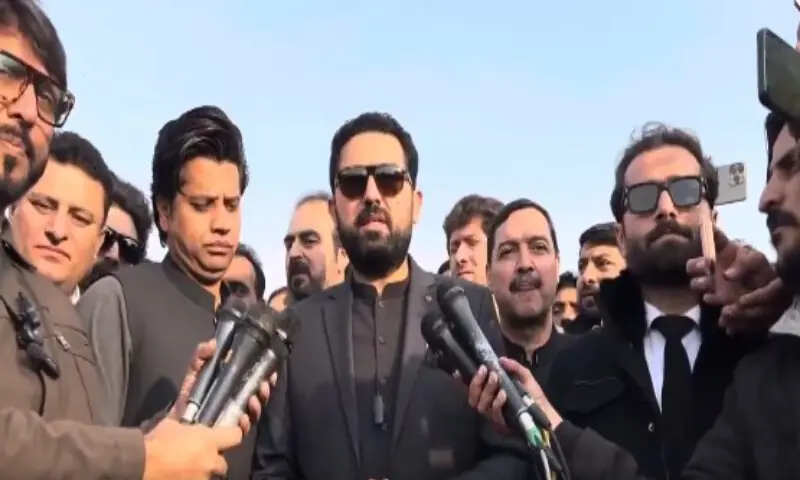
“I write to you with deep concern and strong exception to the manner in which my recent visit to the province of Punjab was handled, and the events that deliberately unfolded during and after the visit,” Afridi wrote in the two-page letter, which was posted on the social media platform X by his provincial government. The visit, which began on Friday, was intended to kick off a street protest campaign by the PTI. But it quickly devolved into confrontations, including scuffles between members of Afridi’s delegation and security personnel at the Punjab Assembly. Both sides traded blame for the clashes.
Afridi, who represents more than 40 million people in his northwestern province, said he had traveled in his official capacity but was met with “discourtesy, unnecessary hostility, and protocol deviations that cannot be justified under any accepted standard of inter-provincial engagement.” He singled out what he called an “extraordinary and excessive security posture,” including mass detentions and heavy police presence, which he viewed as “a message of intimidation rather than cooperation.” “Such measures were neither proportionate nor warranted and conveyed an intent that went well beyond legitimate security considerations,” he wrote.
Public spaces bore the brunt of these actions, Afridi said. Food streets and markets were sealed off, plunging areas into blackouts and disrupting ordinary citizens. Even motorway rest areas were closed, denying what he described as constitutionally guaranteed free access. In one striking incident, when Afridi’s group arrived at Lahore’s bustling Food Street for dinner, restaurants were abruptly shuttered, lights extinguished and the public cleared out. The tensions extended beyond the physical realm. Afridi accused Punjab authorities of orchestrating a “coordinated and malicious social media campaign” that trailed his visit, injecting “serious insinuations — specifically linking with narcotics” into public discussion.
These claims, he said, were boosted by accounts “widely perceived to be aligned with, or operating under the umbrella of, the Government of Punjab.” “Let me state this clearly: the use of state-linked digital platforms to circulate or amplify defamatory insinuations against a sitting Chief Minister of another province is unacceptable, irresponsible, and institutionally indefensible,” Afridi wrote. “Allegations of such gravity cannot be floated through innuendo or suggestion; they require evidence, jurisdiction, and lawful process. Anything short of that constitutes character assassination.”
Taken as a whole, he argued, the “protocol degradation, excessive policing optics, and synchronised digital vilification” formed a pattern “too consistent to be dismissed as coincidental,” suggesting “planning and intent, aimed at humiliation rather than engagement.” Such behavior, he warned, “undermines federal harmony, erodes public trust in provincial institutions, and sets a dangerous precedent where constitutional officeholders are targeted through insinuation rather than addressed through formal channels.”
He called the conduct “beneath the status of a provincial government” and damaging to “the collective credibility of federating units.” Closing the letter, Afridi registered his “strong protest and rejection of the treatment meted out to me and of the defamatory narratives propagated during this episode.” He urged Nawaz to prevent recurrences and enforce accountability.
The Punjab government did not immediately respond to requests for comment.
Separately, during a cabinet meeting in Khyber Pakhtunkhwa on Monday, Mr. Afridi escalated his criticism, labeling the Punjab authorities’ actions “undemocratic, reprehensible, and contrary to national unity.” “The way me and my cabinet members were treated, the whole world witnessed it,” he said. “When the country is going through political and economic instability, such an attitude — at a time when we need national unity — will only fan flames of hatred.”
He recounted “violence perpetrated against cabinet members by the Punjab government,” along with blocked roads, forced market closures and sealed motorway stops. He expressed particular regret over lights being turned off during a visit to Mazar-e-Iqbal, the tomb of Pakistan’s national poet. “This shows their mean mentality, which cannot be approved in a civilised society.” Afridi said the Punjab government was “fanning hatred between the two provinces.”
He described the approach as reflecting “moral and intellectual depravity” and warned that it was “sowing hatred and division,” especially amid the country’s broader challenges. “We condemn the attitude in the strongest of words,” he added, emphasizing that hateful postures were “detrimental to the country.”
Copyright © 2021 Independent Pakistan | All rights reserved