By Staff Reporter
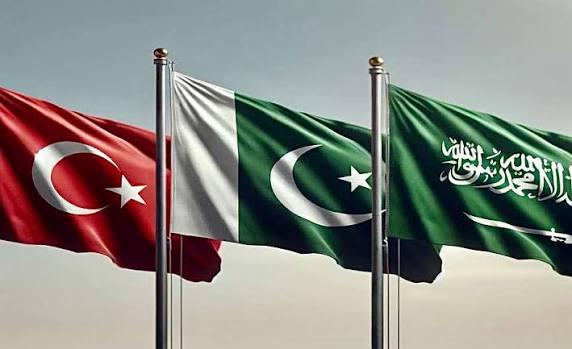
ISLAMABAD: Turkey is nearing an agreement to join a mutual defence pact forged between Pakistan and Saudi Arabia, a development that could coalesce a potent new security bloc in the Muslim world and alter the geopolitical landscape from the Middle East to South Asia, Bloomberg reported on Friday.
The discussions, which are at an advanced stage and expected to yield a deal, would see Turkey sign on to the Strategic Mutual Defense Agreement that commits its members to treat an attack on one as an assault on all. Bloomberg, citing unnamed sources familiar with the matter, reported that the move shows Turkey’s growing disillusionment with the United States, long its primary security guarantor through NATO, and highlights converging interests with Pakistan and Saudi Arabia in regions spanning South Asia, the Middle East and Africa.
For Ankara, the pact offers a chance to bolster its influence amid tensions with Washington over issues like arms sales and regional conflicts. Turkey and Pakistan have nurtured deep military ties for decades, collaborating on projects that include Ankara’s delivery of corvette warships to the Pakistani Navy and upgrades to scores of Pakistan’s F-16 fighter jets. The two countries, along with Saudi Arabia, already exchange drone technology, and Turkey is pushing to draw both into its Kaan program, an effort to develop a fifth-generation fighter jet.
The SMDA itself was sealed on Sept. 17, 2025, when Pakistan’s prime minister, Shehbaz Sharif, traveled to Riyadh for a meeting with Crown Prince Mohammed bin Salman. The signing formalised a longstanding security partnership between the two nations, rooted in shared religious bonds and strategic imperatives. Just weeks later, on Oct. 3, 2025, Pakistan’s deputy prime minister and foreign minister, Ishaq Dar, signaled the pact’s expansive potential during a session of the National Assembly. “Our defence pact with Saudi Arabia is significant,” he said. “More countries now want to sign a similar agreement with us.”
Dar added that various Arab and Islamic states had signaled eagerness for parallel pacts with Pakistan. He projected the framework swelling into a larger entity, comparable to the North Atlantic Treaty Organization or an “Eastern NATO.”
The timing of these expansion talks follows a turbulent year for Pakistan, marked by a swift military triumph over India in a short-lived war that heightened regional anxieties. The conflict ignited in May 2025 after India fired what Pakistan called unprovoked and illegal missile strikes across the border. In the ensuing clashes, Pakistani forces shot down several Indian aircraft, including three advanced Rafale jets, and destroyed dozens of drones. The standoff between the nuclear-armed neighbors concluded on May 10, 2025, with a US-brokered ceasefire, averting a wider catastrophe but leaving lingering distrust.
Pakistan also contended with border violence from Afghanistan in October 2025, when Afghan Taliban forces and allied militants launched attacks on Pakistani outposts. The fighting claimed the lives of more than 200 Taliban and militant combatants, while 23 Pakistani soldiers died in the line of duty. Pakistan retaliated with targeted airstrikes deep into Afghan territory, hitting terrorist strongholds in Kandahar Province and even Kabul.
For Turkey, entering the SMDA would represent a bold shift, amplifying its role as a bridge between Europe and the Islamic world while diversifying away from Western dependencies. President Recep Tayyip Erdogan’s government has increasingly pursued independent foreign policies, including closer economic and military links with Gulf states and Asian powers.
Bloomberg’s report suggested that Turkey’s accession could “shift the balance of power in the Middle East and beyond,” creating a counterweight to existing alliances. Sourcestold Bloomberg that a formal announcement might come soon, though officials in Ankara, Islamabad and Riyadh have remained silent on the matter.
As the pact evolves, it could facilitate joint military drills, shared intelligence and collaborative arms development, strengthening the trio’s ability to address common threats like terrorism and instability. Yet it also risks exacerbating divisions in a region already fractured by proxy wars and great-power rivalries, Bloomberg reported.
Copyright © 2021 Independent Pakistan | All rights reserved