By Staff Reporter
ISLAMABAD: Pakistan’s four provinces have reached an agreement to help finance the federal government’s oil subsidies for consumers, easing pressure on the national budget at a time of acute fuel-supply strains from the Middle East conflict, officials said.
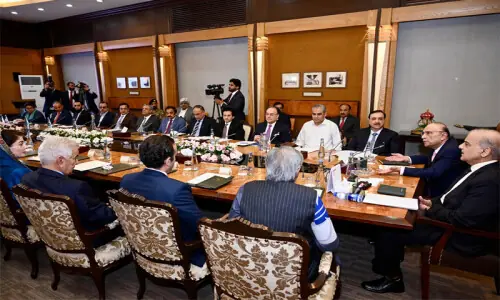
The decision came at a meeting chaired on Monday by President Asif Ali Zardari and attended by Prime Minister Shehbaz Sharif, Deputy Prime Minister and Senator Muhammad Ishaq Dar, Pakistan Peoples Party Chairman Bilawal Bhutto-Zardari, federal ministers and the chief ministers of Punjab, Sindh, Khyber Pakhtunkhwa and Balochistan. Plans for proposed smart lockdowns were set aside for further discussion, Dawn newspaper reported.
“The issue of proposed smart lockdowns was shelved, while provinces have agreed to share the burden of the oil subsidy being given to the people according to their share in the National Finance Commission Award,” the participant said. The lockdowns question “would continue to be considered in the days to come.”
The accord marks a shift. Only days earlier, the provinces had told the Ministry of Finance they could not contribute roughly Rs200 billion sought to shield households from higher petroleum prices. Punjab and Sindh — the country’s two largest provinces by population and economic output — had been expected to shoulder more than 102 billion rupees and about 60 billion rupees, respectively. Instead, both had urged that global prices simply be passed through to the domestic market to encourage conservation.
Pakistan is confronting one of the sharpest fuel crises among major emerging economies. The disruption stems from the ongoing US-Israel war on Iran and Tehran’s subsequent strikes on oil-producing Gulf states, which have tightened global supplies and lifted costs.
A Presidency press release issued after the meeting said Zardari had directed officials to take “all possible measures” to ease the burden of rising energy costs on ordinary citizens, especially for essential goods and services. The gathering was briefed on steps already under way by the four provincial governments, as well as the administrations of Gilgit-Baltistan and Azad Jammu and Kashmir, to contain price pressures, maintain supplies of staples and coordinate a national response.
Participants also reviewed the wider regional picture and its potential spillover into Pakistan’s security environment, economic outlook and food security. They were assured that, despite the global strains, timely decisions had prevented any disruption to fuel supply. Current stocks are adequate, officials said, and arrangements for future requirements are in place.
Prime Minister Sharif has repeatedly rejected proposals to increase oil prices, according to the briefing. Savings from austerity measures — including deep cuts to the development budget and the immediate grounding of 60 percent of official vehicles — are being redirected toward public relief. Zardari told the meeting that economically vulnerable Pakistanis would not be left to face the crisis alone. He called for tighter coordination between economic policy, energy planning, food-security efforts and security preparedness.
The president also stressed the importance of public-awareness campaigns to curb fuel consumption, promote greater use of public transport and encourage shared mobility as part of a broader demand-management strategy.
In a separate earlier meeting, Sharif reiterated that the government was working to protect poor and middle-income households and would not abandon them. He noted that austerity had begun with the federal government itself, citing the same spending cuts and vehicle grounding. Timely action had already averted supply disruptions, he said.
Officials provided a detailed update on fuel-conservation measures, future planning and current stock levels. Coordination is underway with provinces to speed up ownership registration of motorcycles and rickshaws, a step intended to deliver quicker relief to lower-income users. An Intelligence Bureau audit on the implementation of the prime minister’s fuel-saving and austerity campaign was presented, and participants were told that strict enforcement of the simplicity drive would continue.
Sufficient fuel stocks exist to meet national needs, with forward arrangements secured. A higher levy has been placed on high-octane fuel used in luxury vehicles, while jet-fuel prices were left unchanged. Adequate supplies of medicines are also on hand, officials said, and proposals for future action were discussed.
Copyright © 2021 Independent Pakistan | All rights reserved