By Staff Reporter
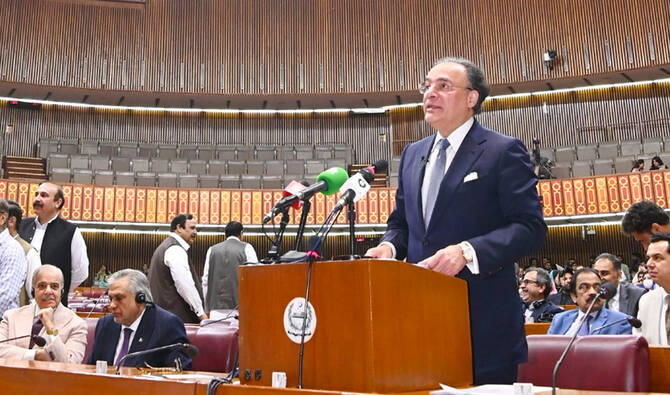
ISLAMABAD: Finance minister Muhammad Aurangzeb presented a Rs18.77 trillion federal budget on Friday that raises defence spending by almost a fifth, set an ambitious revenue target and offers modest tax relief to the salaried middle class — all while leaving the country’s deeper structural failings largely untouched.
The budget, which carries a total outlay marginally up from Rs17.6tn in the previous fiscal year, is the third presented by the government of Prime Minister Shehbaz Sharif and arrives at a moment when Pakistan’s economy has emerged from the edge of default but has yet to find its footing as a growth story. The session in the National Assembly began two hours late amid noisy opposition protests, with members of Imran Khan’s Pakistan Tehreek-e-Insaf bringing placards to the chamber floor, and a brief scuffle breaking out between treasury and opposition benches.
The document reflects the iron constraints of a country still under a $7bn International Monetary Fund programme. Of the Rs18.77tn total outlay, Rs8.05tn — nearly 43 percent — has been set aside for debt servicing alone, crowding out virtually everything else. The government has agreed with the IMF to maintain a primary surplus of 2 percent of gross domestic product, a commitment that, by definition, leaves no room for net new spending before interest payments are counted.
Aurangzeb set a target of 4 percent GDP growth for the fiscal year beginning in July, up from an estimated 3.7 percent in the outgoing year, alongside an inflation forecast of 8.2 percent. The overall fiscal deficit is projected at 3.6 percent of GDP, with much of the consolidation work assigned to a projected provincial surplus of Rs1.79tn, which reduces the headline federal deficit of Rs7.02tn to a combined figure of Rs5.23tn.
Defence and the diplomatic dividend
The most politically charged number in the budget was the defence allocation of Rs3tn, equivalent to 2.1 per cent of GDP and up from Rs2.56tn in the year just ending. Aurangzeb told a raucous session of the National Assembly that the South Asian nation had “completely and correctly passed” a series of tests over the past year, including global trade turmoil, devastating floods and a brief but intense military confrontation with India.
“Today, the world praises Pakistan’s defence capabilities,” he said. “This is the reason that many countries are in contact with Pakistan to include the fighter jets protecting our skies in their fleet.” He described the defence sector as “a source of foreign exchange earnings”, and credited a defence pact signed with Saudi Arabia last year as having “reshaped our strategic partnerships not just in the region but in the world.”
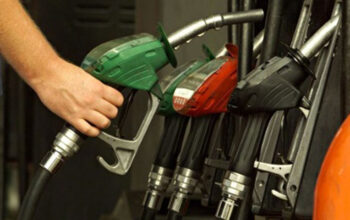
Aurangzeb also presented the budget against an unusually expansive geopolitical backdrop, framing Pakistan’s economic stabilisation as inseparable from its elevated diplomatic standing. He pointed to Pakistan’s role in brokering a ceasefire between the United States and Iran amid what he described as a dangerous regional escalation. The conflict, however, has also complicated the economic picture. The US-Israeli war on Iran has driven international oil prices sharply higher, forcing the government to absorb losses through subsidies rather than pass the full cost on to consumers. Aurangzeb said the government had provided petroleum relief worth Rs128bn to shield households from the full impact of higher global prices, and acknowledged that inflation — expected to average around 7 percent in the outgoing year — could moderate further if and when the war clouds clear.
Revenue arithmetic
The Federal Board of Revenue has been handed a tax collection target of Rs15.26tn for FY2026-27, a rise of roughly 8 percent from Rs14.13tn in the current year — even though the FBR fell short of this year’s target. Total revenues, including non-tax receipts such as the petroleum levy and State Bank profits, are projected at Rs20.60tn.
Aurangzeb sought to demonstrate progress. FBR collections, he noted, had risen from Rs7.2tn to an expected Rs13tn over three years, while the tax-to-GDP ratio had climbed from 8.5 percent to 10.3 percent. Foreign exchange reserves had recovered from below $4bn three years ago to $17bn, sufficient for roughly three months of import cover. Remittances, he said, had reached $38bn in the first eleven months of the fiscal year and were expected to exceed $41bn by year-end, which would be a record.
Yet economists pointed to a fundamental asymmetry at the heart of the numbers. The government expects to generate an additional Rs1.5tn in tax revenue with limited scope for new tax measures, relying instead on enhanced enforcement, digital invoicing and tighter monitoring of retail and wholesale sectors. The FBR has consistently failed to bring agriculture, real estate and the retail trade meaningfully into the tax net — sectors protected by political economy considerations rather than legal exemption. “Without taxing agriculture, real estate and retail, the fiscal deficit may narrow,” noted one economist, “but the trust deficit between citizens and the state will widen.”
Provinces are to contribute Rs8,848bn to federal revenue arrangements, and a new fiscal co-operation mechanism — framed by Aurangzeb under the rubric of “federal cooperativism” — will see a portion of provincial receipts directed towards national strategic demands under Article 164 of the Constitution, without, the minister insisted, altering the allocation formula under the Seventh National Finance Commission award. The mechanism is to run for FY2026-27 and be renewed with provincial consultation for the two subsequent years.
Salaried relief, structural silence
The headline relief package for salaried workers involves reductions across four income tax slabs. The rate for those earning Rs2.2m to Rs3.2m annually falls from 23 percent to 20 percent; from 30 to 25 percent for the Rs3.2m to Rs4.1m band; from 35 to 29 percent for those earning Rs4.1m to Rs5.6m; and from 35 to 32 percent for the Rs5.6m to Rs7m bracket. A surcharge on the salaried class has been abolished entirely, and the super tax on corporate income between Rs150m and Rs500m has been removed, with the rate above Rs500m trimmed from 10 to 8 percent.
Government employees will receive a 7 percent salary increase, pensioners a 7 percent uplift, and the minimum wage is to rise by 10 percent. The allocation for the Benazir Income Support Programme — the flagship cash transfer scheme — has been raised by 17 percent to Rs838bn.
Taxes on contraceptives and sanitary pads have been abolished, and an income tax exemption for the IT sector extended to June 2029, alongside a reduction in the withholding tax on export proceeds from 2 percent to 1.25 per cent. Property transaction taxes for filers have been cut significantly — from 5.5 to 2.75 percent on sales — in an effort to revive the moribund construction sector.
The Federal Public Sector Development Programme (PSDP) has been set at Rs1tn, rising to Rs1.45tn when state-owned enterprise investment and public-private partnership funds are included. Combined with provincial development budgets of Rs2.22tn, total national development spending reaches Rs3.67tn.
Business community’s tempered verdict
The reaction from Pakistan’s industry was measured. Zubair Motiwala, chairman of the Businessmen Group at the Karachi Chamber of Commerce and Industry, described the budget as “neither good nor bad” — a document that “neither hurts nor heals.” He welcomed the super tax reductions but expressed frustration that the government had converted the Final Tax Regime for exporters into a minimum tax rather than restoring the clean, fixed-rate regime the business community had sought. “This defeats the very objective. Exporters do not want additional complications and frequent dealings with tax authorities,” he said.
Motiwala also lamented the budget’s silence on electricity and gas tariffs, which he described as the most pressing concern facing industry. Factories across Pakistan are operating below capacity, he argued, and without competitive energy costs, no revenue target nor tax reform will generate the export-led growth the country requires. “Pakistan needs dollars and dollars can only come through exports,” he said.
On the capital markets, the budget was greeted with more enthusiasm than on the factory floor. The KSE-100 index closed nearly 2,700 points higher on the day, with investors encouraged by the combination of IMF compliance and the selective relief measures. Aurangzeb noted that 11 initial public offerings had been launched in the current fiscal year — the highest in two decades — and that 173,000 new investors had joined the Pakistan Stock Exchange over the past year.
The coalition subplot
The political circumstances surrounding the budget’s presentation were almost as closely watched as its contents. The Pakistan Peoples’ Party, the main coalition ally of the ruling Pakistan Muslim League-Nawaz and the governing party of Sindh province, had spent the days before the session signalling discontent. Reports emerged on the morning of the session that PPP chairman Bilawal Bhutto Zardari would not attend. A post on the party’s official social media account appeared to confirm partial participation before being deleted. Eventually, following a last-minute meeting between Bilawal and senior federal ministers Ishaq Dar and Azam Nazeer Tarar at the parliament building, the PPP leader did take his seat.
His party’s MPs, however, did not sit quietly. PPP members including Shazia Marri staged a protest on the floor of the house before the minister rose to speak, holding placards demanding Sindh’s water rights be restored and raising the slogan “give us water to drink and live.” The PPP has for some months been pressing the federal government over what it describes as an unjust reduction in Sindh’s share of Indus waters under the Inter-Provincial Water Apportionment Accord, a grievance that has acquired growing electoral salience.
The bigger picture
Economists were broadly sceptical that the budget represented a decisive break from the stabilisation phase. The framework — IMF-mandated primary surplus, high debt servicing, constrained development expenditure — leaves growth dependent on factors largely outside the government’s control: oil prices, remittance flows, regional stability and private-sector confidence. The administration has made genuine progress on several fronts: the privatisation of Pakistan International Airlines in a live-televised auction in December 2025, raising Rs185bn; the issuance of Pakistan’s first Eurobond since 2022 and its debut Panda Bond in Chinese capital markets; and a substantial reduction in the cost of domestic debt through early repayment and refinancing. The policy rate, Aurangzeb noted, has fallen from 22 to 11.5 percent.
Yet the architecture of the economy remains largely unchanged. Agriculture, with its powerful vested interests, continues to contribute a fraction of what its size warrants to the tax base. The energy sector’s circular debt problem has been stabilised — the minister claimed net-zero accumulation this year — but not resolved. The IMF programme, by design, prioritises external balance over growth. “The government’s hands are tied,” said one analyst. “Under an IMF programme, growth-oriented policy is simply not possible.”
Aurangzeb, for his part, was careful to frame the budget not as a destination but as passage. “Achieving stability,” he told the assembly, “is just the start of the journey.”
Copyright © 2021 Independent Pakistan | All rights reserved