By Staff Reporter
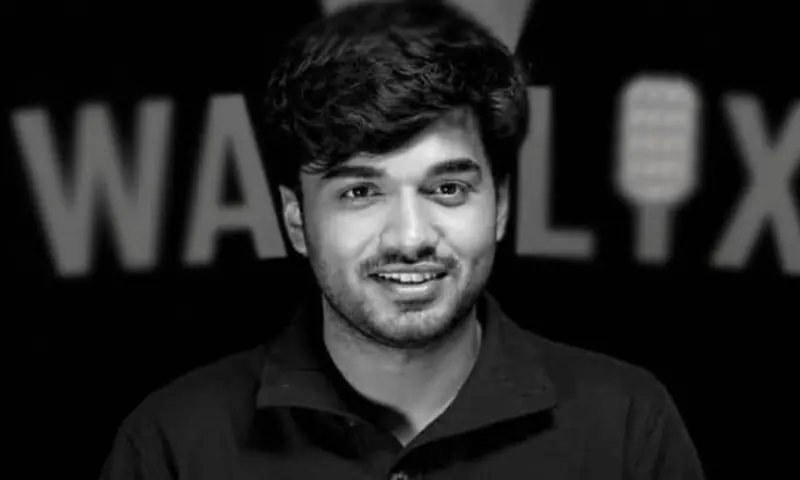
KARACHI: At 9am on Friday, workers will open the grave of Mir Raza Ali, a 25-year-old business graduate whose death has split Karachi’s police force against itself.
A judicial magistrate ruled on Thursday that Ali’s body must be exhumed for a second post-mortem, granting an application from his father that had been building for days — ever since the city’s own police surgeon went on television and said the official autopsy did not add up.
It is an unusual position for a police department to find itself in: publicly investigating a death as a probable suicide while its chief medical officer questions, on air, whether the physical evidence supports that conclusion at all.
Ali, who ran the Karachi eatery Wafflix and graduated from the Institute of Business Administration, disappeared on the night of 28 July. He had left his family’s home in PECHS, telling them he would be back in ten minutes. He did not return. His body was found the next day in bushes near Shahi Qila Ground, in Gulistan-i-Jauhar, with a gunshot wound to the chest.
What happened in between has become the subject of two entirely separate investigations — one carried out by police, the other by a father who does not believe a word of their findings.
A theory built on debt
Police built their case quickly. Ali, they said, had been under financial strain in his final days, borrowing from friends and, according to phone records later obtained by investigators, asking one for a loan of Rs30 million on the night he vanished. Records suggested he owed money elsewhere too. He had taken a taxi, booked through an app, which dropped him a short walk from where his body would be found the next morning. A security guard’s weapon, investigators believe, had gone missing around the same time.
To Mir Hussain, Ali’s father, none of it holds together — and he has said so, repeatedly and pointedly, outside the City Courts.
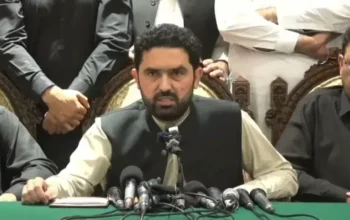
“If my son was in debt, then the whole country is in debt,” he told reporters on Thursday, dismissing the financial motive as thin. He has maintained from the outset that his son was murdered, not that he took his own life, and has alleged that Ali was shot from behind and that his face, body and fingerprints bore signs of burning. On Thursday he added a further grievance: that police still had not taken the family’s formal statement, and that the doctor who carried out the original post-mortem had been kept away from proceedings. “We are already suffering,” he said. “We only want justice.”
When the police surgeon disagreed with the police
Hussain’s case might have remained a grieving father’s word against a formal medical finding, had Dr Summaiya Syed not intervened.
Speaking to a private news channel earlier this week, Karachi’s police surgeon said the post-mortem report did not sit comfortably alongside the photographs taken of Ali’s body. The entry wound, the bullet’s path and the exit wound, she said, did not correspond with each other in the way the report described. She noted, too, that entry wounds are ordinarily smaller than exit wounds in gunshot cases — not larger, as investigators’ own sources have since indicated was found here. And in a case being treated as a possible suicide, she pointed out, nobody had tested Ali’s hands for gunshot residue.
Dr Syed was careful to qualify her comments — she had not examined the body herself, she said, only the paperwork and photographs, and she accepted it is scientifically possible for a bullet to enter from behind and exit through the front. But the qualification did little to soften the impact. Police issued a statement shortly afterwards warning that such remarks risked damaging the investigation, while conceding that exhumation remained possible if a medical board recommended it and the court agreed.
By Thursday, both conditions had been met.
What Friday will decide
In court, the arguments were procedural rather than dramatic. Jibran Nasir, representing Ali’s father, told the magistrate that the original report was built on gaps: no X-ray had been taken, no definitive cause of death established, and — in his telling — the conclusions reached rested more on assumption than evidence. Police, he argued, had no standing to object to the exhumation, since the procedure would in any case be carried out by the police surgeon’s own office.
The prosecutor did not resist. “This is a matter involving a human life,” he told the court — though the magistrate still queried whether an order could be issued without formally notifying the investigating officer first. Nasir pushed back, warning that further notice would only mean further delay. The magistrate reserved judgment, then returned later the same day to grant the exhumation.
Dr Syed has since confirmed that a full medico-legal board — the panel of forensic experts and pathologists the family had asked for — has been assembled. Ali’s grave will be opened at 9am on Friday. Samples will be taken, she said, and the body reburied immediately afterwards. Police have been told to seal the site during the process.
Behind the legal manoeuvring, a wider inquiry continues. Karachi’s Additional Inspector General of Police, Azad Khan, has assembled a three-officer special investigation team — led by SSP Samiullah Soomro, with SSP Zubair Nazir Sheikh and SP Muhammad Usman Saduzai — tasked with reporting progress daily. Fifteen witnesses have given statements so far, including the taxi driver who dropped Ali near the scene and the person who first posted about the discovery of his body online.
Sindh’s Inspector General of Police, Javed Alam Odho, struck a confident note on Thursday, saying investigators had made real headway and would soon brief the public in full. “We have traced the Mir Raza case and worked very hard on it,” he said.
Copyright © 2021 Independent Pakistan | All rights reserved