By Staff Reporter
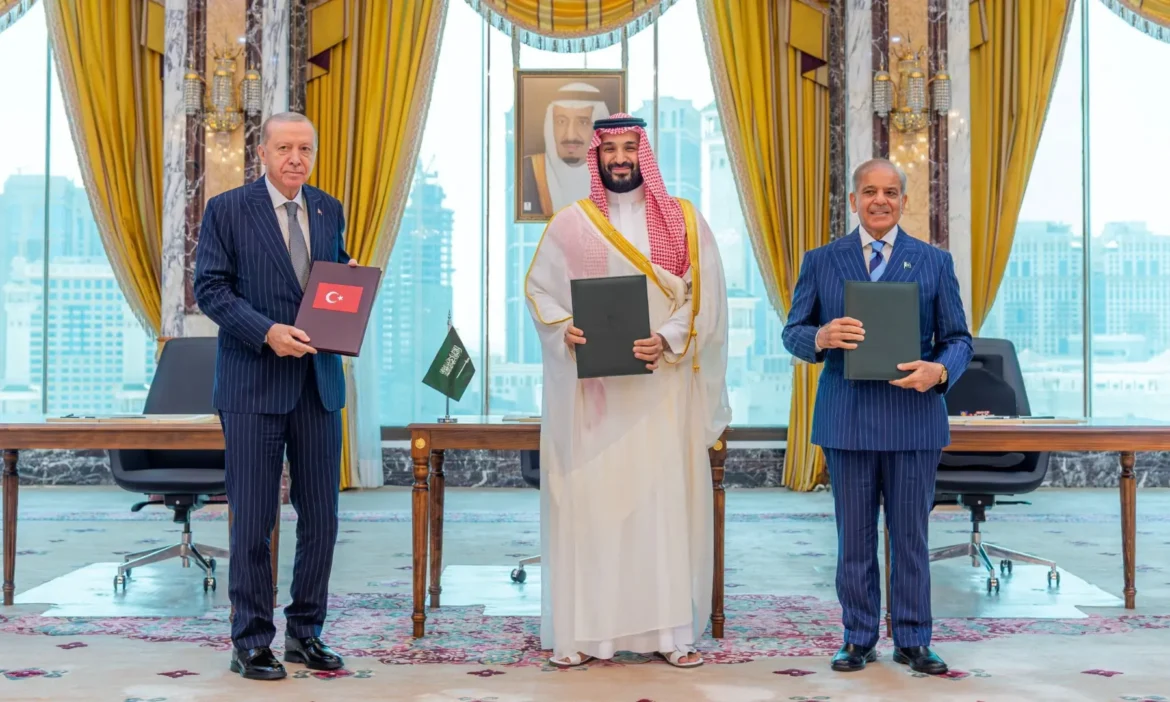
ISLAMABAD: Saudi Arabia, Pakistan and Turkey signed a landmark joint defence agreement in Mecca on Friday, binding together three of the Muslim world’s most powerful states as they seek to shore up their defences against a regional conflict that has sent missiles raining down on Gulf oil producers.
The pact was sealed at a summit in the holy city attended by Saudi Crown Prince Mohammed bin Salman, Turkish president Recep Tayyip Erdogan and Pakistani prime minister Shehbaz Sharif, and comes after months of upheaval triggered by the US and Israel’s attack on Iran on 28 February.
Since that assault, Iran and its regional allies have struck Saudi Arabia and other Gulf states with missile fire and blockaded their energy exports, disrupting shipping through the Strait of Hormuz — a waterway that once carried roughly a fifth of the world’s oil supplies — and unsettling markets across the region.
Under the so-called Mecca Joint Defence Agreement, the three signatories have committed to treating any armed attack on one of them as an attack on all. A joint statement said the pact was designed to strengthen collective deterrence against aggression and to promote “peace, security and stability in the region and beyond,” though it stopped short of detailing the specific military or financial obligations each country has taken on.
A Turkish official, speaking to reporters after the signing, described the agreement as “purely defensive in nature,” insisting it pledged mutual support only in matters of defence. The official added that the pact was not aimed at any particular country, remained open to other states in the region, and would not override any existing bilateral or multilateral arrangements the three nations already hold.
Symbolism of the summit
Analysts said the timing and location of the agreement carried considerable weight. Abdulaziz Sager, chairman of the Gulf Research Center, a Saudi-based think tank, said the gathering reflected a broader shift in how Muslim-majority powers are approaching regional security.
“The political symbolism of the summit is significant,” Sager said. “Three of the Muslim world’s most influential states are convening at a moment of heightened uncertainty, demonstrating a growing willingness among regional and middle powers to coordinate more closely on security matters.”
He suggested that, if properly developed, the arrangement could reshape the regional balance of power. “If institutionalised and translated into concrete cooperation, the trilateral framework could strengthen the three countries’ collective diplomatic and defence weight while contributing to the emergence of a more regionally driven security architecture.”
Each of the three countries brings distinct strategic assets to the table. Turkey fields Nato’s second-largest military. Saudi Arabia is home to Islam’s two holiest sites and remains one of the world’s foremost oil exporters. Pakistan is the only nuclear-armed nation in the Muslim world.
A pilgrimage before the pact
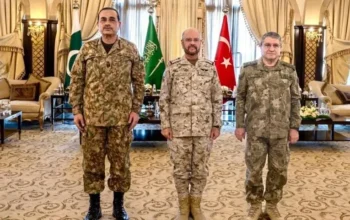
Sharif arrived in Saudi Arabia on Thursday for a three-day visit, accompanied by army chief Field Marshal Asim Munir, ahead of Erdogan’s own arrival on Friday for a shorter, one-day trip. Before the Turkish president touched down, Sharif and his delegation visited the Holy Kaaba and performed Umrah, with the prime minister also expected to visit the Prophet’s Mosque in Medina during his stay.
Erdogan landed at King Abdulaziz International Airport in Jeddah before travelling on to Mecca by road. Once there, both leaders were received separately by Crown Prince Mohammed bin Salman at Al-Safa Palace, where the Mecca Al-Mukarramah Summit for Joint Defence was held and the agreement subsequently signed.
The Pakistani delegation also included deputy prime minister and foreign minister Ishaq Dar, defence minister Khawaja Asif, information minister Attaullah Tarar and special assistant to the prime minister Tariq Fatemi. Saudi and Turkish defence and foreign ministers were also present for the signing.
Gulf states under sustained pressure
The urgency behind the pact reflects just how exposed Saudi Arabia in particular has become since the war began. The kingdom has been repeatedly targeted not only by Iran directly but by Tehran’s regional proxies, including Houthi forces in Yemen and Shia militias in Iraq. A senior Saudi official said on Thursday that the kingdom was bracing for coordinated attacks from both groups, underscoring Riyadh’s determination to widen its network of alliances.
Last month, the Houthis declared what they called a “maritime embargo” against Saudi Arabia, striking Saudi airports, oil facilities and tankers operating in the Red Sea. Riyadh responded with air strikes on Houthi positions and moved to establish a new naval coalition intended to safeguard shipping across the Red Sea and the Gulf of Aden — an initiative that has since drawn declared support from 14 countries, including Pakistan.
Pakistan, for its part, condemned the Houthi threats against Saudi Arabia and warned it reserved the right to self-defence should its own “maritime interests” come under attack.
The broader toll of the conflict has been severe. Since the war between Israel and Hamas erupted in October 2023, the Middle East has barely had a moment of calm. Israel has fought in Gaza, sent forces into southern Lebanon, seized territory inside Syria and launched two separate air campaigns against Iran. Tehran, in turn, has struck US military bases and civilian infrastructure across Saudi Arabia, Kuwait, Bahrain, Qatar, the United Arab Emirates, Oman, Jordan and Israel.
Turkey and Pakistan have so far avoided being drawn into direct attacks, but both nations remain acutely conscious of the economic and security risks posed by a conflict raging so close to their borders.
Building on existing ties
Friday’s agreement did not emerge in isolation. Pakistan and Saudi Arabia signed their own bilateral Strategic Mutual Defence Agreement in Riyadh last September, under which an attack on either country would be treated as an act of aggression against both. Turkey had reportedly been seeking to join that framework even before the current war broke out — Bloomberg reported back in January that Ankara was in discussions to become part of the pact.
That same month, Reuters cited Pakistan’s defence production minister, Raza Hayat Harraj, as saying a draft agreement had been drawn up following ten months of negotiations. Turkish foreign minister Hakan Fidan had at the time spoken of Ankara’s preference for a wider “cooperation platform” among regional states aimed at bolstering security and stability.
The military relationships underpinning the new pact run deep. Pakistan has spent decades providing training and technical assistance to Saudi forces, while Turkey and Pakistan have exchanged both warships and training aircraft. In 2023, Saudi Arabia agreed to purchase Turkish drones in a deal Ankara described as its largest defence export contract to date. Pakistan has since gone further, deploying roughly 8,000 troops alongside fighter jets, drones and an air-defence system to the kingdom, Reuters reported in May, while also opening talks with Kuwait over a separate expanded security pact tied to energy cooperation and investment.
Mansoor Ahmed of the Australian National University’s Strategic and Defence Studies Centre said Pakistan and Turkey were likely to anchor the new alliance with their defence industries, while Saudi Arabia’s role would probably centre on financing and technological investment. He added, however, that the agreement was unlikely to extend into nuclear cooperation, noting that Pakistan’s atomic arsenal remains focused squarely on deterring what Islamabad regards as the threat from India.
A fragile path toward peace
The agreement lands at a delicate moment in the wider US-Iran conflict. US president Donald Trump called off planned strikes against Iran on Sunday, saying regional states had come close to agreeing the “parameters” of a deal to end the fighting. Iran, meanwhile, said earlier in the week that it had struck an agreement with Oman over a shipping route through the Strait of Hormuz.
Pakistan has played a notable mediating role in the conflict since it began. Islamabad hosted the first round of direct talks between Washington and Tehran in April and helped broker an interim ceasefire in June, known as the Islamabad Memorandum of Understanding. That truce did not hold, with fighting resuming after the US accused Iran of attacking shipping in the Strait of Hormuz — a waterway Tehran has effectively closed to trade since the war’s outbreak in February.
A senior Pakistani official with knowledge of the discussions described the Mecca summit as carrying weight well beyond the immediate crisis. “The visit of Pakistani prime minister and Field Marshal Asim Munir is very significant, as Pakistan, Saudi Arabia and Turkey leaders will hold key talks on trilateral defence cooperation,” the official said, speaking on condition of anonymity as they were not authorised to brief the media.
Pakistan’s foreign office echoed that sentiment in a statement, describing the visit as reflecting “Pakistan’s long-standing partnership with the Kingdom of Saudi Arabia anchored in decades of mutual trust, cooperation and brotherhood,” and noting that the trip carried “significance beyond the immediate crises and short-term considerations.”
Copyright © 2021 Independent Pakistan | All rights reserved