By Staff Reporter
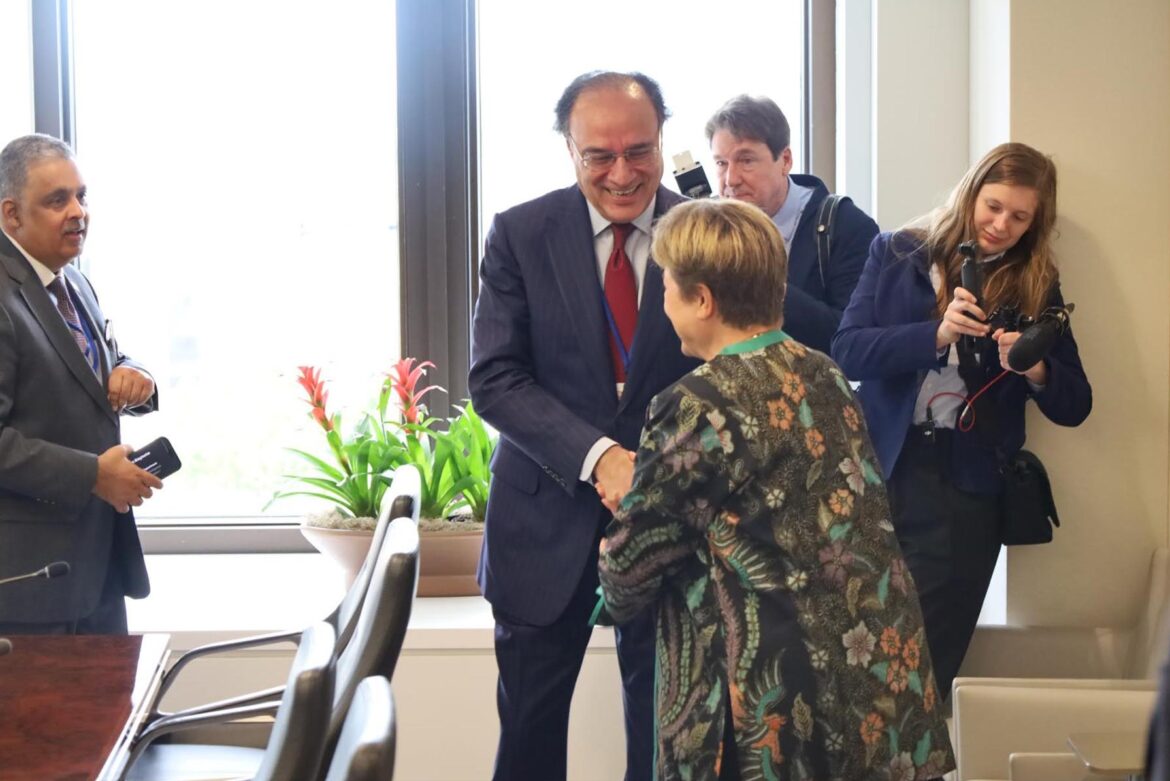
ISLAMABAD: Finance Minister Muhammad Aurangzeb met with the heads of the International Monetary Fund (IMF) and the World Bank on Monday, launching a critical series of high-level consultations in Washington aimed at bolstering the country’s fragile economic recovery.
The meetings mark the start of Aurangzeb’s packed agenda at the 2025 Spring Meetings of the IMF and World Bank Group, an annual gathering that draws finance ministers and central bank governors from 191 countries to tackle pressing global issues like sovereign debt, climate finance, and reforms to the international financial architecture.
Leading a delegation of Pakistani officials, Aurangzeb is engaging with global financial institutions, development partners, and major bilateral creditors to secure support for Pakistan’s economic stabilization and reform efforts.
His discussions with IMF Managing Director Kristalina Georgieva and World Bank President Ajay Banga centered on the nation’s recovery plan, structural reforms, and the trajectory of existing financial programs.
Dawn newspaper, quoting diplomatic sources, described the talks as “constructive,” signaling optimism about Pakistan’s ongoing negotiations with its international partners.
A key highlight of Aurangzeb’s meeting with Georgieva was its potential to sway the IMF’s review of Pakistan’s $7 billion Extended Fund Facility, a lifeline for the cash-strapped nation. Pakistan is pressing for the release of a second $1.2 billion tranche, with an IMF review mission scheduled to arrive in Islamabad on May 14.
The outcome of these discussions could prove pivotal as Pakistan grapples with persistent economic challenges, including high inflation, dwindling foreign reserves, and a heavy debt burden.
Aurangzeb’s meeting with Banga focused on development financing and Pakistan’s medium-term priorities, including fiscal consolidation and energy sector reforms. The World Bank, a longstanding partner in Pakistan’s development efforts, is seen as a key player in supporting infrastructure projects and policy reforms aimed at fostering sustainable growth.
The talks underscored Islamabad’s push to align its economic strategy with global development goals while addressing domestic fiscal pressures.
Since arriving in Washington on Sunday, Aurangzeb has already held half a dozen meetings, with a busy slate of engagements lined up over the coming days.
His itinerary includes discussions with officials from China, the United States, Saudi Arabia, the UAE, and Europe, as well as representatives from commercial banks, global credit rating agencies, and multilateral lenders like the Asian Development Bank.
Later this week, Aurangzeb will meet Chinese Finance Minister Lan Fo’an to negotiate the rescheduling of $3.4 billion in debt—a move aimed at easing Pakistan’s foreign financing crunch. China, one of Pakistan’s largest bilateral creditors, has been a critical partner through initiatives like the China-Pakistan Economic Corridor (CPEC). A successful renegotiation could provide breathing room for Pakistan’s strained balance of payments and signal Beijing’s continued support for its South Asian ally.
Aurangzeb is also slated to meet senior U.S. Treasury officials, including Robert Kaproth, Assistant Secretary for International Finance, and James C. Cruse, Acting President of the U.S. Export-Import Bank (Exim Bank).
A central topic will be the $3 billion financing gap for the Reko Diq copper and gold project, a massive mining venture in Balochistan with significant economic potential.
The Exim Bank has floated a $1 billion loan offer, but it hinges on Pakistan granting preferential creditor status—a condition Islamabad has so far resisted. The talks will test Pakistan’s ability to balance strategic interests with the need for external funding.
Beyond traditional financing, Aurangzeb is set to discuss climate finance and disaster resilience with Mohamed Nasheed, Secretary General of the Climate Vulnerable Forum. Pakistan, highly vulnerable to climate change, is seeking global support to bolster its resilience against natural disasters and secure funding for green initiatives.
On Monday, the minister met with representatives from Deloitte, one of the Big Four accounting firms, briefing them on Pakistan’s macroeconomic outlook, development priorities, and export-led growth strategy.
The wide-ranging discussions touched on energy reforms, the extraction and marketing of critical minerals, privatization, technology and cryptocurrency regulation, and the rollout of the Country Partnership Framework.
“Explored cooperation in the areas of energy sector reforms, extraction and marketing of critical minerals, privatization, technology, crypto policy and operationalization of Country Partnership Framework (CPF),” a statement from the finance ministry said.
Aurangzeb also met Hela Cheikhrouhou, Regional Vice President of the International Finance Corporation, and her team.
“Both sides explored cooperation in the areas of private sector reforms, energy transition, sound municipal finance and full employment,” the finance ministry said. “The Minister appreciated the lead role of IFC in raising $2.5 billion in debt financing for Reko Diq Copper & Gold Mine Project in Balochistan.
Copyright © 2021 Independent Pakistan | All rights reserved