
The government would love to sweeten the ballot box by cutting back economic hardship – financed by more revenue exacted from the retail and realty sectors through both better enforcement and rate hikes.
By Naveed Naqvi
ISLAMABAD: As Pakistan’s economic managers get down to drawing up the budget for an election year, they are eager to bring relief to the masses grunting under the burden of historic economic hardship for obvious reasons.
To finance any relief measures, however, they need to raise more revenue, necessitating higher tax rates or new taxes in fiscal year 2023-24. More revenue, incidentally, is also the refrain of Pakistan’s dealings with the International Monetary Fund (IMF).
Well-placed sources tell Independent Pakistan the government has decided to make the country’s hefty but under-taxed real estate sector to pull its weight with a view to increasing public revenue.
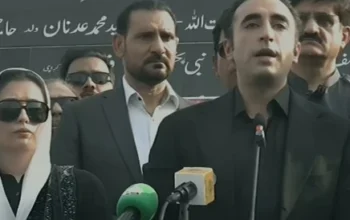
Federal Minister of State for Finance Ayesha Ghous Pasha said Wednesday the government is eager to bring relief to the masses suffering under the burden of inflation and price hike.
“Priorities are being discussed with various stakeholders through committees”, she said talking to journalists about the budget.
The budget for the new fiscal year starting July 1, 2023 will be presented in the first week of June, and likely pass the National Assembly within a week.
Without going into the specifics, Pasha said the upcoming budget will reduce the burden on the common man. “Strong measures are being taken to increase the tax net”, she said, adding, “The tax-to-GDP ratio is not even 10 percent. So how can a nation get rid of debt?”
The Federal Minister made a point of emphasising Pakistan has every intention to stay in the IMF program going forward. “The government has paid a political price for the agreement with the IMF”, she said. “The people have also made sacrifices.
She was referring to a multi-billion-dollar Extended Fund Facility (EFF) signed up by the previous government that has been stalled since at least November 2023. However, the 9th review of the program that fell due that month is yet to be concluded.
The Fund fielded its review mission in February after multiple postponements, which held threadbare talks spread over several days with the Pakistani authorities, but a staff-level agreement (SLA) over the review is yet to materialise.
Two more reviews have since fallen due for the program due to sunset with the current fiscal on June 30, 2023.
“We want an agreement with the IMF. Prime Minister Shahbaz Sharif and Finance Minister Ishaq Dar also favour the agreement.”
The long and short of it is that government is doing all it can to reach an agreement with the IMF, and to that end, the Ministry of Finance and the FBR are in constant touch with the Fund staff.
The key spoiler in this matter has been Pakistan’s yawning budget deficit, which again calls for raising more revenue to meet the expenditure. Small wonder, then, that the government is eyeing the real estate sector as a potential source of more revenue.
The realty sector is one of the largest and fastest-growing sectors of Pakistan’s economy. According to the State Bank of Pakistan (SBP), it was responsible for some 2 percent to the country’s GDP in 2021, its value that year estimated at PKR 5.2 trillion or USD 32 billion.
This largely unregulated sector has posted consistent growth over the years, averaging around 4.2 percent annually from 2011 to 2019, although it experienced a slowdown in 2020 due to the COVID-19 global pandemic.
The mandarins of Finance Division are considering multiple readjustments to the current realty tax regime to squeeze more revenue out of the sector.
An official close to the budget-making process told independent Pakistan on condition of anonymity a proposal to increase the rates of both withholding tax and gain tax.
At present, 2 percent withholding tax and 2 percent gain tax is imposed on the purchase and sale of plots for filers, while 7 percent withholding tax and 4 percent gain tax is imposed on non-filers.
The readjustment proposal will have a bearing on the tax rates for both filers and non-filers, the official said, although he was reluctant to specify the exact quantum of the increase.
Another knowledgeable source said the rates for both the withholding tax and gain tax are proposed to be doubled in the new budget. The information could not be independently verified.
An allied proposal under consideration by the authorities envisages, for the first time, a tax on file transactions in the property sector.
If it materialises into a taxation scheme, the proposal will necessitate registering of realty agents dealing in plots of housing societies through file transactions.
Another sector the government would dearly like to tame for the purposes of taxation is the retail sector. Official estimates put the annual turnover of the sector at around PKR 20 trillion, but only about 20 percent of it is visible for tax purposes.
The Federal Board of Revenue (FBR) the retail sector at 18 percent of the GDP, but manages to squeeze out barely 1 percent of its revenue from the sector.
Succeeding governments have strived to tame the sector over the years to little avail. Efforts to cast the net wider over the sector have included the introduction of the FBR’s POS system to digitise transactions at Tier-1 Retailers across Pakistan that would enable the authorities to directly monitor sales and calculate tax.
However, with their tentacles extending deep into the government and bureaucracy coupled with their preparedness to flex their street muscle has meant the going has been painfully slow.
Nevertheless, Pakistan’s revenue needs today are more urgent than ever before and it is highly likely that the government will try to make these two heavyweight sectors of the country’s economy pull their weight in the wider national interest.
Copyright © 2021 Independent Pakistan | All rights reserved