By Staff Reporter
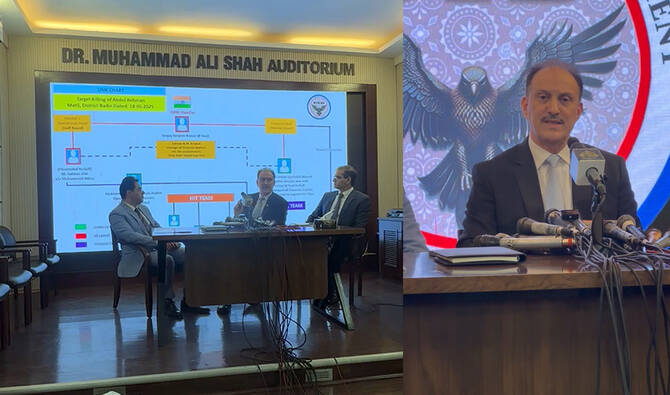
KARACHI: The counterterrorism officials on Saturday accused India’s foreign intelligence agency of masterminding the assassination of a local welfare worker earlier this year, alleging that the killing was carried out by a team of hired gunmen directed from abroad and funded through elaborate financial channels.
The allegations, leveled during a news conference here by a senior police official, represent the latest escalation in the long-running tensions between the nuclear-armed neighbors, who have traded accusations of cross-border intrigue amid ongoing disputes over the Kashmir region. Authorities in southern Sindh province said they had arrested six suspects in the case and recovered weapons used in the attack, describing it as a rare instance in which an entire “hit team” had been apprehended.
Abdul Rehman, also known as Razaullah Nizamani, a 50-year-old resident known for his philanthropic efforts, was gunned down on May 18 in the town of Matli in Sindh. Indian media outlets quickly portrayed Rehman as a prominent figure in Lashkar-e-Taiba, the banned militant group blamed for attacks in occupied Kashmir, a claim that Pakistani officials dismissed as propaganda.
“This is a case of extraterritorial killing,” Azad Khan, the additional inspector general of the Counter-Terrorism Department (CTD) in Sindh, told reporters. He identified the orchestrator as Sanjay Sanjeev Kumar, an alleged handler for India’s Research and Analysis Wing (RAW), operating under the alias “Fauji” from an unnamed Gulf country.
Khan said Kumar had recruited a Pakistani man named Salman, from Sheikhupura district in Punjab province, to lead the operation. “He sent Salman, after paying him a huge amount, and the other group, four other people,” Khan said. “And they went to Hyderabad, stayed there for five, six days and they carried out this killing.”
There was no immediate response from Indian officials to the allegations.
The killing, according to Khan, was part of what he called India’s “cowardly retaliation” following a four-day military confrontation between the two countries in May. Pakistani forces claimed to have shot down six Indian fighter jets, including French-made Rafales, during the standoff, a victory Islamabad has touted, though India has acknowledged losses without specifying the number.
“Indian media expressed immense satisfaction over this targeted killing and began spreading propaganda,” Khan added.
Investigators said Salman arrived in Karachi on May 12 and checked into a hotel in nearby Hyderabad with four accomplices: Umair Asghar, Sajjad, Obaid and Shakeel. The group spent five days surveilling Rehman in Matli before the attack. Three of the men, Shakeel, Obaid and Sajjad, carried out the shooting, while Salman and Umair directed the operation from the hotel, Khan said.
Throughout the plot, Kumar “stayed in contact [with them] from a foreign country,” Khan explained. After the killing, Salman fled through Karachi’s airport to a Gulf country and then to Nepal, where he remains at large.
Pakistani authorities, collaborating with federal intelligence agencies, arrested four of the suspects in Karachi on July 8. Two others, Arsalan and Talha Umair, were detained on Aug. 17 and Aug. 23, respectively. From the suspects, officials recovered a 9mm pistol, a 30-bore pistol, a 125cc motorcycle and several mobile phones.
“When we arrested the suspects, it was done based on technical grounds,” Khan said, citing CCTV footage, eyewitness accounts and the seized weapons as evidence linking them to the crime.
Khan emphasized that this case marked a breakthrough compared to prior alleged assassinations. Indian media have reported nearly 20 such killings in Pakistan in recent years, often in cities like Karachi and Rawalpindi, with claims that the victims were tied to Kashmir-based militants. “This is the first time the actual hit team was arrested,” Khan said, noting that in previous instances, detainees had only been involved in reconnaissance.
A Sindhi separatist group also facilitated the attack, according to Khan, who said further investigation was ongoing. He described Salman as the “prime suspect” and urged federal authorities to pursue his arrest through international channels. “It is essential that he be arrested,” Khan said, calling for the case to be raised at global forums on terrorism financing.
“Our role is limited to investigation and collecting evidence,” he added. “This case now needs to be taken forward by the Government of Pakistan.”
The CTD alleged that RAW had poured “a ton of money” into the operation, funneling funds through banks and various channels to Salman and his associates. A separate terrorism-financing case has been filed against the suspects and their handlers based on records of these transactions and travel histories.
Khan framed the incident as part of a broader pattern of Indian intelligence activities abroad. “Such acts fall under state-sponsored terrorism,” he said. “Our investigation has provided ample evidence of RAW’s involvement.”
He pointed to RAW’s alleged use of “criminal elements, terrorist groups and proxies” as a consistent tactic. “That was also the modus operandi in this case, as evident in the facts on RAW’s involvement during our investigation,” Khan said.
The accusations come against a backdrop of similar claims elsewhere. In 2023, the United States and Canada accused Indian agents of involvement in assassination plots on their soil. India rejected the Canadian allegations as “absurd” and, regarding the U.S. case, established a high-level committee to investigate, stating that any link to an Indian official was “a matter of concern” and “against government policy.”
Pakistan has repeatedly charged RAW with orchestrating killings inside its borders. Last year, officials said they had evidence tying two Indian agents to the deaths of two Pakistanis.
In this case, the CTD claimed an “Indian national” had provided the target and paid the suspects 3 million rupees. Initial interrogations revealed Arsalan and Talha Umair’s roles in terror financing, while the others were directly involved in the killing, officials said.
On Monday, an anti-terrorism court in Karachi granted CTD custody of Arsalan, described as a suspected RAW agent, for further questioning on charges of terror financing and facilitation.
The allegations follow a June raid in Karachi’s Quaidabad area, where four suspected Indian agents were arrested. Police claimed the men had photographed sensitive installations and transmitted the images to RAW using specialized software.
Copyright © 2021 Independent Pakistan | All rights reserved