By Staff Reporter
ISLAMABAD: American buyers are increasingly courting suppliers in Pakistan and Tajikistan for antimony, a critical metal used in munitions, batteries and flame retardants, as concerns mount over Beijing’s grip on global production, FT reported on Monday.
For years, Jabbar Khan, chief operating officer at Pakistan’s Himalayan Earth Exploration, dealt almost exclusively with Chinese intermediaries who drove hard bargains on ore sourced from informal traders across the border in Afghanistan.
That dynamic is shifting. Khan and his colleagues are now receiving inquiries from US parties looking to build stockpiles of the silvery metal from Pakistan and the broader Central Asian region. “The conversations we had been pushing for seven years, especially around antimony, finally started gaining traction both in Pakistan and the United States,” said Liaqat Ali Sultan, Himalayan’s chief executive, citing the Trump administration’s focus on securing critical minerals.
Antimony trioxide prices have climbed to around $40,000 a ton, down from a 2025 peak above $60,000 as some buyers turned to substitutes but still well above levels near $26,000 seen in September 2024.
Pakistan produces limited volumes of mined antimony, much of it from rugged areas along its Afghan border where violence has claimed more than 1,700 lives this year. The country accounts for about 1% of global reserves, per US Geological Survey data, compared with roughly a third for China and a fifth for Russia. Even so, the global push to diversify supplies has drawn attention to Islamabad.
Advisers to Pakistan’s army chief, Field Marshal Asim Munir, the country’s most influential figure, have floated the idea of a dedicated terminal to ship antimony directly to the US. In recent months, Himalayan struck a strategic partnership with dual-listed Nova Minerals to advance antimony exploration and bolster US-Pakistan economic links. Nova, which secured a $43 million grant from the US Department of Defence this year for gold and antimony work in Alaska, plans no immediate production of the metal but has targeted military-grade output by 2026-27.
Christopher Gerteisen, Nova’s CEO, said the company intends to purchase more than 100 tons of Pakistani antimony concentrate for about $2 million early next year for testing and processing in Alaska, with potential future downstream operations in Pakistan. “The Department of War encouraged us to go out in the world and find whatever we can,” Gerteisen said, referring to the Trump administration’s revived nomenclature for the Pentagon.
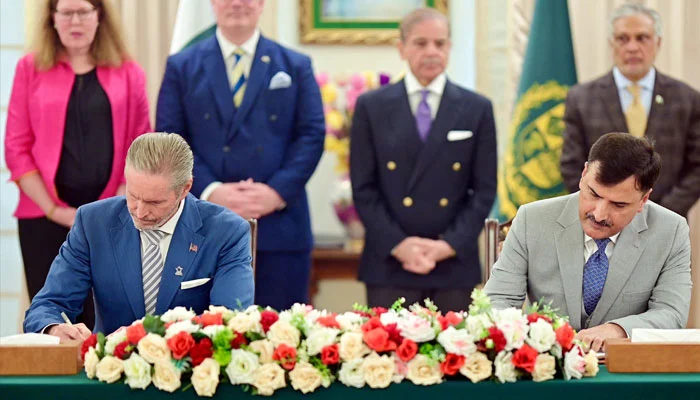
Separately, Missouri-based US Strategic Metals reached agreements this fall with Pakistani military and government leaders on cooperation in critical minerals for defence, aerospace and technology sectors. The firm’s US processing facility and mine remain pre-operational, but it received a Pakistani antimony sample in October for testing.
Neighboring Tajikistan, the world’s second-largest antimony producer, is also drawing US interest. Tajik President Emomali Rahmon, during a recent White House meeting with President Donald Trump, highlighted “brilliant co-operation” on exports of the mineral.
Processing capacity outside China remains a bottleneck. “The recent global price surge was driven not by a shortage of ore, but by limited processing capacity outside China,” said Cristina Belda, an analyst at Argus Media. Smelters capable of handling antimony beyond Chinese borders “remain limited.”
Pakistani miners often operate at the raw-material end of the chain. “Almost all of our raw antimony comes out of artisanal mines from north-west mountain regions and disappear into the hands of Chinese buyers at Karachi’s port, usually far below market rates,” said one industry veteran. Others note risks that material mined in Afghanistan crosses informally into Pakistan, describing the trade as the “wild west.”
On the US side, Texas-based United States Antimony Corp. secured a government contract this year to supply the metal. The processor added roughly $6 million in antimony inventory in 2025, sourced from third parties and avoiding Chinese material. Prices have eased from yearly highs as Southeast Asian supply emerged and buyers explored alternatives like zinc borate. “The reality” is that demand is “soft right now and people are threatening substitution,” one trader said. Still, Gerteisen said US buyers, including his firm, are prepared to pay premiums over Chinese offers in a region long viewed as Beijing’s domain for the metal. “Pakistan is virgin country for mineral exploration.”
Copyright © 2021 Independent Pakistan | All rights reserved