By Staff Reporter
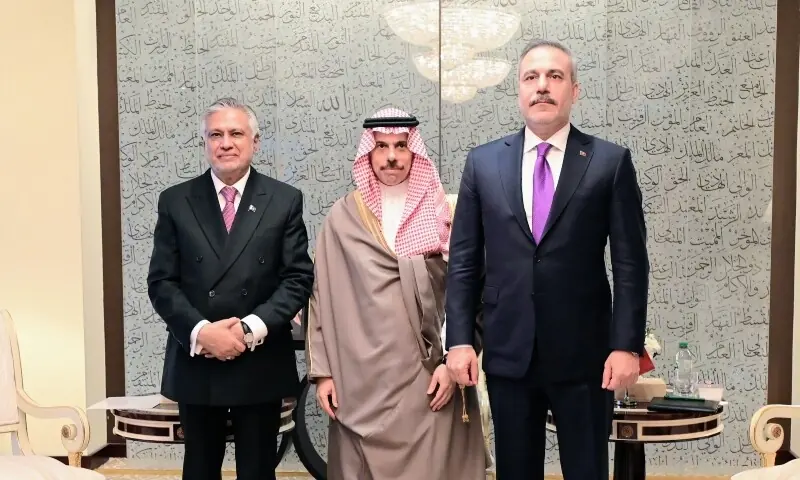
ISLAMABAD: Deputy prime minister and foreign minister, Ishaq Dar, met his Saudi Arabian and Turkish counterparts in New York on Friday to take stock of progress on turning their three-way defence pact into a working institution, as Saudi Arabia contends with an intensifying wave of missile and drone attacks from Yemen’s Houthi movement.
The talks, held on the margins of the 81st session of the UN General Assembly, brought together Dar, Saudi Arabia’s Prince Faisal bin Farhan and Turkey’s Hakan Fidan for what all three sides described as a review of the machinery underpinning the Makkah Joint Defence Agreement, the mutual-defence pact the three countries signed on 7 August. Under its terms, an attack on any one signatory is to be treated as an attack on all.
“Under the framework of the Makkah Joint Defence Agreement, we reviewed progress towards establishing the institutional structures under the agreement and exchanged views on regional and international security issues,” Dar wrote afterwards on X.
The pact’s first formal gathering took place in Istanbul on 31 August, when officials from the three states began laying down its institutional architecture. Pakistan was chosen to host the general secretariat, based in Riyadh, and on Wednesday the post’s first occupant was named: retired Lieutenant General Nauman Mahmood, whose brief will cover coordinating joint activities and overseeing implementation of the agreement.
Houthi attacks force pact’s hand
Friday’s meeting was not simply procedural. Saudi Arabia’s foreign ministry said in a statement that the three sides used the session to condemn the Houthis’ recent attacks on Saudi territory, including strikes aimed at civilian and economic sites, and to set in motion arrangements for what it called an “urgent meeting of the chiefs of staff of the three countries” — a step intended to translate the pact’s mutual-defence clause into practical military coordination in support of Riyadh.
The ministry’s statement praised the “vigilance” of Saudi armed forces and reaffirmed the kingdom’s right to take whatever measures “it deems appropriate” in its own defence. It said the three sides also reviewed the establishment of the pact’s secretariat, committees and working groups, and preparations for those bodies to begin operating.
Beyond the immediate military question, the ministers’ statement leaned on more familiar diplomatic language: the three governments underscored what they called the importance of international law, good-neighbourliness, mutual respect for sovereignty, non-interference in internal affairs, and freedom of maritime navigation — language that points as much to the wider regional rupture as to Yemen specifically. All three reaffirmed a commitment to pursuing peaceful solutions to the region’s crises.
The diplomacy came a day after Saudi Arabia intercepted six ballistic missiles fired from Yemen, after its civil defence authorities had issued a rapid sequence of alerts covering several regions, including the holy city of Mecca itself, along with Jeddah, Taif, Yanbu and Tabuk. A spokesman for the Saudi-led coalition, Major General Turki al-Maliki, said the missiles had been aimed at Taif and at Yanbu, the kingdom’s main Red Sea oil port, and warned that further escalation by the Houthis would be met firmly. The alerts were lifted within minutes once the threat had passed. It was the second time this month that Mecca itself had been placed under an aerial-threat alert — a city that had not seen such a warning in close to a decade before this year.
The missile interception came against the backdrop of a punishing 24 hours of fighting inside Yemen. According to a tally compiled by AFP from sources on both sides, at least 150 Houthi fighters and government troops were killed, many in clashes for hilltops overlooking the Bab al-Mandeb strait, the narrow waterway at the mouth of the Red Sea. Roughly 98 of those killed were government-aligned forces, with a large share dying in Houthi missile and drone strikes rather than direct combat, while the Houthis lost some 52 fighters, according to sources within the group.
A rebellion that has reached Saudi soil
The current bout of fighting traces back to July, when a years-long truce between the Houthis and the Saudi-backed government collapsed, drawing Yemen fully into the broader Middle East conflict that began in February with US and Israeli strikes on Iran. Since then, the Houthis have declared a naval blockade against Saudi Arabia, struck its tankers and territory, and seized large stretches of Yemen’s Red Sea coastline that are critical to Saudi oil exports.
Pakistan has been vocal in signalling where it stands. On 18 September, the director general of Inter-Services Public Relations, Lieutenant General Ahmed Sharif Chaudhry, said Islamabad would go to “any extent” to defend Saudi Arabia, describing Pakistan’s commitment to the kingdom’s security as “unconditional”. Prime Minister Shehbaz Sharif echoed that position on Wednesday, pledging that Pakistan would stand “shoulder to shoulder” with Saudi Arabia in defending its sovereignty and security.
Saudi Arabia’s senior religious establishment has also weighed in. According to the state news agency SPA, the kingdom’s top religious authority called on Saudi soldiers to be ready to lay down their lives in the campaign to drive the Houthis from power — a striking public intervention that reflects how seriously the country’s institutions are treating the threat.
Tehran seeks distance, and a possible opening
The renewed push to institutionalise the Makkah pact also landed just as Iran sought publicly to put daylight between itself and its Houthi allies. In a television interview broadcast on Thursday, Iranian President Masoud Pezeshkian told Fox News’s “Special Report with Bret Baier” that “the Houthis are responsible for their own actions” — remarks delivered a day after he addressed the UN General Assembly in New York.
The interview came during a lull in direct fighting between the United States and Iran, and amid a tentative diplomatic opening in New York, with Qatar acting as intermediary between the two sides. Iran’s foreign minister, Abbas Araqchi, told reporters on Thursday that Tehran had passed a proposal to Washington via intermediaries under which the Strait of Hormuz — the conduit for roughly a fifth of the world’s oil exports before the war — would reopen once Iran’s conditions were met. Under that proposal, hostilities would end across all fronts, including in Lebanon, within seven days; in exchange, the US would lift its naval blockade of Iranian ports, release frozen Iranian funds and waive oil sanctions. “The Strait of Hormuz will be reopened on the last day,” Araqchi said, adding that talks on other outstanding issues, including Iran’s nuclear programme, would follow. A senior Iranian official had told Reuters on Wednesday that Tehran was still reviewing Washington’s response to its proposals.
The war Donald Trump launched alongside Israel in February has killed thousands of people and unsettled global energy markets, pushing oil prices higher. While direct US-Iran combat has largely subsided, Iran’s regional allies remain active: Hezbollah is engaged with Israel in Lebanon, and the Houthis continue to press their advance in Yemen. Between them, Iran and its allies have squeezed Saudi oil exports significantly — the Houthis by disrupting shipping at the mouth of the Red Sea, and Iran by constraining tanker traffic through the Strait of Hormuz. A separate attack by Iran-backed militias in Iraq also briefly knocked out Saudi Arabia’s East-West pipeline.
Quite how directly Iran controls the Houthis remains disputed among security analysts; the group evolved from a local insurgency into the dominant armed force across much of northern Yemen. But Yemeni government officials, along with Iranian and regional sources, have said the Houthis’ push down the Red Sea coast was carried out under direct guidance from Iran’s Islamic Revolutionary Guard Corps.
Copyright © 2021 Independent Pakistan | All rights reserved