
By Staff Reporter
ISLAMABAD: Pakistan’s economy, with August inflation projected at 4-5% and support from a narrowing fiscal deficit and strong revenue growth, faces rising risks from flood damage that could disrupt food supplies, strain fiscal resources and threaten agricultural growth targets, the Finance Division said in its monthly outlook on Thursday.
Consumer Price Index inflation rose to 4.1% year-on-year in July 2025, from 3.2% in June and a steep 11.1% in July 2024, reflecting the stabilising impact of a $7 billion IMF bailout secured in September 2024.
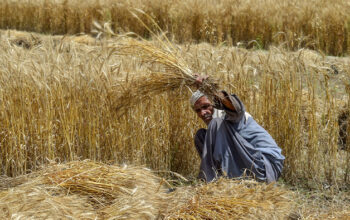
The Finance Division expects inflation to remain manageable but flagged flood-induced disruptions as a risk to food supply chains and fiscal pressures, which could jeopardise agriculture sector targets.
Agricultural support measures showed progress, with credit disbursement up 16.3% to Rs2,577.3 billion in fiscal year 2025. Imports of agricultural machinery surged 123.9% to $14.4 million in July 2025, underscoring efforts to boost productivity.
Pakistan’s fiscal metrics improved significantly in fiscal year 2025. The fiscal deficit shrank to 5.4% of GDP from 6.9% a year earlier, the lowest in eight years. A primary surplus of Rs2,719.4 billion (2.4% of GDP), the highest in 24 years, was driven by controlled non-mark-up spending and strong revenue growth.
Total expenditure climbed 18% to 24,165.5 billion rupees, with current spending up 15.9% to Rs21,528.6 billion. Federal Public Sector Development Program outlays jumped 43.3%, signalling robust development focus. Tax collection rose 26.2% in fiscal year 2025, with non-tax revenues soaring 65.7%.
In July 2025, Federal Board of Revenue collections grew 14.8% to Rs757.4 billion, fueled by a 12.5% increase in domestic taxes and a 31.2% rise in customs duties.
The current account deficit narrowed to $254 million in July 2025 from $348 million a year prior. Goods exports rose 16.2% to $2.7 billion, while imports increased 11.8% to $5.4 billion, widening the trade deficit to $2.7 billion from $2.5 billion. Service exports grew 18.1% to $745 million, and a 0.7% drop in service imports to $871 million cut the service trade deficit to $126 million from $246 million.
Foreign direct investment ticked up 6.9% to $208.1 million, led by China ($51.4 million), Canada ($37.8 million), and Hong Kong ($30.1 million). Portfolio investment, however, saw net outflows of $33.8 million (private) and $10.8 million (public). Foreign exchange reserves reached $19.6 billion as of August 15, 2025, with $14.3 billion held by the State Bank of Pakistan.
Large-Scale Manufacturing output grew 4.1% year-on-year in June 2025 but fell 3.7% month-on-month. For fiscal year 2025, LSM declined 0.74%, compared with 0.78% growth the prior year. A recovery since April, driven by automotive and fertilizer sectors, is expected to gain traction.
The Monetary Policy Committee held the policy rate at 11% on July 30, 2025, citing rising inflation risks from energy price hikes, particularly gas tariffs. Money supply (M2) contracted 4.9% from July 1 to August 1, versus a 3.2% decline last year. Net Foreign Assets fell 61.8 billion rupees, and Net Domestic Assets dropped Rs1,940.7 billion
The Pakistan Stock Exchange continued its rally, with the KSE-100 index gaining 13,763 points in July to close at 139,390, hitting a record 150,591 points in mid-August. Market capitalisation rose Rs1,464 billion to Rs16,703 billion.
Social initiatives advanced, with 63,255 workers registered by the Bureau of Emigration & Overseas Employment in July, up 23.9% from June. The Pakistan Poverty Alleviation Fund disbursed 16,368 interest-free loans worth Rs840 million in July, part of Rs119.5 billion lent since 2019. Benazir Income Support Programme spending rose 27.1% to Rs592.4 billion in fiscal year 2025.
Pakistan’s economy is on firmer footing entering fiscal year 2026, buoyed by a stronger external position, fiscal discipline, and reform-driven growth prospects. Investment facilitation, private sector reforms, easing inflation, and accommodative monetary policy are set to bolster confidence.
A favorable global environment, robust demand from trading partners, and a new US trade deal could lift exports, with remittances helping offset import pressures from tariff rationalisation. Yet, flood risks loom large, threatening agricultural output and food security.
Copyright © 2021 Independent Pakistan | All rights reserved