By Staff Reporter
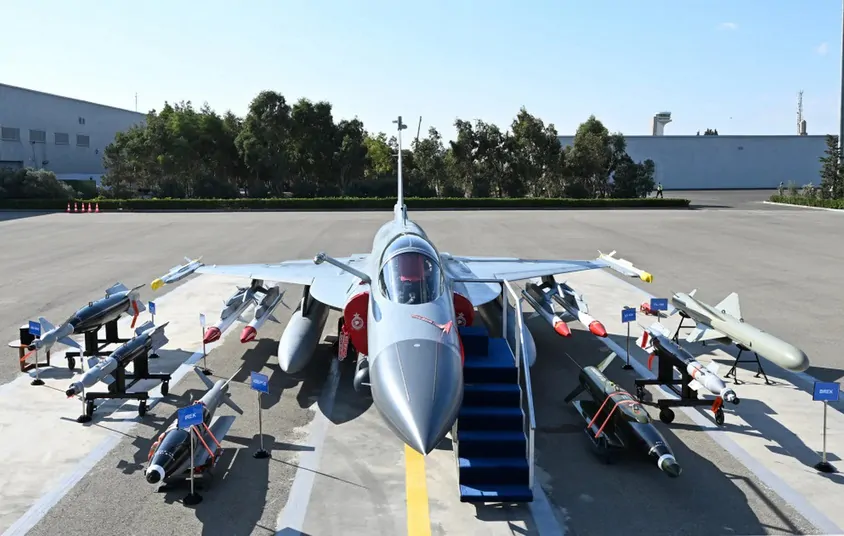
ISLAMABAD: Pakistan is grappling with a sudden wave of interest in its JF-17 fighter jet from at least five countries, a development that could overwhelm the production lines of its joint venture with China, according to a recent Bloomberg report.
The uptick follows the aircraft’s high-profile role in the May 2025 conflict with neighboring India, where it showcased its capabilities and boosted its reputation on the international stage. Developed collaboratively by Pakistan and China, the lightweight, multi-role fighter is manufactured in Pakistan, and the fresh inquiries mark a potential turning point for Islamabad’s ambitions in the arms export market.
In the past month alone, Iraq, Bangladesh and Indonesia have signaled their intent to acquire the JF-17 Thunder, Pakistani military officials have said. Separately, Reuters has reported that Saudi Arabia and Libya are also in discussions about the jet, coming on the heels of Pakistan’s praise for its performance in the 2025 clashes with India.
Pakistan’s current output hovers below 20 units a year, with the bulk earmarked for its own air force. This limited capacity now faces strain as Islamabad positions itself as a supplier to developing nations while aiding Beijing’s push to expand its influence in global defense markets. The JF-17 stands out “as a market disruptor due to its affordable price tag and, more importantly, its recent success in combat,” Manoj Harjani, a research fellow at the S. Rajaratnam School of International Studies in Singapore, said in an assessment of its appeal. “Not hard to imagine the JF-17 becoming more widely adopted, especially by militaries that cannot afford fighters produced by Western companies.”
For countries like Indonesia and Saudi Arabia, any deal would signal a notable pivot away from longstanding reliance on US and European systems. Indonesia, for instance, recently received three Rafale jets from France’s Dassault Aviation SA as part of a broader agreement, and in 2023 it committed to purchasing 24 F-15s from Boeing Co. Saudi Arabia, too, has leaned heavily on American and European suppliers, including efforts to secure Lockheed Martin’s F-35 stealth fighters.
Negotiations with Riyadh have taken on added significance, with talks underway to repurpose roughly $2 billion in Saudi loans into a JF-17 procurement package. This move would build on a mutual defense agreement signed last year between the two countries, further cementing their military ties. Pakistan has also engaged in in-depth conversations with Bangladesh about acquiring JF-17s alongside Super Mushshak training aircraft. In Libya, a $4 billion weapons agreement with the Libyan National Army includes provisions that could encompass the fighter jet.
Meanwhile, a senior Indonesian defence delegation recently conferred with Pakistan’s air force chief on aviation partnerships, with the JF-17 Thunder figuring prominently in the agenda. The program traces its roots to a 1999 pact between Pakistan’s Aeronautical Complex in Kamra and China’s AVIC Chengdu Aircraft Industry Group. Former Air Commodore Khalid Chishti has pegged the annual production at 16 to 18 aircraft.
A key selling point is the jet’s cost: $40 million to $50 million per unit, varying by model and modifications, as outlined by Pakistan’s Minister for Defence Production, Raza Hayat Harraj, in a BBC Urdu interview last month. That undercuts rivals like the Rafale or F-16, which often top $100 million apiece. “The proven combat record, advanced capabilities and cost-effectiveness of the JF-17 Thunder have made the aircraft an attractive option for countries seeking modern fighter jets,” former Air Commodore Abbas Petiwala told Business Recorder last month. Petiwala emphasised that buyers prioritize battle-tested performance. “The war record of the JF-17 has been proven time and again,” he said, pointing to its effectiveness in the May 2025 confrontation with India.
To date, exports have been modest. Myanmar led the way in 2015 with an order for at least 16 Block II variants, though only six have been delivered. Nigeria incorporated three into its fleet in 2021. Azerbaijan sealed a $1.6 billion deal for 40 jets in 2024, displaying five during its November 2025 Victory Day parade. Should the new expressions of interest solidify, Pakistan and China would need to scale up manufacturing significantly. Reports indicate Libya and Bangladesh each eyeing 16 aircraft, Saudi Arabia potentially pursuing up to 50 in a $2 billion arrangement, and Indonesia in preliminary talks for about 40.
Pakistan’s air force already operates more than 150 JF-17s and plans to phase out over 250 obsolete Mirages from Dassault and F-7s from China, likely incorporating additional JF-17s, J-10Cs and FC-31s. Forty-five export orders remain in the pipeline. “So far it was like whatever Pakistan can make, the capacity was just enough for Pakistan,” former Air Vice Marshal Faaiz Amir observed. “We had a long view for exports, but you don’t build capacity for exports before there are orders.”
Copyright © 2021 Independent Pakistan | All rights reserved