By Staff Reporter
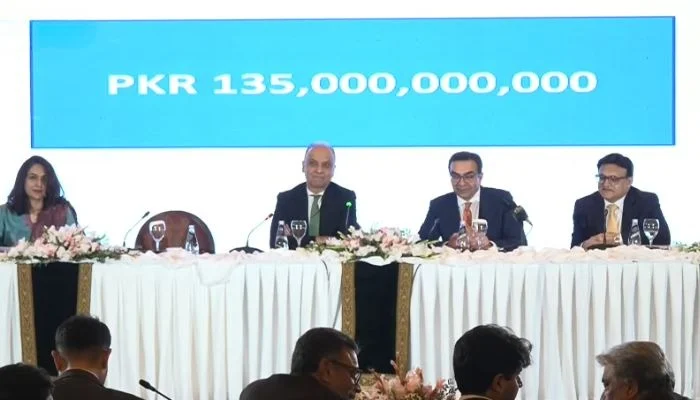
ISLAMABAD: Pakistan sold a controlling stake in its loss-making national airline to a consortium led by Arif Habib Corp. for Rs135 billion, the country’s first major privatisation in nearly two decades and a key step in efforts to revive the struggling economy under an International Monetary Fund bailout.
The Arif Habib group outbid a rival consortium headed by Lucky Cement Ltd. in a televised auction in Islamabad on Tuesday, capping a process that drew three initial offers for 75% of Pakistan International Airlines Corp. The deal gives the winning bidder the right to acquire the remaining 25% within 90 days, potentially handing full ownership of the flag carrier.
Arif Habib opened with a sealed bid of Rs115 billion in the morning session, topping Lucky Cement’s Rs101.5 billion and a Rs26.5 billion offer from private carrier Airblue Ltd., which fell below the government’s Rs100 billion reference price and exited the race. The two frontrunners then advanced to an open auction round, where bids started at Rs115 billion with minimum increments of 250 million rupees.
Lucky Cement briefly took the lead in the first phase of the open round with Rs115.5 billion, but Arif Habib countered to Rs121 billion while Lucky closed at Rs120.25 billion. After a 30-minute recess requested by Lucky, the session resumed at a base of Rs125 billion. Lucky raised to Rs134 billion before Arif Habib sealed the win at Rs135 billion, prompting Lucky’s representative to concede and congratulate the victor.
The entire proceedings were broadcast live on television and government social media channels, underscoring the administration’s push for transparency in what Prime Minister Shehbaz Sharif called “the biggest transaction in the history of Pakistan.” “If the auction is held in a successful manner, then privatisation will just take off,” Sharif told a cabinet meeting earlier in the day, noting that bids arrived in sealed envelopes deposited into transparent boxes before being opened on air.
Finance Minister Muhammad Aurangzeb, addressing the ceremony, praised the domestic interest as a boon for Pakistan’s investment climate. “All of the bidders today are from Pakistan. I used to say that no matter which team wins, Pakistan would win,” he said. “The fact that they have stepped up is a doubtless sign that anyone who is the successful bidder will take it not only to where we were, but where we need to be in the comity of nations.”
Aurangzeb added that the sale would help halt PIA’s financial hemorrhaging and position the airline competitively on the global stage. “We need to stop the bleeding and losses, but more importantly, our institutions need to be part of the comity of nations, and we will take them there,” he said, expressing hope that it would draw more local and foreign capital.
Privatization Adviser Muhammad Ali, who oversaw the process, emphasized the goal of restoring PIA’s former stature rather than a mere asset sale. “Government’s aim is not to sell the national airline but to make it stand on its own feet,” he said before the open bidding. “The government wanted to structure this transaction so it would also get a fair share and investment to be made.”
Ali detailed the framework, allowing for privatization of 75% to 100% of shares, with bidders able to pay two-thirds upfront within 90 days and the balance over 12 months. Of the proceeds from the initial stake, 92.5% will flow directly into PIA for fleet expansion, engine repairs and liability reductions, while 7.5% — about Rs10.12 billion — goes to the federal treasury. “We wanted a multitude of bidders so the process of bidding would be transparent and competitive,” Ali said, thanking all participants, including those who didn’t advance. He highlighted the need for fresh capital to grow the fleet from 18 aircraft to 30-40 or more, pay employees promptly and revive routes.
The Arif Habib consortium includes Fatima Fertiliser Co., City Schools and Lake City Holdings Ltd. Lucky Cement’s group comprised Hub Power Holdings Ltd., Kohat Cement Co. and Metro Ventures. A stipulation bars losing bidders from joining the winner’s management, though non-participants like Fauji Fertiliser Co., which withdrew last week, could potentially align later.
This marks Pakistan’s second televised attempt to offload PIA after last year’s effort collapsed with a single bid of Rs10 billion from Blue World City, well below the Rs80 billion floor for a 60% stake. That process derailed amid concerns over the airline’s finances and operational leaks. PIA, once among Asia’s top carriers, has racked up over $2.8 billion in losses from mismanagement, political meddling, overstaffing and debt. A 2020 pilot licensing scandal triggered bans by the European Union, UK and US, slashing revenues from lucrative routes. Those restrictions were lifted recently, aiding a pre-tax profit — the first in two decades — after Islamabad absorbed much of the legacy debt.
The airline holds rights to 78 destinations and 170 global landing slots, but officials say it requires urgent investment and professional oversight to compete. The government has pledged 12 months of job security for employees, with the holding company managing pensions, medical benefits and post-retirement perks, while new owners handle current salaries. The sale aligns with IMF-mandated reforms under a $7 billion bailout, including divestitures of state banks, power distributors and other unprofitable entities to stem fiscal losses and bolster confidence.
Ahead of bidding, reports of a failed behind-the-scenes proposal to split stakes among Arif Habib, Lucky Cement and others surfaced, confirmed by Lucky’s Muhammad Ali Tabba as an informal discussion he declined.
Copyright © 2021 Independent Pakistan | All rights reserved