By Staff Reporter
ISLAMABAD: Talks between Pakistan and the International Monetary Fund are moving in the “right direction”, Finance Minister Muhammad Aurangzeb said on Wednesday, as a review of the country’s $7.1 billion bailout programme got under way amid shortfalls in tax collections.
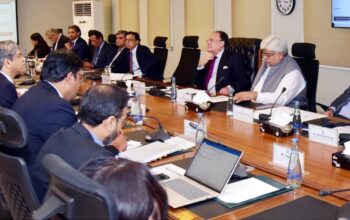
An IMF mission led by Iva Petrova held a formal kick-off meeting on Monday with Pakistan’s economic team to assess implementation of the three-year Extended Fund Facility (EFF) and the $1.1 billion Resilience and Sustainability Facility (RSF). The performance under the programme through the end of June, the period under review, has been mixed, with power sector benchmarks comfortably met but revenue collection falling short.
The start of the next review period, which ends in December, has also been off track, particularly in revenue collection, requiring both sides to agree on corrective measures during the dialogue to hit the next set of biannual targets.
Aurangzeb, speaking to reporters as he left a meeting of the Senate Standing Committee on Finance and Revenue in Islamabad, said the EFF was undergoing its second review while the RSF was being assessed for the first time. “So far, so good,” he said.
When asked about the reviews and whether they would conclude by Oct. 8, Aurangzeb said that “whatever discussions are happening, they are moving in the right direction.” The minister expressed satisfaction with the pace of the government’s talks with the IMF, saying the negotiations were progressing “positively”.
The mission will remain in Pakistan for almost two weeks and will also hold forward-looking discussions with the authorities to push for faster implementation of the end-December targets. Upon successful completion of the review, Pakistan will be eligible for the disbursement of about $1 billion by the end of next month.
Pakistan and the IMF reached the three-year, $7 billion aid package deal in July last year, providing much-needed respite to the cash-strapped nation. The new programme aimed to enable Pakistan to “cement macroeconomic stability and create conditions for stronger, more inclusive and resilient growth”.
In May this year, the IMF board approved a fresh $1.4 billion loan to help Pakistan strengthen its economic resilience to climate vulnerabilities and natural disasters. However, the disbursement of funds is contingent upon successful completion of reviews under the EFF.
Aurangzeb also addressed the FBR’s shortfall of Rs198 billion in the first quarter of the fiscal year, attributing part of the gap to pending court cases. “We want to get FBR tax to gross domestic product (GDP) of 11 percent by the end of this fiscal year,” he said. “We want to remain very committed to that target. As you know, there are certain pending court cases … let’s see how the court decides and that can help bridge some of this gap.”
The FBR faced a shortfall of Rs1.2 trillion against its original target of 12.97 trillion rupees for fiscal year 2024-25, despite the imposition of Rs1.3 trillion in additional taxes. The board ultimately collected Rs11.74 trillion after two downward revisions, with officials attributing the gap to unrealised recoveries of Rs250 billion from pending court cases.
Aurangzeb, however, said that the government was not considering taking additional tax measures. “We are not immediately taking additional tax measures.”
In an earlier briefing to the Senate Standing Committee on Finance and Revenue, Aurangzeb said that the Finance Division would take over the duty to prepare the Finance Bill for the next fiscal year and the Tax Policy Office (TPO) at the Finance Division will replace the FBR in the making of the Finance Bill.
Copyright © 2021 Independent Pakistan | All rights reserved