By Staff Reporter
ISLAMABAD: Finance Minister Muhammad Aurangzeb pushed back against opposition criticism of a recent International Monetary Fund report that flagged financial irregularities in the country, describing the document not as an attack but as a “catalyst for accelerating long-overdue reforms.”
The IMF assessment, released as a precondition for approving the next $1.2 billion loan tranche in December, spotlighted institutional weaknesses, a lack of transparency in state functions, preferential treatment for select businesses and inefficiencies in public-sector transactions as major drags on growth. It recommended a slate of reforms over the next three to six months to lift the economy’s expansion rate to 5-6.5% over the coming five years.
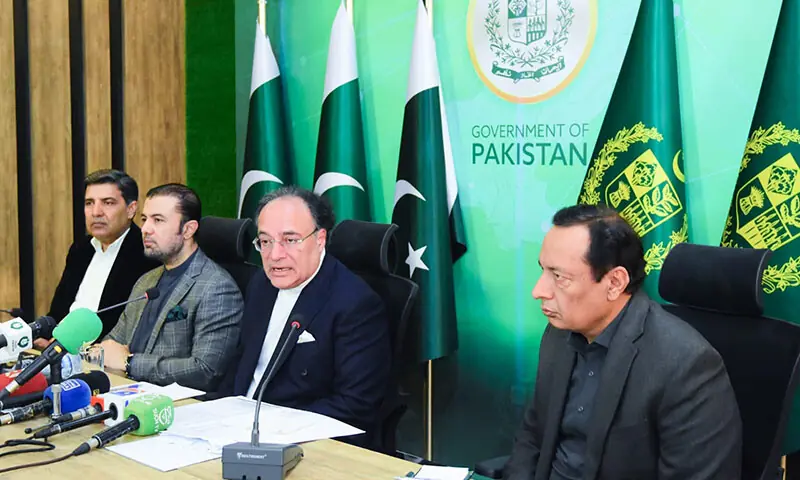
The report has fueled political backlash, with opposition parties demanding a probe into what they called the “worst financial scandal of Pakistan’s history.” But Aurangzeb, speaking at a press conference in Islamabad on Sunday, said the government had itself requested and facilitated the review to bolster institutional changes.
He stressed that the document recognized substantial progress in areas like taxation and governance, and that many of its key recommendations were “already work in progress.” The government remains committed to rolling out the rest as part of wider reforms needed to maintain Pakistan’s economic recovery, Aurangzeb added. “Pakistan’s structural challenges had built up over decades, and institutional reform was essential for sustaining economic stability.”
Aurangzeb outlined a pivot toward an “inclusive, private-sector-driven and export-led growth strategy,” highlighting the recent scrapping of the Export Development Surcharge, a levy dating back to 1991, as a “key demonstration of the government’s commitment to boosting export competitiveness.”
Paired with governance improvements at the Export Development Fund, the move “reflects a strong policy direction centred on empowering exporters, removing outdated distortions, and enabling the private sector to drive economic expansion,” he said. The decision has been summarised for cabinet approval, after which implementation will kick off.
Exports have picked up, climbing 5% overall while IT services surged more than 20% year-on-year, according to Aurangzeb. “It is very important that we take this forward in a sustainable manner,” he added. “Exports are helping us.”
The IT sector notched record monthly highs in September and October, cementing its role as a cornerstone of the “new economy,” alongside budding areas like minerals and mining, the minister noted.
He pointed to the $3.5 billion syndication tied to the Reko Diq project, now financially closed after procedural holdups were cleared, as a game-changer set to yield $2.8 billion to $2.9 billion in annual exports once output starts.
Remittances, another economic mainstay, continue to climb. “[Remittances] are moving from strength to strength. Last year, they were $38m, which was a big uptick from the year before that,” Aurangzeb said. “God willing, at a minimum, this year we will cross $41m. This $3bn delta will help in terms of our current account discussion as we go forward.”
On tariffs, Aurangzeb called for a revamp favoring raw materials and intermediate goods, while phasing out longstanding protections to foster global competitiveness among local producers over the next four to five years. “About our tariff regime, it’s simple: the protections we granted for the longest time have to go away, because that’s the only way we’re going to become internationally competitive,” he explained.
Broader indicators from July to October showed gains: cement production up 16%, fertilizer output rising 9%, petroleum products increasing 4%, automobile manufacturing jumping 31% and mobile phone assembly climbing 26%. Large-scale manufacturing expanded 4.1% year-on-year in the first quarter, flipping from contraction a year earlier.
Aurangzeb flagged advances in tax policy, digitalization, state-owned enterprise overhauls, pensions, energy and debt management. The new Tax Policy Office under the Finance Division is up and running with its advisory board, poised to make next year’s budget process more analytical and attuned to private-sector input.
Domestic debt has stabilized for the first time in nine years, with servicing costs starting to fall, he said. Pakistan’s debut Panda Bond, backed by the Asian Development Bank and Asian Infrastructure Investment Bank and greenlit by China’s central bank, is slated for issuance ahead of the Chinese New Year.
The 11th National Finance Commission Award process launches next week, involving provincial leaders, Aurangzeb said. He voiced optimism that talks on revenue, spending and governance reforms would advance under a “Pakistan First” ethos, echoing the National Fiscal Pact.
Addressing queries on taxes and energy, the minister reiterated pledges to broaden the tax net, curb leakages, boost compliance and level the playing field between formal and informal sectors. Tax refunds swelled from 200 billion rupees to 250 billion rupees over a comparable five-month span, underscoring industry support, according to the ministry.
“He also stressed that durable reform in areas like the sugar sector requires full deregulation and the Government’s withdrawal from market-influencing roles,” the ministry said in a press release.
Global investors are taking notice, with pledges from heavyweights like Aramco, Wafi, Gunvor, Turkish Petroleum, Barrick Gold, Citizen Metals, Nova Minerals, BYD, Chery, NWTN Motors, Abu Dhabi Ports and Google, which plans a Pakistan office as a tech and export hub.
Copyright © 2021 Independent Pakistan | All rights reserved