By Staff Reporter
ISLAMABAD: A ferocious monsoon season continued to batter northern Pakistan on Monday, with fresh torrential rains claiming at least 20 lives in a single district and halting critical rescue operations, local officials said.
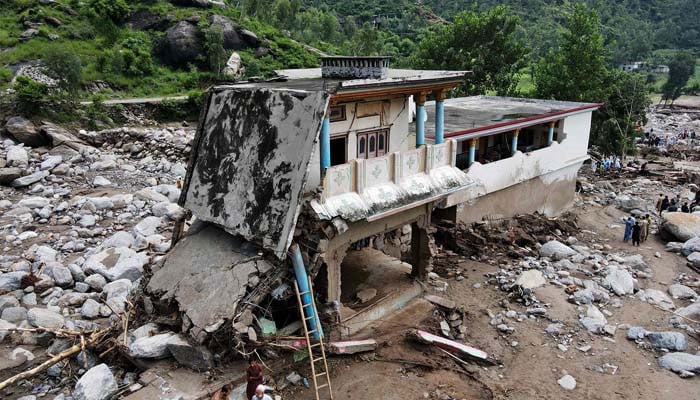
The unrelenting downpours, which have killed nearly 670 people since late June, have triggered catastrophic flooding and landslides, wiping out entire villages and leaving hundreds missing across the country’s northwest.
In Swabi, a district in Khyber Pakhtunkhwa province, a cloudburst, a sudden, intense deluge, unleashed chaos, destroying homes and killing more than 20 people, according to local officials who. They said several villages were obliterated by the sheer volume of rain that fell in a short period. Since Thursday, the province has borne the brunt of the disaster, with over 340 deaths reported by the provincial disaster agency, which warned of new flash floods in the coming days.
The latest rains forced a pause in rescue efforts, as volunteers and emergency workers struggled to navigate mud-choked roads and collapsed infrastructure. “This morning fresh rains forced a halt to relief operations,” volunteer Nisar Ahmad said in Buner, the hardest-hit district. “Dozens of bodies are still buried under the mud and rocks, which can only be recovered with heavy machinery. However, the makeshift tracks built to access the area have once again been destroyed by the new rains.”
Pakistan’s National Disaster Management Authority (NDMA) reported that approximately 670 people have died and about 1,000 have been injured since the monsoon season began in late June. Up to 90 people remain missing, and officials fear the death toll could climb further as rescue operations falter.
“We are going through the seventh spell of monsoon of 2025,” NDMA Chairman Lt. Gen. Inam Haider Malik said at a press briefing on Monday. He warned that at least two more heavy rain events are expected before the season subsides in September, with cloudbursts and localised rains forecast from August 23 through early September.
Malik highlighted the compounding dangers of “horizontal flows” from rapidly melting glaciers in northern regions like Gilgit-Baltistan, Khyber Pakhtunkhwa, and Azad Jammu and Kashmir, which have already destroyed bridges and other infrastructure. These flows, combined with “vertical flows” from cloudbursts and prolonged rains, create a volatile mix. “When these flows converge, they trigger serious emergencies,” Malik said, invoking the memory of the 2022 floods that killed over 1,700 people and caused more than $30 billion in damages.
In response, the government has mobilised resources. The Pakistan Army has deployed engineers and special units for search and rescue, while field hospitals and Combined Military Hospitals are on standby to treat the injured. The NDMA has activated 425 relief camps and dispatched convoys of trucks carrying food to severely affected areas, including Buner. “By September 10, we will have comprehensive national data on casualties and damages,” Malik said.
Prime Minister Shehbaz Sharif, addressing the crisis at a high-level meeting in Islamabad, announced that his cabinet would donate one month’s salary to support flood victims in Khyber Pakhtunkhwa. “This is not the time for politics, it is the time for service and to heal people’s wounds,” Sharif said, according to an official statement. He directed ministers to oversee the restoration of electricity, roads, water systems, and other infrastructure in the affected regions, emphasising that they must remain in the field until the last affected person is assisted. The Prime Minister’s Office reported that 456 relief camps have been established nationwide, with over 400 rescue operations conducted.
In Buner, where more than 300 people have died since Friday, the situation remains dire. A regional government officer, Abid Wazir, told Reuters that heavy rains forced rescue teams to suspend operations for several hours on Monday. “Our priority is now to clear the roads, set up bridges and bring relief to the affected people,” he said. The district, a three-and-a-half-hour drive from Islamabad, was struck by a cloudburst on Friday morning, with over 150 millimeters (6 inches) of rain falling in a single hour.
Witnesses in Buner’s Bayshonai Kalay village described scenes of panic as a swollen water channel, which had previously overflowed and caused widespread destruction, began rising again with Monday’s rains. Residents fled to higher ground as rescuers, including teams from the local government, NDMA, and the army, used excavators to clear roads clogged with mud, fallen trees, and toppled electric poles.
The NDMA reiterated that the current weather system could bring “heavy to very heavy rainfall” over the next 24 hours, raising fears of further devastation.
Copyright © 2021 Independent Pakistan | All rights reserved