By Staff Reporter
ISLAMABAD: A judge on the Islamabad High Court petitioned the country’s highest constitutional authority on Wednesday to overturn a lower court ruling that opened the door to a challenge against the validity of his law degree, escalating a legal dispute that has raised questions about judicial qualifications and due process in Pakistan’s superior courts.
Justice Tariq Mehmood Jahangiri, in a filing with the Federal Constitutional Court, argued that the Islamabad High Court’s order declaring the challenge maintainable was biased, unlawful and issued without giving him a chance to respond, violating his fundamental rights.
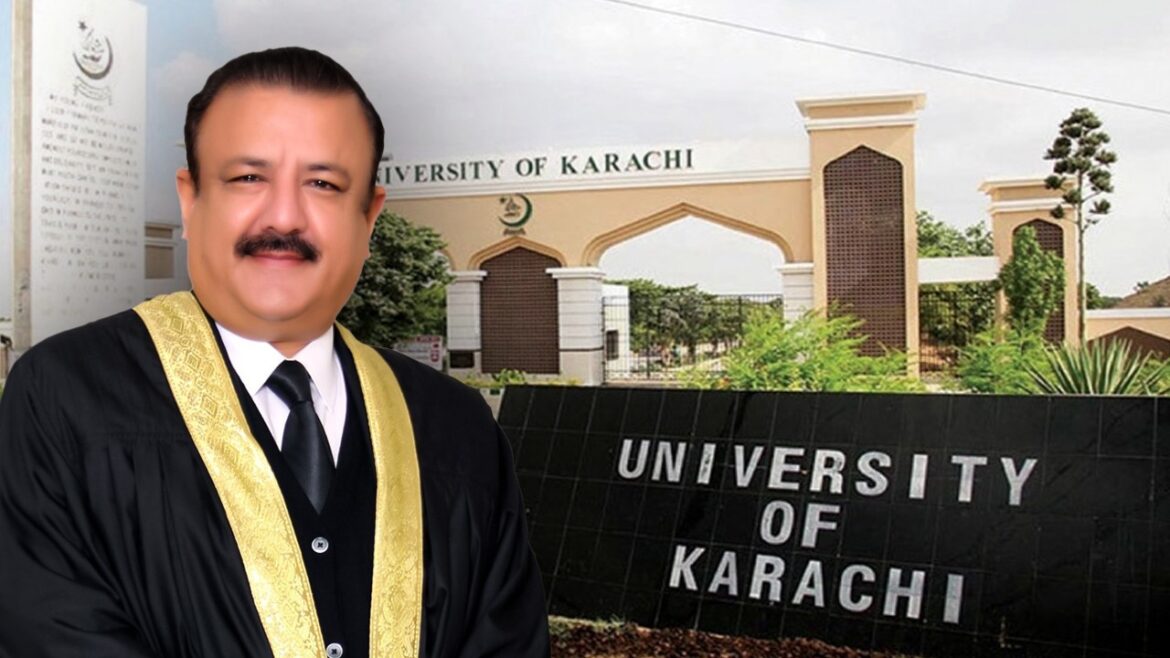
The move comes amid a protracted controversy over Justice Jahangiri’s credentials, which has drawn scrutiny from legal circles and prompted intervention by the Supreme Court earlier this year. The original plea, brought by lawyer Mian Dawood, questions the authenticity of Justice Jahangiri’s law degree from the University of Karachi and, by extension, his appointment to the bench.
A division bench of the Islamabad High Court, led by Chief Justice Sardar Muhammad Sarfraz Dogar and including Justice Muhammad Azam Khan, ruled on Dec. 9 that the plea could proceed.
In his petition to the Federal Constitutional Court, Justice Jahangiri named Dawood, the Federation of Pakistan, the president of Pakistan, the Judicial Commission of Pakistan, the parliamentary committee on judges’ appointments to superior courts, the Higher Education Commission, the University of Karachi and another lawyer, Siraj Ahmad, as respondents.
He contended that the Islamabad court’s handling of the case — including its order on maintainability, a Sept. 16 directive that temporarily barred him from judicial duties and the “unnecessary haste with which the division bench is proceeding” — demonstrated clear bias, particularly from the chief justice.
The petition detailed procedural lapses in the lower court proceedings. It noted that after a hearing on Dec. 2, the case was adjourned to Dec. 9, but no notice had been issued to Justice Jahangiri beforehand. As a result, he neither appeared nor was represented that day. “Nevertheless, the order dated December 2 erroneously records the attendance of ‘Mr Aleem Khan Abbasi and Mr Riasat Ali Azad, advocates for respondent no.1’(the petitioner),” the filing stated.
The petition further criticised the Islamabad court for relying on a report from the University of Karachi that omitted key information: a declaration that the university’s Sept. 25 withdrawal and cancellation of the judge’s degree had been suspended by an Oct. 3 order from the Sindh High Court. Terming the Dec. 9 order “unconstitutional, unlawful and liable to be set aside,” Justice Jahangiri highlighted that it was issued before any notice reached him. While the bench heard arguments from several parties, including some not formally involved in the plea, he was excluded. “This amounts to a violation of the petitioner’s (Justice Jahangiri) fundamental right to due process and fair trial as enshrined under Article 10-A of the Constitution,” the filing asserted.
It added that the order failed to preserve his ability to contest the plea’s maintainability later, effectively deciding the issue “once and for all, behind the petitioner’s back and without hearing him.” “The impugned order is liable to be set aside on this count alone,” the petition said. Moreover, the challenge to his qualification involves factual disputes over the degree’s validity, which, Justice Jahangiri argued, cannot be resolved by a high court under its constitutional powers but must go to “a court of competent jurisdiction after a full trial involving the recording of evidence.”
The case traces back to a letter that surfaced on social media last year, allegedly from the University of Karachi’s controller of examinations, casting doubt on the degree. This led to a complaint filed with the Supreme Judicial Council in July of last year and Dawood’s petition in the Islamabad High Court earlier this year. On Sept. 16, the same division bench took up the matter and issued an interim order restraining Justice Jahangiri from judicial functions pending a decision on maintainability. Delivered without prior notice to the judge, the move ignited debate among lawyers over a high court’s authority to sideline a sitting colleague through such a step.
The Supreme Court stepped in on Sept. 29, vacating the restraint. A five-member constitutional bench, headed by Justice Aminuddin Khan, ruled that a high court lacks the power to bar a judge from duties while considering a quo warranto petition, which questions an official’s right to hold office. The Supreme Court’s decision focused solely on the interim order’s legality, not the underlying allegations, and instructed the Islamabad court to address all preliminary objections and handle the case according to law.
Justice Jahangiri has also been at the center of broader tensions over judicial independence. He was among six Islamabad High Court judges who sent a letter to the Supreme Judicial Council last year, accusing intelligence agencies of meddling in court affairs. The missive fueled national discussions on accountability and prompted calls for an official inquiry.
Copyright © 2021 Independent Pakistan | All rights reserved