By Staff Reporter
ISLAMABAD: A committee representing legal profession on Saturday accused the country’s top judicial appointment body of running what it called a “horse trading” operation, and named a veteran advocate who once led a landmark 2007 protest movement to head a fresh campaign against the practice.
The Lawyers Action Committee, meeting in Islamabad, adopted a resolution condemning the process by which the Judicial Commission of Pakistan selects judges for the country’s high courts. The commission had recently formed seven-member panels to interview high court candidates for the Lahore, Islamabad, Sindh, and Balochistan high courts, with none of the panels including a sitting Supreme Court judge. Committee members said the process amounted to little more than a bargaining exercise, and used the word “horrific” to characterize it.
The resolution said the fallout from Pakistan’s 26th and 27th constitutional amendments had continued to damage the country’s justice system, and singled out the current appointment process as especially troubling.
To lead the response, the committee turned to Ali Ahmed Kurd, a former president of the Supreme Court Bar Association and one of the central figures in the 2007 lawyers’ movement. That earlier campaign erupted after then-President Pervez Musharraf removed Chief Justice Iftikhar Muhammad Chaudhry, a move that was widely condemned as unconstitutional and that drew thousands of lawyers into the streets.
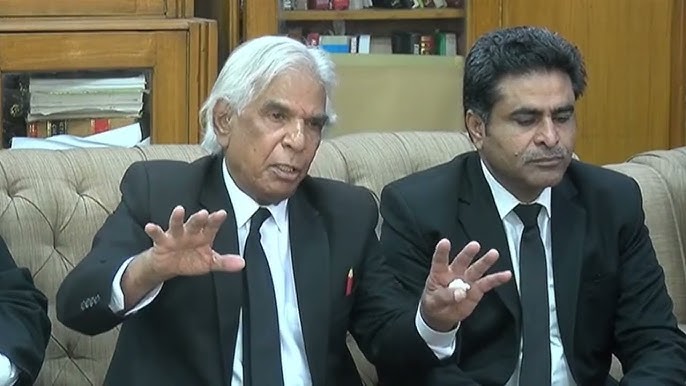
Speaking to reporters at the Supreme Court, Kurd said he had taken on the new movement reluctantly, at the urging of colleagues who felt the public had lost confidence in the courts.
“I have accepted the leadership of the movement with a heavy heart at the insistence of my colleagues, particularly because the people of the country have lost faith in the justice system,” Kurd said.
He was joined at the appearance by three other senior lawyers — Hamid Khan, Salahuddin Ahmed, and Abid Shahid Zuberi — a lineup that echoed the leadership structure of the earlier movement.
Kurd said the new campaign would follow a similar model, aiming to draw ordinary citizens into the fight on the grounds that they, not the legal profession alone, have the greatest stake in how the justice system functions. He said the committee would hold its first public gathering in Khyber Pakhtunkhwa, and that organizers were also planning an event in London at the invitation of Pakistani expatriates who want to draw attention to the movement’s concerns.
A commission accused of rewarding loyalty
The resolution called on any members of the Judicial Commission who retained what it termed a conscience to withdraw from what it described as a horse-trading exercise, and to publicly denounce the process as a farce.
Committee members argued that high court appointments had come to resemble Senate nominations, alleging that judgeships were being handed out as political favors or obtained through financial leverage rather than earned through merit. The resolution said that when judges secure their positions through political maneuvering rather than competence or integrity, the future of justice in the country is in serious jeopardy.
The committee also took aim at how candidates are interviewed, calling the process a mockery. It alleged that interviews were being conducted behind closed doors and that several commission members had been shut out of the interview process altogether, a combination the resolution said had allowed unqualified candidates to be chosen.
Balochistan violence and detentions draw criticism
Beyond the judiciary, the resolution addressed the security situation in Balochistan, where the committee said dozens of people have died in repeated terrorist attacks. It argued that the government’s pursuit of what it called a hard-state approach had alienated large segments of the population in the province and in other troubled regions, cost lives, and undermined security, while feeding long-running grievances that other actors have since exploited. The committee called for a fact-finding commission to examine the underlying issues in those regions and to hold public consultations on how to address them.
The resolution also criticized the continued detention of lawyers Imaan Mazari and Hadi Ali Chattha, as well as several political figures, including former Prime Minister Imran Khan, Dr. Yasmin Rashid, Mahrang Baloch, and Ali Wazir. Committee members said the detentions reflected an absence of any real strategy for handling dissent, and faulted the judiciary, the legal profession, and political parties broadly for staying silent in the face of what the resolution called blatant injustice.
The resolution described the current state of affairs as entirely unsustainable, warning that the country was heading toward a catastrophe that no amount of international posturing could conceal.
Bar association elections and minority rights
The committee separately condemned the ongoing efforts by the Pakistan Bar Council and provincial bar councils to interfere with or manipulate bar association elections in instances where the outcome appeared unfavorable to them. It demanded that all such elections be held on schedule, in accordance with the law, and with verification through Pakistan’s national database authority, Nadra.
The resolution further called for the removal from the rolls of lawyers holding fraudulent degrees or working other jobs while practicing law, and demanded a complete prohibition on voting by anyone holding memberships in more than one bar association.
Finally, the committee expressed support for an ongoing sit-in at Babarlo in Sindh, organized by the Priya Kumari Action Committee over the disappearance of children including Priya Kumari, a Hindu girl who has been missing since 2021. The resolution called on the Sindh government to respect the rights of religious minorities and address their grievances.
Copyright © 2021 Independent Pakistan | All rights reserved