By Staff Reporter
ISLAMABAD: Pakistan has thrust itself into the center of a high-stakes diplomatic scramble to halt nearly a month of open conflict between the United States and Iran, convening senior diplomats from across the Muslim world in Islamabad this weekend, while signalling that face-to-face American and Iranian talks could begin as early as Tuesday.
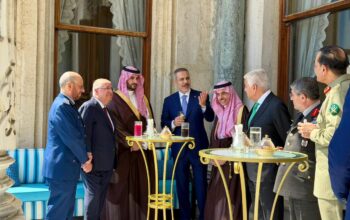
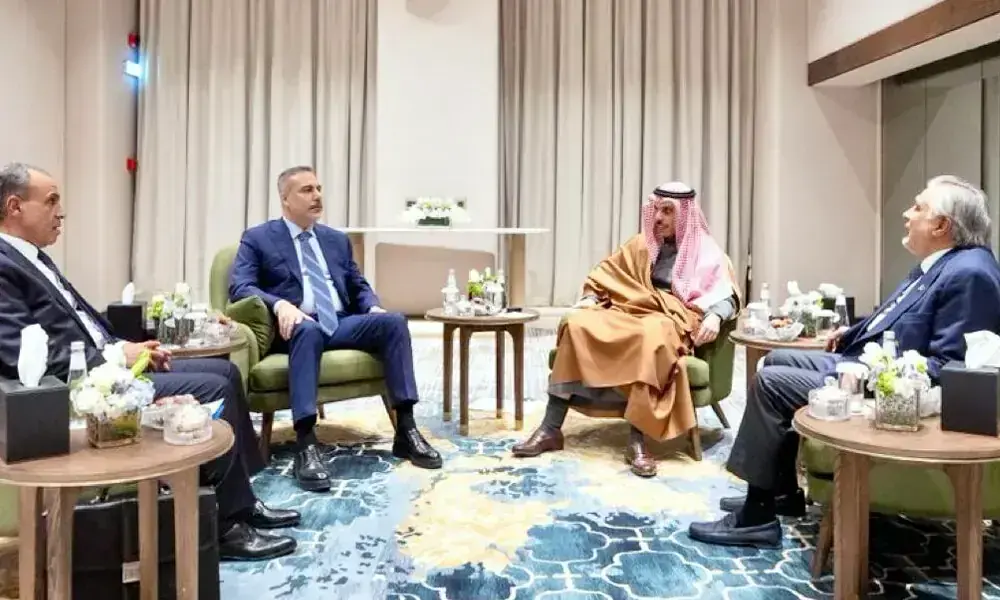
The flurry of activity culminated on Saturday in a 90-minute telephone conversation between Prime Minister Shehbaz Sharif and Iranian President Masoud Pezeshkian — their second discussion in five days — and the late-night arrival in the Pakistani capital of the foreign ministers of Saudi Arabia, Turkey and Egypt.
The four-country gathering, originally set for Turkey, was hastily moved to Islamabad so that Deputy Prime Minister and Foreign Minister Ishaq Dar could remain on hand to steer Pakistan’s delicate back-channel role between Washington and Tehran.
The session is the most visible sign yet that a narrow window for de-escalation has opened. Neither American nor Iranian officials are expected to attend the meetings on Sunday and Monday. Yet Pakistani and regional diplomats describe the gathering as a vital preparatory step, intended to lock in broader Muslim-world support for an eventual ceasefire and to coordinate positions before any direct U.S.-Iran encounter.
The foreign ministers are expected to issue a joint call for de-escalation and to coordinate support for any eventual U.S.-Iran dialogue. They are also scheduled to meet with Sharif during their two-day stay.
Dar, speaking to local media, said Pakistan was proceeding “with honesty and sincerity” and had received strong backing from friendly governments. Indirect contacts were continuing, he added, but public comment was being kept to a minimum because of the sensitivity of the talks.
The conflict erupted Feb. 28 with U.S. and Israeli strikes on Iranian targets and has since spiralled into Iranian counterattacks on American interests and oil infrastructure in the Gulf. The fighting has crippled shipping through the Strait of Hormuz and closed key air corridors, sending ripples through global energy markets.
Pakistan, which has no direct stake in the war but maintains close ties to both Tehran and Washington, has quietly positioned itself as the principal go-between, relaying messages and proposals in recent weeks.
Saturday’s phone call between Sharif and Pezeshkian underscored both the fragile progress and the formidable obstacles that remain. According to officials, Pezeshkian spoke at length about Tehran’s “deep mistrust” of the United States. He reminded Sharif that Iran had come under military attack twice while nuclear negotiations with Washington were underway. Even after President Donald Trump declared a pause in strikes on economic and energy facilities, those same sites were hit repeatedly, the Iranian leader said. Such contradictions, he argued, had destroyed any foundation for trust.
Pezeshkian insisted that concrete confidence-building measures — beginning with an end to attacks — would be essential before substantive talks could proceed. He also voiced concern that Israel was seeking to widen the conflict and that bases or airspace in some Muslim countries had been used to stage strikes on Iran. Tehran’s own actions, he maintained, had been purely defensive.
Sharif responded by reiterating Pakistan’s strong condemnation of the Israeli bombings, including recent strikes on infrastructure in Ahvaz and Isfahan. He conveyed condolences for the more than 1,900 Iranians killed since the war began and expressed solidarity with the Iranian people. Any dialogue, he told Pezeshkian, must rest on “trust and mutual respect” and an immediate halt to military aggression and the killing of civilians and officials.
The quadrilateral meeting now underway grew out of a larger gathering of Arab and Muslim nations in Riyadh earlier this month. It has since evolved into the most active diplomatic track feeding into the broader effort to end the fighting. Pakistani officials say their country has become the central interlocutor, shuttling proposals between the two adversaries.
Iran has already transmitted its formal response to Trump’s 15-point plan for ending the war through Pakistani channels, according to sources familiar with the exchange. Earlier this week, Tehran rejected an initial U.S. proposal relayed by Islamabad, declaring that it would conclude what it calls the “imposed war” on its own terms and timeline.
Chinese diplomats have separately assured Tehran that Beijing supports Pakistan’s mediating role and have urged Iran to engage in talks. German Foreign Minister Johann Wadephul told reporters on Friday that a direct U.S.-Iran meeting would take place in Pakistan “very soon.”
One diplomat close to the planning indicated that Secretary of State Marco Rubio and Iranian Foreign Minister Abbas Araghchi could meet in Islamabad around Tuesday, possibly accompanied by a US announcement of a ceasefire — a step Tehran has repeatedly demanded as proof of American seriousness.
Yet even as momentum appeared to build, Pakistani officials repeatedly cautioned that nothing was settled. “All this remained subject to how events would unfold over the next 48 hours,” one diplomatic source said.
For now, the process remains tentative. Iranian officials have continued to deny that formal talks with Washington are underway, even as they acknowledge passing responses through third parties. Yet the fact that detailed proposals are flowing through Islamabad — and that four influential regional powers have gathered here at short notice — suggests that the diplomatic opening, however narrow, is still alive.
Copyright © 2021 Independent Pakistan | All rights reserved