By Staff Reporter
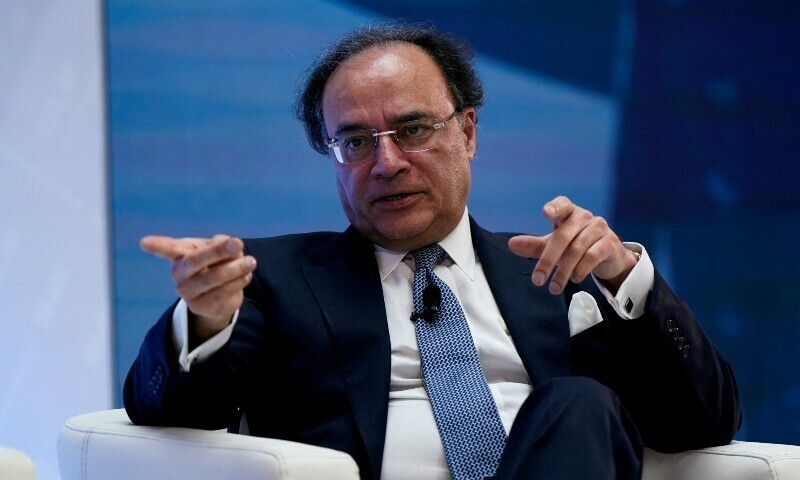
ISLAMABAD: Pakistan plans to issue its first Panda bond before the Chinese New Year in late January, Finance Minister Muhammad Aurangzeb said, in a clear signal that Islamabad is accelerating its push to diversify funding sources and re-enter international capital markets after years of isolation.
Speaking in an interview with Arab News, Aurangzeb said the renminbi-denominated bond, sized at the equivalent of roughly $250 million, would be completed “certainly well before CNY, which is going to be in February of this year.” “I’m very clear we have to get it done before the Chinese New Year,” he said. “So, it’s not late into 2026.”
Two non-deal roadshows have already been completed, credit enhancement from the Asian Development Bank has been approved, and the Asian Infrastructure Investment Bank is expected to follow shortly. Regulatory clearances from the People’s Bank of China and the China Securities Regulatory Commission are progressing, Aurangzeb said.
The minister stressed the Panda issuance is a strategic diversification move rather than a requirement tied to the IMF program’s external financing gap. “It has nothing to do with our external discussion at all,” he said. “This is something Pakistan should have done some time back.” The Panda bond is part of a broader roadmap that runs from export-led growth to export-oriented foreign direct investment and, finally, to full international capital-market access via Eurobonds and sukuk.
Aurangzeb pointed to the alignment of the three major rating agencies, Fitch, S&P, and Moody’s, which have all stabilised Pakistan’s outlook this year after repeated downgrades linked to balance-of-payments crises and political turmoil, as a critical enabler. “We are also refreshing our GMTN program,” he said, referring to the Global Medium Term Note structure that underpins Eurobond and sukuk issuance.
The update will refresh risk disclosures, financial statements, and legal documentation so Pakistan can move quickly when market windows open.
On monetary policy, Aurangzeb said the State Bank of Pakistan’s independent Monetary Policy Committee holds sole authority over rate decisions, but he personally expects the benchmark rate to fall to single digits within the current fiscal year if inflation remains contained. “If the inflation stays range-bound… the policy rate, during this fiscal year, can move into single digit,” he said.
Aurangzeb attributed the improved outlook to aggressive liability management that has lowered the debt-to-GDP ratio from the mid-70s to the mid-60s percent range and cut annual debt-servicing costs by more than Rs800 billion ($2.9 billion).
Turning to fiscal reform, Aurangzeb described Pakistan’s tax-to-GDP ratio, stuck for years around 9%, as “not fiscally sustainable” and said the country had already lifted it to roughly 10.2% with a target of 11% through enforcement, technology, and new taxpayer inclusion.
He singled out agriculture, retail, and real estate as sectors that contribute heavily to GDP but “have not been contributing to the exchequer in the same proportion.” Crucially, all four provincial assemblies have now passed agricultural income-tax legislation, a reform long considered politically impossible because many lawmakers own farmland is owned by sitting legislators. “First I was being told this can never be done,” Aurangzeb said. “It’s been done. Now people tell me it can’t be collected. Okay, one thing at a time.”
On the power sector, the minister pushed back on suggestions that further tariff increases could hit a political red line, saying tariffs have actually started declining because of better governance at distribution companies.“No, in fact, the tariffs have been coming down,” he said. Nearly 90% of DISCO boards are now chaired by private-sector professionals, recoveries are improving, and losses are falling. Three distribution companies have been transferred to the Privatisation Commission as Islamabad advances long-delayed structural changes. “Whether we do outsourcing, whether we privatise… that, to me, is the structural solution as we go forward,” Aurangzeb said.
Foreign direct investment fell 26% in the July-October period, but the minister said part of the drop reflected the clearance in June of a multibillion-dollar backlog of repatriable profits and dividends. New investments are arriving, including a U.S. conglomerate’s acquisition of First Women Bank and Google’s designating Pakistan as a regional technical and export hub. October IT exports hit a record $386 million, the highest monthly figure in Pakistan’s history.
Aurangzeb highlighted the newly created Pakistan Virtual Asset Regulatory Authority and the Crypto Council he chairs, saying the framework would allow freelancers to earn in digital assets while maintaining AML and consumer-protection standards.
On the exchange rate, he rejected claims of heavy State Bank intervention and overvaluation. “It’s a market-based exchange rate, real, which has to define where the value of the rupee is,” he said. Pakistan is operating under a $7 billion, 37-month Extended Fund Facility with the International Monetary Fund that demands fiscal consolidation, revenue mobilisation, energy-sector cleanup, and state-owned enterprise reform. The Panda bond and refreshed GMTN program mark the latest steps in Islamabad’s attempt to graduate from repeated IMF support and regain sustainable market access.
Copyright © 2021 Independent Pakistan | All rights reserved