By Staff Reporter
ISLAMABAD: Pakistan will host the next formal meeting of the Makkah Defence Alliance’s apex committee in Islamabad, probably before the end of the month, foreign minister Ishaq Dar said on Monday.
Dar, who is also deputy prime minister, said the Strategic Political and Defence Committee (SPDC) “will actually be meeting, hopefully [at the] end of this month, in Islamabad”.
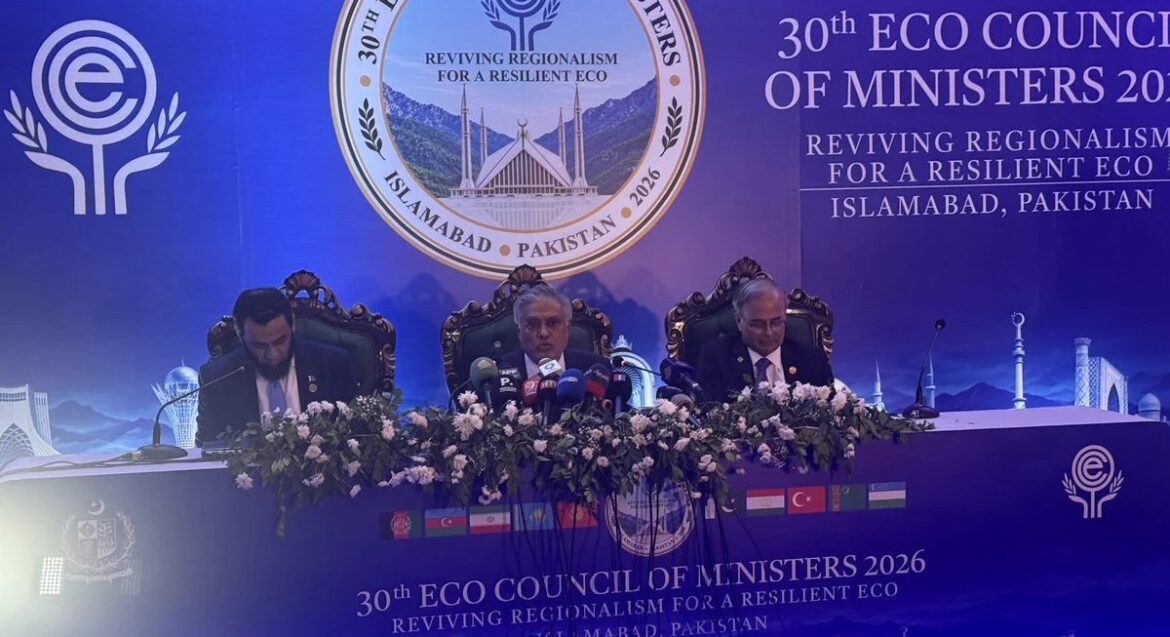
He was speaking at a press briefing after a ministerial meeting of the Economic Cooperation Organisation (ECO) in the Pakistani capital. Asked about regional security architecture, he recalled that Pakistan, Saudi Arabia and Turkey signed the Makkah Joint Defence Agreement on 7 August. The pact allows the three states to treat an attack on any one of them as an attack on all.
“We offered in our inaugural meeting that our next formal meeting will be held in Islamabad and everybody accepted,” Dar said.
The SPDC comprises the foreign and defence ministers of the three countries and their top military officials. It first met in Istanbul on 31 August, when it agreed to set up a permanent secretariat in Saudi Arabia, initially headed by a Pakistani secretary general for three years. Dar said an emergency meeting was held in Riyadh last month amid Houthi attacks on Saudi Arabia. Pakistan’s Foreign Office said after that meeting that the three countries had agreed to deploy military forces and capabilities rapidly in the kingdom.
Asked whether the pact pointed to a new security architecture for the region, Dar said: “Well, let me be very honest with you. I think time and again, different regions, including this region, have witnessed that the need and the best way to have regional security is to have some sort of security at the local or domestic architecture.
“In other words, this region should have its own security architecture. Maybe this is a beginning.”
He said the “global institutions who claim to be masters of having the security arrangement globally were not created in one day”. The Makkah pact, he added, was signed for self-defence and does not violate Article 51 of the UN Charter, which allows individual and collective defence.
“Now, it is not restricted that these three countries will have a monopoly and will not have, will not entertain ever [any] other membership,” he said.
Dar said the alliance was in a “transition time of setting up the infrastructure”, with decisions taken on the secretary general’s office and a permanent secretariat in Riyadh. A working committee, with one representative each from the foreign, defence and military offices of the three countries, has also been formed.
“That committee has been working; it has had a few sessions. And the last meeting, hopefully, will be in November, where they will work out all the nitty-gritty regarding detailed SOPs etc,” he said.
He said new members would be considered once the alliance was established, in about a year, provided they agreed to its principles. “I’m very hopeful that, God willing, this is not going to benefit just these three countries,” he said. Dar said earlier last month that at least six countries had expressed interest in joining, though he did not name them.
Diplomacy on Iran
Dar also said Pakistan had not given up its efforts to secure a peaceful end to the US-Iran war.
He said he had held “very candid, very frank, very brotherly, very comprehensive discussions” with Iranian foreign minister Abbas Araghchi on the sidelines of the ECO meeting. Iran, he said, had “fast-tracked” its seven-day proposal for reopening the Strait of Hormuz into a two-day plan.
“So, the response from the United States is pending. We have not given up hope or efforts. We are still doing our best [so] that the situation gets sorted out,” he said.
He hoped Washington, no longer preoccupied with its midterm elections, would respond “very soon”.
Dar said both the seven-day and two-day proposals were “actually extracted” from the Islamabad Memorandum of Understanding signed by Iran and the US on 18 June, and said he hoped it would be implemented. “There’s nothing new. It’s only fast-tracking things here and there, showing confidence-building measures, taking actions by one side and opening of the Hormuz by the other,” he said. “So I think let’s hope for the best. We haven’t given up hope.”
Asked how the ECO would handle US sanctions on Iran, given that its secretariat is based in Tehran, he said: “Sanctions are not going to be there forever. And once sanctions are over, the whole world will just land there; I can guarantee.” He recalled that a British prime minister was the first person to visit Tripoli when sanctions on Libya were lifted. Pakistan, he said, had “always” followed international law, the UN Charter and Security Council resolutions.
The Foreign Office said Dar and Araghchi reviewed bilateral relations and regional developments. Araghchi congratulated Pakistan on hosting the ECO meeting and praised its “warm hospitality and excellent arrangements”, it said. Mr Dar stressed that “dialogue and diplomacy remain the only viable means of addressing outstanding issues, preventing escalation and achieving lasting peace and stability”. The two agreed to stay in close contact.
Araghchi told reporters in Islamabad on Monday that the 10-nation ECO bloc had backed Tehran’s two-day plan. “The meeting responded positively and, by supporting the plan proposed by Iran, namely the two-day plan, expressed hope that this plan would lead to a definitive and comprehensive ceasefire,” he said.
Senior officials from Pakistan, Turkey, Azerbaijan, Kazakhstan, Iran, Kyrgyzstan, Tajikistan, Turkmenistan and Uzbekistan attended the meeting. Afghanistan, also an ECO member, was not represented. ECO Secretary General Asad Majeed Khan and information minister Attaullah Tarar were at Mr Dar’s briefing.
Iran said on Monday that its two-day proposal remains the most practical roadmap for restoring security in the strait, and that progress depends on Washington’s political will. Tehran has said it is ready to reopen the waterway within two days if the US meets its conditions. They include the release of frozen assets abroad, sanctions relief and an end to the US naval blockade of Iranian ports.
Donald Trump rejected the seven-day version in late September. The Wall Street Journal reported at the time, citing unnamed US officials, that he expected to resume bombing Iran after the midterms. Washington has not publicly responded to the two-day plan.
The war began on 28 February with US-Israeli strikes on Tehran that killed supreme leader Ayatollah Ali Khamenei and other members of Iran’s leadership. The US and Israel also demanded that Iran stop any nuclear-related activity. Tehran retaliated with strikes on Washington’s Gulf allies, sending global energy prices sharply higher, and has blockaded the Strait of Hormuz, a vital route for global oil, since the start of the conflict. In more than eight months of fighting it has also struck infrastructure and US assets across the Middle East.
On Friday, after this month’s US strikes on Qeshm island in the strait, the Revolutionary Guards said they had targeted a US early warning radar system in Bahrain. Efforts to end the war have stalled in recent months.
Copyright © 2021 Independent Pakistan | All rights reserved