By Staff Reporter
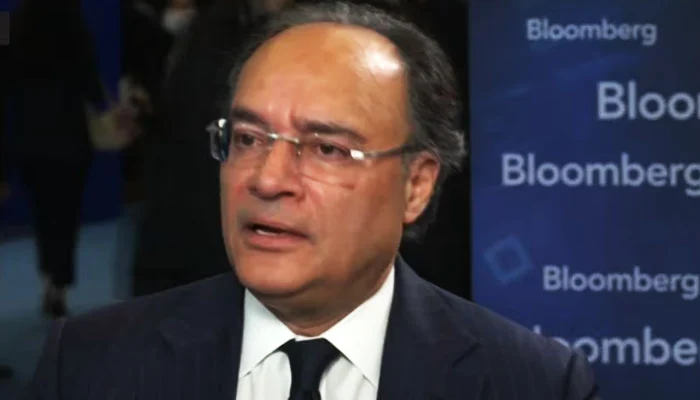
KARACHI: Pakistan is gearing up to re-enter international capital markets with a Eurobond issuance under its Global Medium-Term Note (GMTN) program in 2026, Finance Minister Muhammad Aurangzeb said on Wednesday, signaling growing confidence in the country’s economic stabilisation efforts.
The move follows a successful $500 million Eurobond repayment last month and comes amid upgrades from major credit rating agencies and renewed support from the International Monetary Fund (IMF).
Speaking during a meeting with a delegation of German investors and businessmen led by German Ambassador to Pakistan Ina Lepel, Aurangzeb outlined Pakistan’s strategy to deepen its presence in global financial markets. The minister revealed plans for an inaugural Panda Bond issuance in China’s capital market, alongside the GMTN program’s revival next year.
“We are now clearly poised well to repay the next tranche, which is $1.3 billion, in April of next year,” Aurangzeb said in a recent interview on CGTN America’s One on One program, published Tuesday. “We are refreshing our GMTN with a view to go for a major print after the Panda bond.”
The planned Eurobond issuance, which could be denominated in euros, US dollars, or as an Islamic sukuk, marks Pakistan’s return to international bond markets after a two-and-a-half-year hiatus. The country successfully repaid a $500 million Eurobond that matured on September 30, 2025, originally issued in 2015 with a 10-year tenor.
Aurangzeb attributed this repayment capacity to improved macroeconomic fundamentals, noting that Pakistan has also tapped Middle Eastern commercial bank borrowing for the first time in over two years.
Economic Stabilization Gains Traction
Aurangzeb highlighted significant progress in restoring fiscal and external stability, validated by upgrades from Fitch, S&P, and Moody’s in recent months. “Inflation continues to be a good story, which is now in single digits. [The] policy rate has been halved,” he said on CGTN America. The IMF’s staff-level agreement earlier this month, which paves the way for Pakistan to access $1.2 billion pending board approval, further underscores international confidence. “We are very grateful that the management of the Fund continues to repose trust and confidence in the authorities in Pakistan,” Aurangzeb said, emphasising progress in taxation, energy, state-owned enterprises, privatization, and public finance.
Despite challenges posed by recent floods, Aurangzeb remains optimistic about economic growth. “We grew at 3% GDP last year. We had estimated that we would grow a little over 4% this year, but now, given the flood situation, this will shave off a certain percentage around that,” he told CGTN America. “I am still quite hopeful that we can manage anything close to 3.5% during this fiscal year.” He described climate change as an “existential issue for Pakistan,” noting the country’s ongoing struggles with its impacts.
Privatization and Foreign Investment Push
The finance minister underscored structural reforms, particularly in privatization. Thirty-four state-owned enterprises have been transferred to the Privatization Commission, with notable progress on Pakistan International Airlines (PIA). “We are very sanguine” about privatizing PIA before year-end, Aurangzeb said, noting that four major international conglomerates are conducting due diligence.
Additionally, a small bank, long on the privatization list, was recently acquired by a UAE bidder, with plans to expand its digital footprint. Aurangzeb invited German investors to explore opportunities in Pakistan’s technology, energy, and manufacturing sectors, praising the role of the AHK German Bilateral Chamber of Commerce in fostering business ties.
He highlighted Pakistan’s improving geopolitical environment and renewed engagement with partners like Europe, China, the United States, and Gulf countries, creating a conducive climate for foreign direct investment and business-to-business partnerships.
China Partnership and CPEC Phase II
Pakistan’s economic ties with China remain a cornerstone of its growth strategy. Aurangzeb described the China-Pakistan Economic Corridor (CPEC), a flagship of China’s Belt and Road Initiative, as an “ironclad partnership.” While CPEC’s first phase focused on infrastructure, “phase two is all about monetization of that infrastructure, using the special economic zones,” he said.
Recent developments include 24 joint venture agreements signed during a trip to Beijing, a shift from memoranda of understanding to concrete private-sector collaborations. Key areas for investment include minerals, mining, agriculture, artificial intelligence, information technology, and pharmaceuticals.
Aurangzeb emphasized the potential for vaccine production in Pakistan, citing lessons from the COVID-19 pandemic when the country faced challenges securing supplies. “This is one of the key areas where we can work with Chinese enterprises,” he said.
Copyright © 2021 Independent Pakistan | All rights reserved