By Staff Reporter
ISLAMABAD: Pakistan is gearing up to declare an export emergency as part of a sweeping push to revamp its economy, with officials aiming to ramp up shipments by 40% over the next four years and nearly triple them by 2035 to break free from reliance on IMF bailouts and foreign aid.
The move, outlined by Planning and Development Minister Ahsan Iqbal at a news conference in Islamabad on Monday, comes amid sluggish export growth and mounting pressure to deliver sustainable expansion without repeating past mistakes that fueled inflation and drained reserves. “We will have to transform the entire system and become an export nation on an emergency basis, otherwise, the dependence on the International Monetary Fund (IMF) and friendly countries for financial support would continue,” Iqbal said.
Exports edged up just 1% in the July-to-October period, a performance Iqbal called unsatisfactory, even as the government resists the temptation to juice growth through consumer spending. He pointed to the previous administration’s 2022 strategy, which lifted GDP to 6% by easing imports but triggered a $50 billion trade deficit, depleted foreign reserves and sparked devaluation and inflation that linger today. “We don’t have to go for artificial growth but the one which is backed by all sectors of the economy, including agriculture, industry and exports for a sustainable path,” Iqbal said. “This can only be done through pragmatism. If we were to break free of external crutches and achieve economic independence, we would have to leapfrog exports. There is no other option.”
To that end, a committee chaired by Iqbal has pitched a raft of measures to Prime Minister Shehbaz Sharif, including the export emergency declaration, expedited refund payments and a dedicated unit in the premier’s office with a hotline to field and resolve business gripes on a fast-track basis. Other ideas include letting industrialists bargain with workers to skip long holidays in exchange for bonuses, ensuring uninterrupted production, and tailored plans for 20 high-potential export sectors developed with industry input.
Sharif has responded by forming a new panel under Deputy Prime Minister Ishaq Dar, pulling in finance, planning and economic affairs ministries alongside public and private players, to hammer out an implementation roadmap. Final recommendations are due next week for the prime minister’s sign-off. “There is no other way to gain economic sovereignty,” Iqbal said. “The question is how fast we grow our exports,” or else the cycle of IMF programs and bilateral deposits will persist.
The government is also teaming up with the Federation of Pakistan Chambers of Commerce and Industry to craft export strategies at the district level, tapping local insights to drive gains. Iqbal acknowledged hurdles like uncompetitive energy costs, partly tied to the current IMF deal, but framed the next two years as a window to overhaul agriculture, fiscal policy and power sectors for a post-2027 surge.
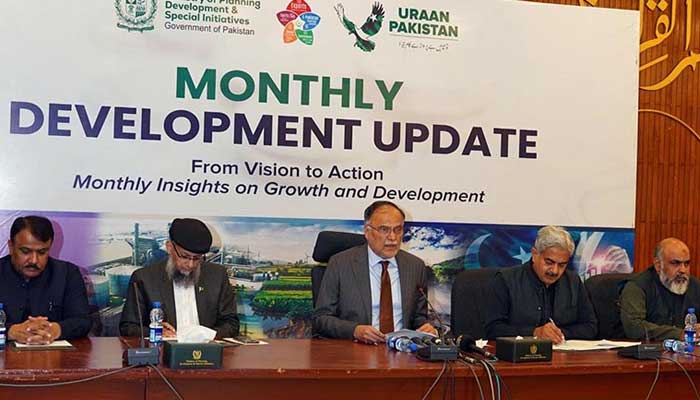
At its core, the strategy boils down to a stark choice: stick with loans from the IMF and allies, or pivot to productivity and export-driven growth to ditch the Washington lender for good. “There is no other choice but to increase exports to $60 billion within four years and cross $100 billion by 2035,” Iqbal said while unveiling the Monthly Development Update for December 2025. “With a status quo approach, the country’s GDP will stand at $600 billion, but it needs to reach the $1 trillion mark. If our neighboring country’s economy can reach $9 trillion, then why can Pakistan not reach $1 trillion?”
The Dar-led committee will map out a path to sustain the economy beyond the $7 billion Extended Fund Facility’s expiration, shifting focus from low-value goods to high-value exports in targeted industries. Iqbal highlighted potential for $20 billion in near-term gains and district-specific plans hashed out with trade groups.
Pakistan needs “Arshad Nadeem-like players” in exports to vault ahead, he added, invoking the Olympic javelin champion as a symbol of breakthrough success. Iqbal stood by the 3.7% GDP growth in the July-September quarter—verified by UN and IMF metrics—with agriculture up 2.9%, industry surging 9.4% and services at 2.4%. Large-scale manufacturing rebounded 5% through October, despite floods and supply snags.
Exports hit $16.6 billion in the first half of the fiscal year, while remittances climbed 10.5% to $19.7 billion, signalling trust from abroad in the government’s steady hand. Inflation averaged 5.2% from July to December, down from 7.2% a year earlier, though it ticked up to 5.6% last month. Federal tax collections rose 9.5% over the period, with a 7.3% bump in December, but the fiscal deficit widened to 0.8% of GDP through November from 0.03% before. On spending, Public Sector Development Program authorisations reached Rs356 billion, with Rs314 billion sanctioned and Rs210 billion deployed in the first half—up from Rs148 billion last year.
Beyond exports, Iqbal touched on broader fronts: pursuing knowledge corridors with the US and China for 10,000 scholarships each; advancing olive and tea commercialisation to cut imports; and a polio eradication drive backed by $638 million from Pakistan and $2 billion from Bill Gates, aiming to join 118 virus-free nations soon.
Copyright © 2021 Independent Pakistan | All rights reserved