By Staff Reporter
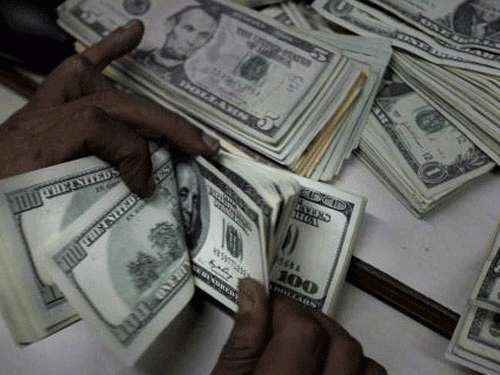
ISLAMABAD: Pakistan took on $16.2 billion in fresh foreign loans in the fiscal year through June, more than the government borrowed a year earlier, as a widening trade gap and weak foreign investment left Islamabad reliant on Gulf and Chinese creditors to keep its finances afloat.
The increase, disclosed in a provisional report from the Ministry of Economic Affairs released on Friday, came even as the government has pledged under its International Monetary Fund program to reduce dependence on external borrowing. Nearly all of the new debt went to plugging the budget deficit, repaying maturing loans and building reserves — just 13% was used to fund development projects, the kind of spending the loans are typically meant for.
The borrowing figure doesn’t tell the full story. Separately, Pakistan rolled over $5 billion in Saudi deposits and $4 billion in Chinese deposits during the year, along with $2.2 billion from the IMF that wasn’t captured in the ministry’s own disbursement sheet — bringing total external financing closer to $27 billion once those rollovers are counted. Neither Saudi Arabia nor China has shown signs of calling in the debt; both keep extending it, at rates far above what Pakistan pays multilateral lenders.
Saudi Arabia has placed $8 billion in cash deposits with the State Bank of Pakistan, charging 4% to 4.5% interest, funds Islamabad has rolled over each time they’ve matured because it lacks the reserves to repay them outright. The rollover terms have been getting shorter even as the deposit balance holds steady, a sign Riyadh is tightening its exposure even as it keeps the money in place. China has $4 billion on deposit at rates above 6%, and separately guaranteed $393 million in loans during the year, mostly for asset purchases.
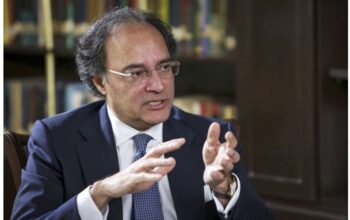
Finance Minister Muhammad Aurangzeb said a day before the data was released that Pakistan was on track to roll over a separate $3 billion in Saudi funding extended in April for three months. The rollovers matter beyond Pakistan’s balance sheet: continued support from Riyadh and Beijing is effectively a condition for the IMF program to hold, since a failure to roll the deposits over would open a financing gap the fund would need to see closed before approving further disbursements.
The central bank’s gross reserves stood at $18.5 billion at the end of June, built mostly from rollovers, loan refinancing and dollar purchases in the open market rather than from exports or investment. Exports fell 6% over the year to $30 billion, the Pakistan Bureau of Statistics said, leaving a roughly $40 billion gap against imports. Foreign direct investment stayed below $2 billion. The current account, which had run a $1.84 billion surplus a year earlier, slipped to a $139 million deficit, as record remittances weren’t enough to offset the import bill.
Commercial borrowing also fell short. The government raised $1.9 billion in commercial loans — $1.7 billion refinanced through China Development Bank and roughly $200 million from Standard Chartered’s London desk — against a $3 billion target. Pakistan returned to international bond markets after a multiyear gap, raising $1 billion through a $750 million Eurobond and a $250 million Panda Bond, the latter backed by guarantees from the Asian Development Bank and the Asian Infrastructure Investment Bank because Pakistan’s own credit rating remains sub-investment-grade. The government also pulled in more than $3 billion through its Naya Pakistan Certificate program, a diaspora savings scheme that carries a steeper cost of capital than most of the multilateral financing on the ministry’s books.
Multilateral lenders disbursed roughly $7 billion combined. The Asian Development Bank provided $1.8 billion, about $400 million less than the year before, though it was the single largest source of funding in June alone, disbursing $953.7 million. The World Bank released close to $2 billion, and the Islamic Development Bank $1 billion. Saudi Arabia separately provided $1 billion under an oil financing facility at 6% interest that expired in April; Pakistan is now negotiating a $6.7 billion replacement facility with a 15-year term.
Pakistan’s debt-to-GDP ratio and its gross financing needs both remain above levels the IMF treats as sustainable — a gross financing need above 15% of GDP is generally considered a red flag, and the finance ministry’s own projections show Pakistan staying above that mark through the medium term. The IMF has penciled in $21.2 billion in gross external financing needs for the current fiscal year, rising to $30 billion the year after — a period that falls outside the current IMF program, which expires in September 2027. That gap leaves Islamabad with limited room to misjudge its next round of rollovers.
Copyright © 2021 Independent Pakistan | All rights reserved