By Staff Reporter
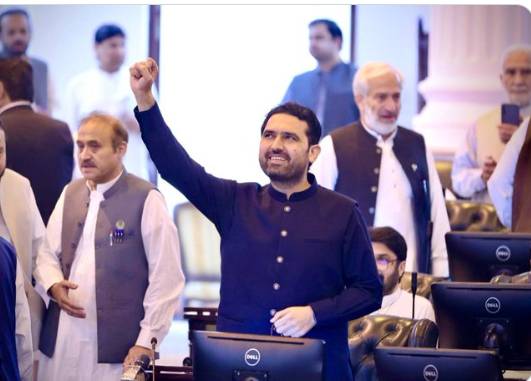
PESHAWAR: The Peshawar High Court on Tuesday directed the governor of Khyber Pakhtunkhwa Province to administer the oath of office to the newly elected chief minister, Sohail Afridi, by 4 pm on Wednesday, amid a deepening constitutional tangle over the resignation of his predecessor that has left the province in administrative limbo.
The order, issued by Chief Justice S M Attique Shah, came in response to an application from Afridi’s party, Pakistan Tehreek-e-Insaf, which sought to nominate the provincial assembly speaker or another suitable person to swear in the chief minister-elect if the governor failed to do so. The court specified that if Governor Faisal Karim Kundi did not comply, the assembly speaker, Babar Saleem Swati, should perform the duty.
The decision capped a day of legal maneuvering in the high court, where lawyers for the PTI and the governor presented arguments over the validity of the resignation of the outgoing chief minister, Ali Amin Gandapur, also a PTI member. Gandapur stepped down on Oct. 8 at the direction of the party’s founder, Imran Khan, setting off a chain of events that has exposed tensions between the PTI-controlled provincial government and the federally appointed governor.
In its written order, the court noted that Gandapur had “unequivocally affirmed” his resignation on the floor of the provincial assembly. “In light of the certified copy of the transcript of the speech, […] it is manifest that the office of the chief minister stood vacated with effect from” Oct. 8, the order stated. Citing Article 130(5) of the Constitution, which requires a newly elected chief minister to be sworn in by the governor before assuming office, the court emphasised that it was “the constitutional obligation of the worthy governor to administer the oath of office to the newly elected chief minister without delay or obstruction.”
“Certainly, upon his failure to administer oath to the newly elected chief minister within a reasonable time, it would be construed that such circumstances have arisen rendering the administering of oath to the newly [elected] chief minister impracticable in terms of Article 255 of the Constitution,” the order read. The court expressed confidence in the governor’s compliance, based on assurances from Additional Attorney General Sanaullah, who represented him. “This forum further trusts that no impediment shall be caused in the administration of oath, and that the process will be completed without any further delay,” it added.
But in a contingency measure, the order invoked Article 255(2), nominating the assembly speaker to step in if necessary. “This direction is issued to uphold the sanctity of the Constitution, to ensure continuity in governance, and to prevent the constitutional vaccuum in the Province of Khyber Pakhtunkhwa,” the court said.
The governor had returned two resignation letters from Gandapur over “disparate signatures” and summoned him to appear on Oct. 15 to resolve the matter. The PTI, however, insists that under the Constitution, a chief minister’s resignation does not require the governor’s approval. During the hearing, PTI counsel Salman Akram Raja questioned the governor’s scrutiny of the signatures. “Why did the governor want to verify Gandapur’s signatures,” Raja contended, accusing the opposition of intending to “create difficulties.”
The chief justice observed that Article 255 had been amended to address such issues. Addressing the governor’s lawyer, Amir Javed, he asked: “Can you guarantee that the governor will be present tomorrow and administer the oath?” Javed informed the court that he had spoken to the governor multiple times over the phone the previous day. The governor, he said, would decide on Gandapur’s resignation if legal conditionalities were met.
Javed cited Article 130(7), which states: “The chief minister shall hold office during the pleasure of the governor, but the governor shall not exercise his powers under this clause unless he is satisfied that the chief minister does not command the confidence of the majority of the members of the provincial assembly, in which case he shall summon the provincial assembly and require the chief minister to obtain a vote of confidence from the assembly.”
He also referenced Article 48, which outlines the president’s duty to act on advice. Javed assured the court that the governor would make a decision on Wednesday in accordance with the Constitution and requested a delay until 3 pm.
The chief justice pressed further, asking, “Who is running the province at the moment?” He also inquired whether the election schedule for the chief minister’s post had been challenged, to which Javed replied that Saturday and Sunday were off days for the court, which was why the schedule wasn’t challenged. Sanaullah told the court that the governor was out of the city and had informed him that his flight to Peshawar was scheduled for Wednesday. “He said he does not have a private plane […] and the provincial government could send him helicopter to arrive in the city today,” Sanaullah said.
The advocate general requested the court to nominate someone to swear in Afridi and ensure the oath-taking occurred on Tuesday. The court had directed Sanaullah on Monday to confirm whether the governor had received the summary related to Afridi’s oath-taking from the assembly secretariat and to submit a reply on Tuesday.
Afridi was elected on Monday in a session boycotted by the opposition, amid the dispute over Gandapur’s resignation. The opposition walked out, and candidates from Jamiat Ulema-e-Islam-Fazl, the Pakistan Peoples Party and the Pakistan Muslim League-Nawaz received zero votes, while Afridi secured 90.
Earlier on Tuesday, Jamiat Ulema-e-Islam-Fazl leader Maulana Lutfur Rehman, one of the opposition candidates, filed a petition in the Peshawar High Court seeking to set aside Afridi’s election as “ab initio void.” The petition argued that the election was “wholly unlawful, arbitrary, capricious, mala fide, without jurisdiction, coram non judice.”
Rehman questioned how an election could proceed without Gandapur’s resignation being accepted, citing Article 130(8). He urged the court to declare decisions by the assembly and speaker on the appointment as “without lawful authority, void, and of no legal effect,” and to suspend the result until the governor had “lawfully received and verified” the resignation. The petition called for a fresh election “in accordance with the Constitution and the assembly rules, after lawful confirmation of vacancy.”
The crisis traces back to Oct. 8, when Khan directed a change in leadership. Gandapur submitted a typed resignation on official letterhead, which the Governor’s House initially denied receiving. He later sent a handwritten version, acknowledged by Kundi on Oct. 11. Late on Oct. 12, the governor returned both letters over signature discrepancies and summoned Gandapur for Oct. 15.
Copyright © 2021 Independent Pakistan | All rights reserved