By Staff Reporter
ISLAMABAD: Pakistan is on track to sign a staff-level agreement with the International Monetary Fund this week, Finance Minister Muhammad Aurangzeb said, clearing a hurdle for the release of $1.24 billion in funding from the lender.
An IMF mission departed Pakistan last week without inking the accord on the second review of the $7 billion Extended Fund Facility and the first review of the $1.4 billion Resilience and Sustainability Facility, both agreed in 2024 to stabilise the economy after a deep financial crisis. Program performance through June showed mixed results, with the IMF noting “significant progress” toward a staff accord despite the mission’s departure without one.
“The mission was on the ground for a couple of weeks, we had very constructive dialogue with them around the quantitative benchmarks, the structural benchmarks and we’ve been having some follow-up discussions,” Aurangzeb told Reuters in an interview on the sidelines of the IMF and World Bank annual meetings in Washington. “During the course of this week, we’re hoping that we can get the SLA done.”
The agreement is essential for nations in IMF programs, as it precedes executive board approval and the disbursement of the next loan tranche. The IMF deal from September 2024 provided relief to Pakistan’s $400 billion economy, which had been battered by soaring inflation, a plunging currency and a widening external deficit.
Aurangzeb also outlined plans for Pakistan to issue its first green Panda bond, denominated in Chinese yuan, before the end of the year. The government aims to tap international markets in 2026 with a bond sale of at least $1 billion, with the format still under consideration. “Euro, dollar, Sukuk, Islam Sukuk — we’re keeping our options open,” he said.
On privatization, a core element of Pakistan’s reform agenda, Aurangzeb signaled momentum in the fiscal year ending June after lackluster progress last year. “This is something which is very important as part of our economic roadmap,” he said. Advances are underway in divesting three power distribution companies and the state-owned Pakistan International Airlines. “We are quite hopeful,” Aurangzeb said, pointing to renewed interest in PIA after the reopening of profitable routes to Europe and Britain, making it “a very good proposition for the investors.”
The PIA sale would be Pakistan’s first significant privatization in roughly two decades. An earlier effort failed last year due to a sole undervalued bid, but the government has since attracted expressions of interest from five local groups, including Airblue, Lucky Cement, Arif Habib, and Fauji Fertilizer. Final offers are anticipated later this year.
Earlier today, Aurangzeb met with IMF Middle East and Central Asia Director Jihad Azour to discuss the reform agenda. Before traveling to the US, the minister had voiced confidence that the staff deal would wrap up during his Washington visit.
Officials indicated no urgent requirement for new tax measures to address revenue gaps, though targets could be adjusted based on first-quarter GDP figures expected in late December. Any adjustments to rates or policies would take effect Jan. 1, 2026, to offset first-half shortfalls amid the biannual review cycle.
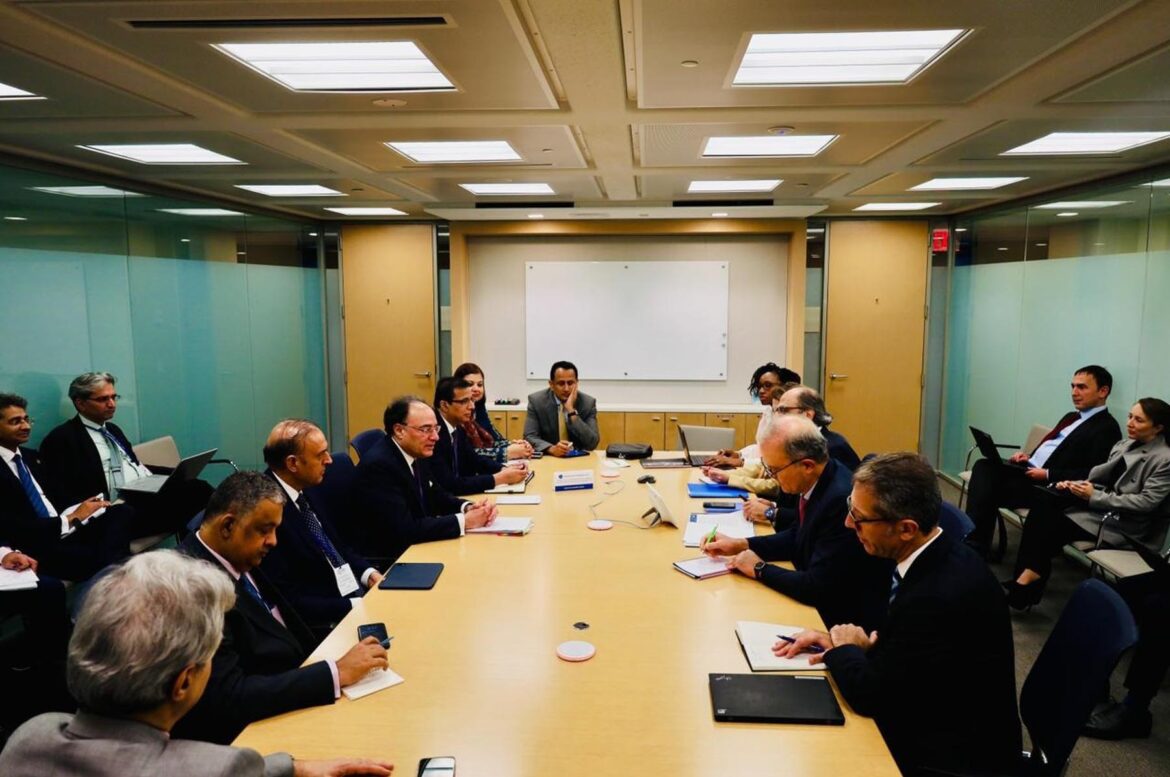
Aurangzeb and Azour led delegation-level talks in Washington, exchanging perspectives on reforms and pledging to maintain reform momentum, according to a finance ministry statement. The session reviewed the second EFF review and stressed the value of fiscal discipline.
In a separate discussion, Aurangzeb engaged extensively with World Bank Senior Managing Director Axel van Trotsenburg, praising the institution’s support for Pakistan’s development goals. “The minister reiterated that the climate crisis remains an existential challenge for Pakistan, referencing the devastation caused by recent floods and their severe impact on the agriculture sector and GDP growth,” the statement said. “He emphasised the need for enhanced investment in climate adaptation and mitigation measures and agreed on the importance of mobilising additional resources to manage future natural calamities.”
Aurangzeb’s US trip, spanning Oct. 13 to 18 for the IMF and World Bank plenaries, gathers finance chiefs, central bankers and development officials. It provides Pakistan a vital venue to lock in the IMF tranche, push reforms and court partners on growth, investment and resilience.
Aurangzeb participated in the Commonwealth Finance Ministers’ Meeting, advocating for actionable steps to foster a resilient Commonwealth. He backed the launch of the Commonwealth Infrastructure and Financial Resilience Hub and a Technical Assistance Fund for peer reviews and capacity enhancement. He highlighted climate financing’s criticality for nations like Pakistan and pressed for activating tools like the Loss and Damage Fund.
Hosted by the US-Pakistan Business Council, Aurangzeb updated attendees on improving macroeconomic metrics, stressing private sector expansion as key to momentum.He affirmed the government’s focus on resolving business hurdles and easing burdens, noting a fresh US trade agreement and optimism for deeper government and business links in mining, agriculture, IT and pharmaceuticals.
In talks with U.S. Assistant Treasury Secretary for International Finance Robert Kaproth and Counsellor Jonathan Greenstein, Aurangzeb emphasized Pakistan’s robust fundamentals backed by the IMF program. He hailed the tariff deal’s closure and updated on legislation for virtual assets, while inviting US firms to invest in oil and gas, minerals, agriculture and IT.
Copyright © 2021 Independent Pakistan | All rights reserved