By Staff Reporter
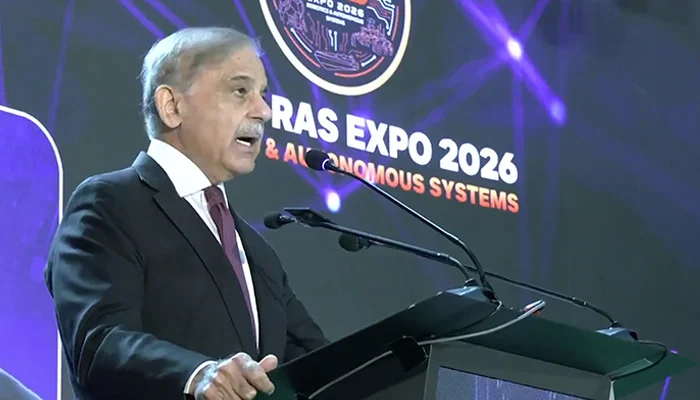
ISLAMABAD: Prime Minister Shehbaz Sharif said on Wednesday that more than 60 percent of Pakistan’s drones are now manufactured domestically, as he opened a two-day robotics and autonomous systems exhibition in Islamabad.
Addressing the Indus Robotics and Autonomous Systems (RAS) Expo 2026 at the Pak-China Friendship Centre, Sharif said the country had made “remarkable progress in developing indigenous autonomous capabilities in the field of defence and security.” He added that some of the simulators on display at the event were “100 percent manufactured and assembled in Pakistan,” and that drone production had “achieved more than 60 per cent indigenisation.”
The expo, running until Thursday, brings together defence organisations, researchers, startups and investors to discuss expanding Pakistan’s robotics industry. It follows the Indus AI Summit, held in Islamabad in February as the centrepiece of a week-long series of AI-focused events, which Sharif said had begun to “shape Pakistan’s journey” in artificial intelligence.
The ceremony was attended by Chief of Defence Forces and Chief of Army Staff Field Marshal Syed Asim Munir, along with federal ministers, industrialists, entrepreneurs, foreign delegates and students.
Two new government schemes
Sharif announced two initiatives during his address. The first, the Spark and Elevate Programme, is intended to turn domestic research into commercial technology and jobs. The second, the Pakistan Venture Fund, has been launched with an initial commitment of $20 million to support investment in the country’s technology sector. He gave no further detail on how either scheme would be run.
He called on universities, research centres, startups, industries and farmers to form what he described as a single national innovation ecosystem, so that “the knowledge behind these technologies is indigenous, owned and continuously advanced in Pakistan.” The advance of robotics and autonomous systems, he said, should not be confined to advanced economies, large corporations or major cities, but should reach “farmers, small businesses, women entrepreneurs, young innovators and underserved communities across Pakistan and the Global South.”
Sharif also said the government needed to put in place “clear, regulatory and ethical frameworks to ensure autonomous systems are safe, secure, transparent and always used for the benefit of mankind.”
Farming and flood relief
Much of the prime minister’s speech dealt with civilian uses of the technology, particularly in agriculture. He said drones flying over wheat fields could detect crop stress and determine, with what he called “incredible precision,” where water, fertiliser and pesticide were needed — addressing what he described as long-standing water scarcity and rising costs faced by farmers. He also pointed to the use of drones during floods, saying the technology had helped reach communities and save lives in areas where roads and bridges had been destroyed.
Military background
Sharif credited Munir’s leadership for the advances made in autonomous defence technology and referred to the military confrontation with India in May 2025, during which Pakistan’s forces used unmanned combat aerial vehicles. He said the armed forces had guarded the country’s “physical and cyber frontiers through the highly effective use of advanced autonomous systems” during that period, crediting Munir alongside Air Chief Marshal Zaheer Ahmed Babar Sidhu and Naval Chief Admiral Naveed Ashraf.
“These remarkable military advancements are an integral part of our national defence,” Sharif said. “They will further strengthen our security architecture, make our defence more impregnable and enhance our resilience against emerging and future threats.”
Pakistan’s military separately uses armed drones in operations against militant groups in the provinces bordering Afghanistan.
Copyright © 2021 Independent Pakistan | All rights reserved