By Staff Reporter
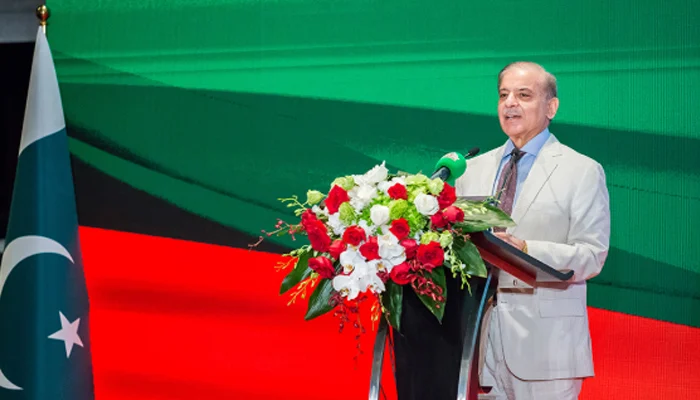
ISLAMABAD: Prime Minister Shehbaz Sharif of Pakistan on Sunday pressed Chinese companies to pour money and expertise into his country’s farms, factories, and mineral riches, framing the push as a practical next step in the two nations’ long alliance and the second phase of the China-Pakistan Economic Corridor.
Speaking at the Pakistan-China Business-to-Business Investment Conference in Hangzhou, Sharif laid out four sectors he said held the greatest promise: agriculture, information technology and artificial intelligence, special economic zones, and mines and minerals. The event, focused on information technology, telecommunications, battery energy storage systems, and agriculture, drew more than 500 companies from both sides and was expected to produce a flurry of cooperation agreements and memorandums of understanding.
Sharif arrived in Hangzhou on Saturday, the first stop on a four-day visit that will also take him to Beijing for meetings with top Chinese leaders. The trip comes as Pakistan and China mark 75 years of diplomatic relations and seek to translate decades of political friendship into deeper commercial results under CPEC 2.0, the infrastructure-and-trade initiative that has already drawn more than $60 billion in Chinese pledges.
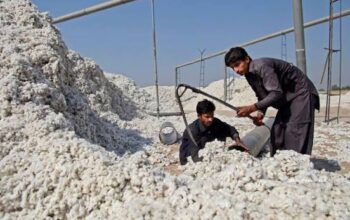
Pakistan, Sharif told the gathering, remains “basically an agrarian economy.” Last year, he said, 1,000 young Pakistanis received advanced agricultural training in China and have since returned home “doing a great job.” He urged both countries to build on that foundation by improving per-acre yields, introducing high-quality seeds, adopting best practices, and embracing mechanization. “China imports every year about $100 billion worth of agricultural products from abroad,” Sharif said. “Pakistan’s share is just a fraction. … We will be able to produce agricultural products as per your requirements.” If the two sides worked together, he added, they could create “massive” job opportunities in Pakistan’s rural areas and spawn “hundreds of thousands” of small and medium-scale entrepreneurs who could export value-added goods to China. Within five to seven years, he predicted, agricultural trade between the countries could rise by about $10 billion. “That is not a big task,” he said. “It can be done, it is possible, not difficult at all — but we need your support.”
Sharif also spotlighted the potential of special economic zones, pointing to a new 6,000-acre development in Karachi where the government has promised “all basic amenities,” modern infrastructure, and what he called a “one-window operation.” Chinese and Pakistani entrepreneurs would receive “red carpet treatment” and land on long-term leases at “very attractive terms and conditions,” he said. “We will have a world-class SEZ, and then that model will be replicated elsewhere in Pakistan through your great contribution.”
With labor costs rising in China and the country shifting toward higher-tech industries, Sharif invited Chinese investors to relocate manufacturing operations to Pakistan through joint ventures. Goods produced there — in textiles, leather, or other sectors where Chinese costs have become less competitive — could then be exported to third countries, he said, creating “a win-win model for Chinese and Pakistani entrepreneurs alike.” “This will be … a roaring success in times to come.”
He urged Chinese business leaders to visit Karachi’s export zone themselves. “Be our guest; we’ll play host to you, and you’ll have great opportunities to understand business propositions.” Sharif also noted Pakistan’s “huge potential” in information technology and artificial intelligence, as well as its substantial deposits of minerals and gemstones. On Sunday, a separate announcement underscored the mining pitch: Pakistan Salt Corporation signed a long-term strategic cooperation agreement with China National Salt Industry Group to develop the country’s rock salt reserves. The deal, facilitated by Pakistan’s Special Investment Facilitation Council and the Ministry of Energy’s Petroleum Division, calls for technology transfer, advanced mining methods, local processing, and integration into global supply chains. Chairman Shen Xiaojun of China National Salt Industry Group said the pact “opens new avenues for mutual growth.”
Throughout his address, Sharif emphasized that Pakistan is seeking “expertise, experience, investments — not loans, not aid, not handouts.” “Handouts [and] aid never made a nation vibrant, never made a nation stand on its own feet.” He praised President Xi Jinping’s “dynamic leadership” and described the bilateral friendship as deeper than the ocean and higher than the Himalayas, adding that it had reached “new heights” since the launch of China’s space program. The prime minister said billions of dollars in memorandums of understanding had already been signed in Shenzhen and Hangzhou, and that roughly 30 percent had been converted into binding agreements.
Later Sunday, Sharif was scheduled to meet heads of leading Chinese companies and visit Alibaba Group headquarters, where cooperation agreements between the company and the Pakistani government are to be signed. A parallel diplomatic track unfolded in Beijing, where Deputy Prime Minister and Foreign Minister Ishaq Dar arrived on Sunday with Planning Minister Ahsan Iqbal. Dar, who was received by Vice Minister Sun Haiyan of the International Department of the Communist Party of China Central Committee, will serve as chief guest at the second Pakistan-China Political Parties Forum and the fourth CPEC Political Parties Joint Consultation Mechanism.
Earlier in the day, Dar addressed the investment conference in Hangzhou, telling participants that more than 500 companies from both countries were present. “You are the driving force behind this partnership,” he said. “This conference belongs to you: it is for you, and because of you.” Dar highlighted the Pakistani government’s focus on economic stabilization and growth. “Over the past four years, we have achieved economic stabilisation, and the economic trajectory today is firmly upward, despite external headwinds.” He also pointed to a successful joint venture between Pakistan’s Servis Group and China’s Long March Tyres, which he said is on track to become a billion-dollar enterprise within five years.
Copyright © 2021 Independent Pakistan | All rights reserved