By Staff Reporter
Sir Garfield Sobers, the West Indies cricketer acclaimed across the sport as the finest all-rounder the game has produced, has died at his home in Barbados. He was 89, his death coming just 11 days before what would have been his 90th birthday.
Cricket West Indies announced his passing on Friday in a brief statement: “A great innings has come to an end. In our hearts, now and forever, Sir Garfield Sobers.”
Sobers’s command of the game was total. He was a Test batter of the highest class, could bowl left-arm pace, orthodox left-arm spin or wrist-spin, and fielded, often at short leg, with a courage and reflex that made him one of the finest close catchers the sport has seen. It was this range that prompted Sir Donald Bradman, in one of the most quoted lines in cricket, to call him a “five-in-one cricketer”. Richie Benaud, the former Australia captain and broadcaster, went further, writing that Sobers was “a brilliant batsman, splendid fielder, particularly close to the wicket, and a bowler of extraordinary skill, whether bowling with the new ball, providing orthodox left-arm spin or over-the-wrist spin.”
Garfield St Aubrun Sobers was born in Bridgetown on 28 July 1936, one of six children raised largely by his mother, Thelma, after his father, a merchant seaman, was killed when his ship was torpedoed by a German U-boat in 1942. Sobers was five years old. He was born with an extra finger on each hand, both later removed in childhood, and as a boy excelled across sports, playing basketball, football and golf to a high standard alongside cricket.
He was recruited into local club cricket in his early teens, turned out for the Barbados police at 15, and made his first-class debut a year later, in January 1953, against a touring India side at Kensington Oval — the Bridgetown ground whose pavilion now bears his name. Selected primarily as a bowler, he took four wickets in the first innings and three in the second, helping enforce the follow-on.
His Test debut came 14 months later, in 1954, when West Indies’ regular left-arm spinner Alf Valentine fell ill before the final match against Len Hutton’s England at Sabina Park in Jamaica. Sobers, only 17, scored 14 and 26 batting at No 9 and took four wickets in England’s first innings.
He was drafted into the middle order the following year against Australia, and it was against Pakistan at Sabina Park in 1958 that he wrote himself into cricket’s record books. Coming in at No 3, the 21-year-old shared a stand of 446 with Conrad Hunte and remained unbeaten on 365 when West Indies declared — surpassing the Test record of 364 set by Hutton two decades earlier. The mark stood for 36 years, until Brian Lara passed it with 375 against England in Antigua in 1994, with Sobers present at the ground to shake his hand.
“I had to be there for Brian,” Sobers told the Guardian in 2002. “There was a lot of pressure on him, people telling him not to break the record, to preserve it for the legend. So I spoke to him in the dressing room during his innings and said: ‘Go out and do it, man.’ Records are there to be broken. I don’t cling to the idea that nobody else can do that.”
The innings at Sabina Park was the start of a purple patch: Sobers scored five further centuries in his next five Tests and, as his bowling matured across all three of his styles, established himself through the 1960s as the outstanding all-rounder in the world game.
He captained West Indies in 39 Tests between 1965 and 1972, succeeding Frank Worrell, the side’s first black captain, at the age of 28. In the summer of 1966 he led West Indies to a 3-1 series win in England, contributing 722 runs, three centuries and 20 wickets himself. He was also part of Worrell’s celebrated 1960-61 touring party to Australia, a series remembered for the first tied Test in history, in Brisbane, where Sobers made 132 in the first innings; he finished that series with 430 runs and 15 wickets.
With South Africa isolated from international sport because of apartheid, Sobers captained Rest of the World XIs against England and Australia in place of cancelled tours. Bradman himself described a Sobers double century for the Rest of the World against Australia in Melbourne in 1972 as “probably the greatest exhibition of batting ever seen in Australia”. Sobers later apologised for a decision, criticised at the time in the Caribbean, to play a competition in white-minority-ruled Rhodesia in 1970.
It was in England, however, that Sobers produced the feat for which he is perhaps most widely remembered outside Test cricket. Having signed for Nottinghamshire as captain in 1968, he was looking to force quick runs against Glamorgan at Swansea on 31 August that year when he took on the seamer Malcolm Nash, who was experimenting with left-arm spin. Sobers hit all six balls of the over for six, becoming the first batter in first-class cricket to achieve the feat. He was briefly thought to be out from the fifth ball, caught by Roger Davis at long-off, before the fielder was seen to have toppled over the boundary rope with the ball in hand, and six was signalled.
Nash, who died in 2019 and remained a friend of Sobers’s, later recalled the ferocity of the striking. “He hit them all pretty cleanly except one. The second ball was pretty dramatic. It nearly destroyed the [nearby] pub after hitting the guttering,” he said. “It went like a tracer bullet and was still going up when it hit the building.” The feat has been matched only once in first-class cricket, by India’s Ravi Shastri in 1985.
Away from his statistics, Sobers’s career had its complications. In 1962 a car he was driving collided with a cattle truck in Staffordshire; his West Indies team-mate Collie Smith, asleep in the back seat, suffered spinal injuries and died three days later, and Sobers was found guilty of careless driving. Six years later, as West Indies captain in a Test against England in Trinidad, a sporting declaration — driven, some suggested, by his taste for a gamble — allowed England to complete an unlikely victory and win the series, a decision that drew criticism at the time.
By the time he retired from first-class cricket at the end of the 1974 county season with Nottinghamshire, Sobers had played 383 first-class matches for West Indies, Barbados, Nottinghamshire and South Australia, scoring 28,314 runs at an average of 54.87 and taking 1,043 wickets at 27.74. In 93 Tests he scored 8,032 runs at 57.78 — among the highest Test averages in history for a player with more than 5,000 runs — with 26 centuries and 30 half-centuries, and took 235 wickets at 34.03, including six five-wicket hauls. His international career predated the growth of one-day cricket almost entirely; he played only once in the format, for West Indies against England at Headingley in 1973, and was out for a duck.
Sobers was knighted for services to cricket by Queen Elizabeth II in 1975, in an investiture at the Garrison Racecourse in Barbados, close to his childhood home in the parish of St Michael. He was later named a National Hero of Barbados by the country’s parliament, and in 2000 was placed second, with 90 of a possible 100 votes, behind only Bradman on Wisden’s list of Five Cricketers of the Century, ahead of Sir Jack Hobbs, Shane Warne and Sir Viv Richards.
He went on to coach Sri Lanka during their early years as a Test nation, and pursued a lifelong enthusiasm for golf, taking up the sport at 25 and eventually playing off a scratch handicap. An annual schools’ tournament bearing his name was launched in 1986; among those who played in it as a boy was Brian Lara, the man who would one day break his Test record. Sobers was an inaugural inductee of the International Cricket Council’s Hall of Fame in 2009, and the governing body’s award for the outstanding men’s international cricketer of the year, introduced in 2004, carries his name.
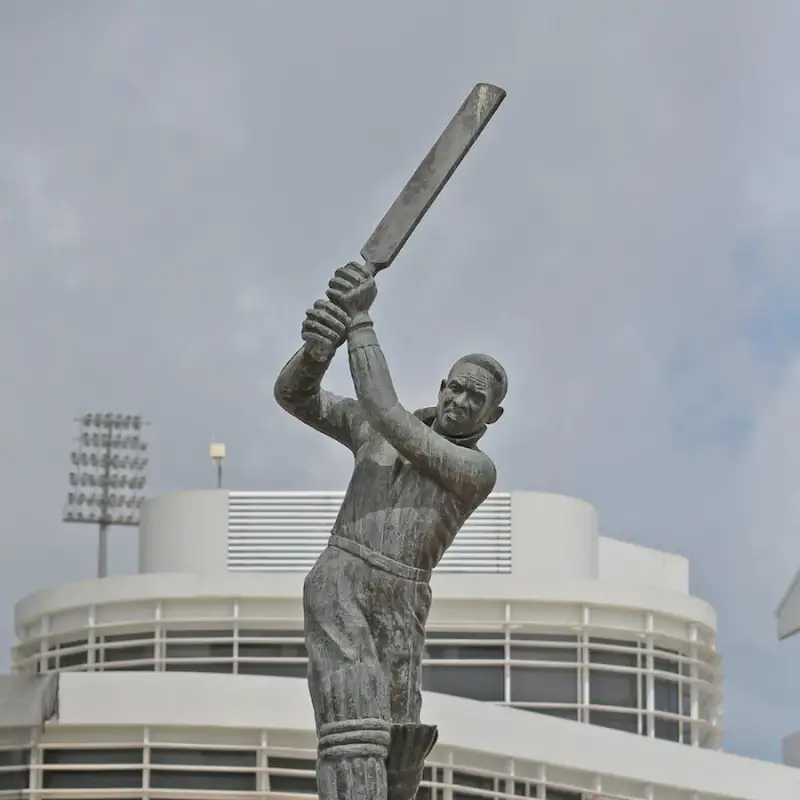
In retirement he was a familiar presence at Kensington Oval, watching West Indies from a wicker chair in the stand named for Worrell, Everton Weekes and Clyde Walcott, beside the pavilion that carries his own name. A statue of Sobers playing a straight drive stands at the same end of the ground.
Sir Garfield Sobers is survived by his family. Cricket lovers who travel to Barbados continue to queue at Kensington Oval to be photographed beside his statue — a small, enduring tribute to the man widely held to be the greatest the game has produced.
Copyright © 2021 Independent Pakistan | All rights reserved