By Staff Reporter
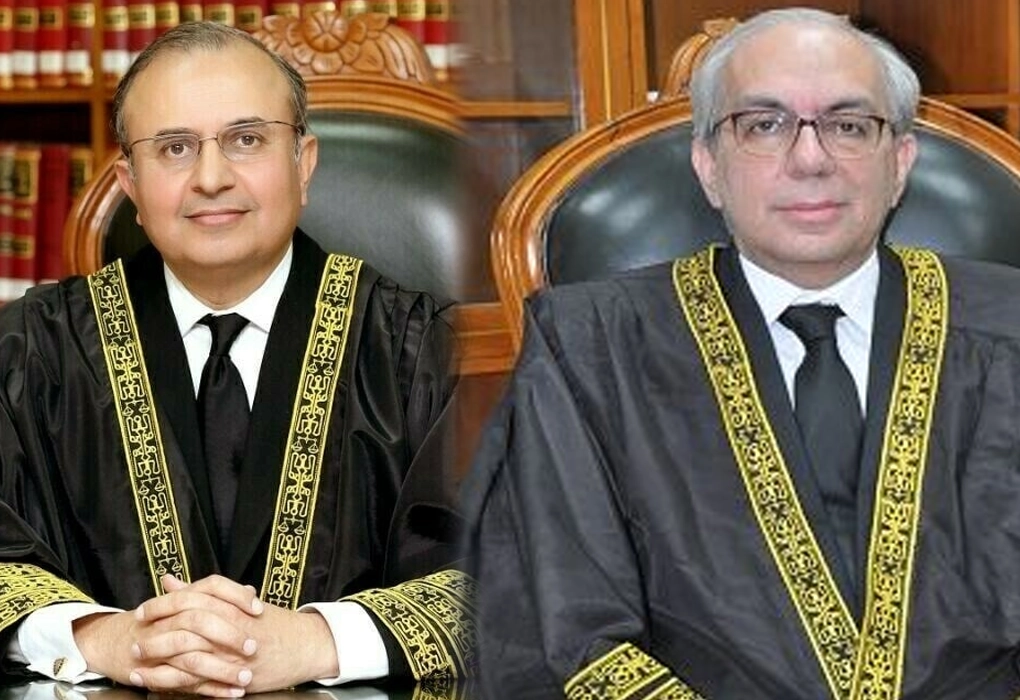
ISLAMABAD: Two senior justices of the Supreme Court of Pakistan have sharply criticised recent amendments to the code of conduct for superior court judges, warning that the changes would curb judicial independence, foster self-censorship and open the door to internal and external pressures on the judiciary.
In a letter to the Supreme Judicial Council, Justices Mansoor Ali Shah and Munib Akhtar described the revisions, approved last week, as transforming “an open and collegial institution into a closed and hierarchical one” and creating “avenues for control, both internal and external.” The amendments, endorsed by the council on Oct. 18, prohibit judges from engaging in public controversy or media interactions, especially on political matters, and impose new limits on their social and diplomatic engagements.
The meeting, chaired by Chief Justice Yahya Afridi, included virtual participation by Justices Shah and Akhtar, with Lahore High Court Chief Justice Aalia Neelum and Islamabad High Court Chief Justice Sardar Muhammad Sarfraz Dogar attending in person.
The justices’ objections, detailed in their latest correspondence to the council’s chair and members, build on unsigned written comments they submitted at the meeting’s outset in a letter dated Oct. 17. They later revised those remarks to address what they called the “unfortunate and constitutionally inappropriate development” of the National Judicial Policy-Making Committee discussing the code beforehand, a matter they said “lies solely and exclusively within the jurisdiction of the SJC.”
Among their chief concerns was the revision to Article V of the code, which bars judges from speaking, writing, debating or commenting publicly on controversial matters and on political questions, even where questions of law arise. “The phrases ‘public controversy’ and ‘political questions’ are undefined and could encompass nearly every matter of constitutional or legal significance,” the justices wrote.
They expressed apprehension that the “fear of being accused of ‘public controversy’ will compel judges to remain silent on matters of constitutional importance, even outside the courtroom.” “This self-censorship undermines intellectual growth within the judiciary and weakens the development of constitutional jurisprudence,” they added.
The justices outlined 10 “weaknesses and risks” posed by the amendments to Article V alone, including a ban on “any interaction with the media,” which they said “amounts to a gag order, imposing total silence and insulating the institution from public scrutiny.” They also objected to a new rule requiring judges to “not cause any judicial or administrative matter to be discussed publicly,” arguing that it shields the judiciary from external accountability and disables judges from defending the institution publicly.
Such a provision “could be selectively invoked against outspoken judges, particularly those critical of executive overreach or internal mismanagement,” creating a “chilling effect” and opening the door to disciplinary misuse, the justices cautioned. “In Pakistan’s fragile democratic environment, such a clause can be easily weaponised by executive or establishment forces through compliant leadership to silence independent voices within the judiciary,” they wrote. “During ‘testing times’ for democracy, judicial independence requires openness, moral courage — not silence or conformity.”The insertion of Article XIX drew further criticism.
It establishes an “institutional response” for judges facing “influence,” mandating that they report to their respective chief justice, who would then inform the chief justice of Pakistan. “In the current political and institutional climate — where pressures on the judiciary are widely perceived — such a mechanism can be manipulated to suppress legitimate whistleblowing by judges who resist external interference,” the justices said.
They also opposed the incorporation of 2003 council resolutions and guidelines, which include a bar on attending social, cultural, political and diplomatic functions, saying it “reduces the judiciary’s visibility and connection to the community.” Another clause deems the soliciting of invitations to conferences or meetings from foreign or international bodies as misconduct. The justices criticized this, noting that judges attend such seminars to “enhance comparative learning and professional competence — activities that strengthen judicial capacity, not diminish it.”
Beyond the substance of the changes, Justices Shah and Akhtar raised procedural reservations about the approval process. In an earlier letter dated Oct. 13, they had proposed postponing the meeting or reconstituting the council, citing a pending Supreme Court challenge to the seniority and status of Justice Dogar in his high court. “The outcome of that case will directly determine his eligibility to serve as a member of the Supreme Judicial Council,” they wrote.T
hey also highlighted that the 26th Amendment to the Constitution remains under challenge before the Supreme Court. “Until that matter is decided, the status of the chairperson and one of the members is sub judice. Constitutional propriety therefore requires that no amendments to the Code be undertaken until that issue is settled,” the justices said. The Oct. 13 letter noted, “While we would obviously not wish to comment on sub judice matters, it goes without saying that there is always an inherent uncertainty involved in any litigation, no matter how sanguine one may be about the outcome.”It added that the decision in that case could directly affect Justice Dogar’s membership of the council, and consequently its composition.
The justices suggested it would be appropriate “if Justice Dogar recuses himself, then the council may proceed with its meetings/proceedings.” “The decision in those proceedings can directly affect the Hon’ble Judge’s membership of, and consequently the composition of the Council,” they wrote.Justices Shah and Akhtar further noted that since “three chief justices participating today (October 18) are ex officio members of both the NJPMC and the SJC, their participation in approving the amendments at the NJPMC meant that the majority of the SJC had effectively predecided the matter before it was even placed before the Council.”
Copyright © 2021 Independent Pakistan | All rights reserved