By Staff Reporter
ISLAMABAD: The Supreme Court registry has declined to accept a constitutional petition drafted by four Islamabad High Court judges challenging the validity of the 27th Constitutional Amendment, informing them that the matter now falls exclusively within the jurisdiction of the newly created Federal Constitutional Court, officials said on Thursday.
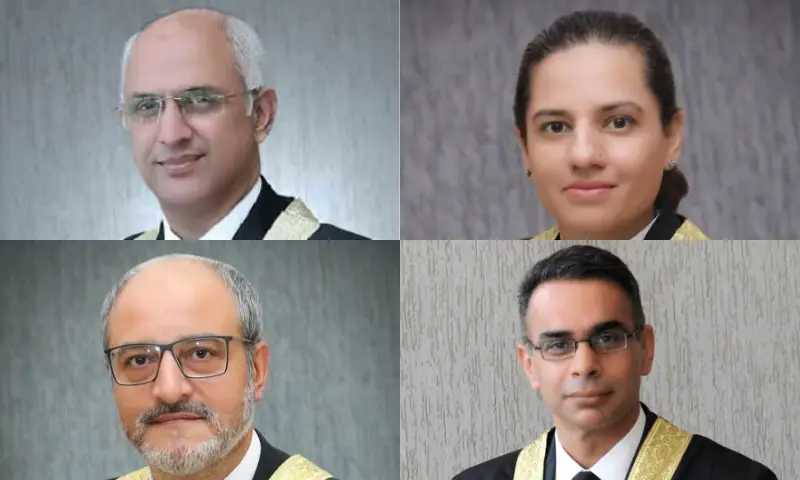
Justices Mohsin Akhtar Kayani, Babar Sattar, Sardar Ejaz Ishaq Khan and Saman Rifat Imtiaz had prepared the petition under the Supreme Court’s original jurisdiction as it existed before the amendment stripped away Article 184(3). When the draft was sent to the registry, officials refused to entertain it, stating that the provision had been deleted from the Constitution and that challenges to constitutional amendments must now be heard by the Federal Constitutional Court.
The attempted filing represents the most direct confrontation to date between members of the superior judiciary and the sweeping constitutional changes introduced by the ruling coalition over the past thirteen months. The same four judges have spent months issuing detailed judicial orders and administrative letters that openly warned of a deliberate, step-by-step erosion of judicial independence, beginning with the 26th Amendment and completed with the 27th.
In the draft petition, the judges argue that the Federal Constitutional Court cannot possibly sit in judgment on the very amendment that brought it into existence. No forum, they contend, can lawfully “judge its own birth.” They insist that the Supreme Court’s inherent power to interpret the Constitution and to protect its salient features cannot be extinguished by constitutional amendment.
The petition specifically attacks the appointment of the Federal Constitutional Court’s chief justice by the president acting solely on the advice of the prime minister, with no consultation whatsoever with the chief justice of Pakistan, a procedure the judges say violates principles repeatedly affirmed by the Supreme Court in the Al-Jehad Trust case and the Sharaf Faridi case.
It further alleges that the initial bench of the new court was effectively handpicked by the executive even before the amendment was passed. The judges describe the Federal Constitutional Court as a parallel supreme jurisdiction that binds every other court in the country while remaining unbound by precedent, an arrangement they say has no parallel in any common-law system.
They warn that the court’s unrestricted power to withdraw any constitutional case from any high court at any stage creates an unacceptable risk of executive domination over constitutional adjudication. The petition also challenges the amendment’s changes to Article 200, which now permit the transfer of high court judges without their consent, measures the judges say expose the superior judiciary to pressure, retaliation, and political manipulation of bench composition.
Additional grounds target the reconstituted Judicial Commission of Pakistan and Supreme Judicial Council, both of which now contain a majority of non-judicial members or judges appointed under the contested framework. The judges argue that the appointment process for superior court judges has been converted from a merit-based system into what amounts to an election conducted by an executive-dominated electoral college.
Taken together, the petition asserts, these alterations violate the constitutional guarantees of due process, fair trial, and equality before the law enshrined in Articles 9, 10A and 25, while fundamentally breaching the separation of powers that forms the bedrock of the 1973 Constitution.
By refusing to accept the filing and directing the petitioners to the Federal Constitutional Court, the Supreme Court registry has placed the four judges in an impossible position: they must either approach a tribunal whose legitimacy they categorically reject or abandon their challenge to changes that, in their considered view, have subordinated the entire judicial branch to the executive.
Copyright © 2021 Independent Pakistan | All rights reserved