By Staff Reporter
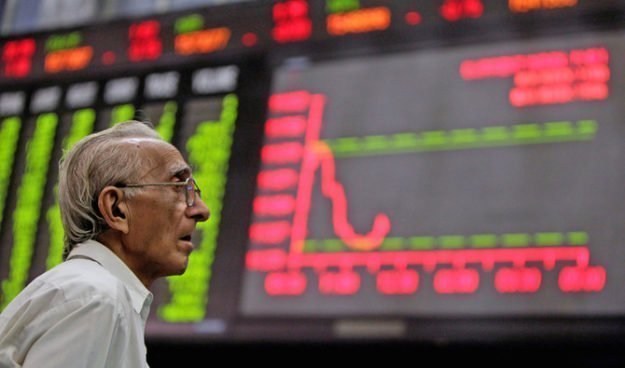
KARACHI: Pakistan’s benchmark stock index suffered its biggest one-day drop on record on Monday after a sharp early plunge triggered a market-wide trading halt, as escalating military conflict in the Middle East sent oil prices soaring and sparked panic selling.
The KSE-100 Index closed at 151,972.99, down 16,089.17 points or 9.57% from Friday’s close of 168,062.16. That marked the gauge’s steepest single-session decline ever. It traded as low as 151,747.96 intraday.
Trading began with chaos as the index tumbled more than 15,000 points within minutes of the 9:17 a.m. open. By 9:22 a.m. local time, the benchmark had crashed 15,071.01 points, or 8.97%, to 152,991.15. That rapid drop in the KSE-30 Index triggered an automatic halt under Pakistan Stock Exchange rules. “All TRE Certificate Holders are hereby informed that due to a 5% decrease in the KSE-30 index from the previous trading day’s close of the same, a Market Halt has been triggered as per PSX Regulations, and all equity-based markets have been suspended accordingly,” the exchange said in a notice. Trading resumed around 10:22 a.m.
The initial rout reflected an overreaction amid selling by a few funds and leveraged players, according to Mohammed Sohail, chief executive officer of Topline Securities. After the halt, some buying emerged as investors realised the market had already fallen about 20% from recent peaks and offered attractive values, he said.
The gauge pared losses to trade down 12,334.88 points, or 7.34%, shortly after resumption and was down 9,164.62 points, or 5.45%, by 11:07 a.m. It climbed as high as 159,328.59 intraday before selling pressure intensified again in the final hours.
Across-the-board declines hit every major sector. Automobile assemblers, cement makers, commercial banks, fertilizer producers, oil and gas explorers, oil marketing companies, power generators and refineries all traded deep in the red. Heavyweights including Habib Bank Ltd., MCB Bank Ltd., Meezan Bank Ltd., Mari Petroleum Co., Oil & Gas Development Co., Pakistan Oilfields Ltd., Pakistan Petroleum Ltd., Hub Power Co. and Attock Refinery Ltd. led the losses.
Volume leaders included K-Electric Ltd., which fell 12.53% to Rs6.70 on turnover of 163.3 million shares; Worldcall Telecom Ltd., down 13.18% to Rs1.12 with 82.6 million shares traded; and First National Equities Ltd., which slumped 20.13% to Rs1.23 on volume of 41.8 million shares. The selloff extended a difficult stretch for Pakistani equities. The KSE-100 fell 5,107.53 points, or 2.9%, last week to close at 168,062.17 amid rising geopolitical tensions and domestic security concerns.
The chaos in Karachi came as the United States and Israel on Saturday launched what they described as a “pre-emptive” joint strike against Iranian targets. US President Donald Trump announced the start of “major combat operations.” Iran responded with missile barrages across the region, with attacks that included strikes killing Supreme Leader Ayatollah Ali Khamenei and other senior officials.
Oil prices jumped on the developments. Brent crude spiked as much as 14% early in the session and briefly topped $82 a barrel before paring gains to settle higher around $76-$77. US crude climbed sharply in tandem. Gold gained as much as 1.6% to $5,360 an ounce as investors sought safety.
The surge in energy costs is particularly painful for Pakistan, analysts said. “Elevated oil prices are highly detrimental to Pakistan’s external account, and persistently high commodity prices are likely to trigger a new wave of inflation,” said Waqas Ghani, head of research at JS Global. AAH Soomro, an independent investment and economic analyst, described the session as “panic mode” that “may last a few days. Keep an eye on Oil. Below 80 should settle the market by Friday.” Topline’s Sohail added that leveraged positions coupled with Iran and Afghanistan positions added fuel to the fire. “The sharp sell-off was driven by escalating geopolitical tensions globally, triggering widespread risk-off sentiment and heavy selling pressure across the board.”
The conflict raised fresh concerns over the Strait of Hormuz, through which about one-fifth of global seaborne oil and LNG passes. Marine tracking sites showed tankers piling up on either side of the waterway, wary of attack or unable to secure insurance for the voyage. The vital chokepoint has not yet been blocked, but the risk of disruption loomed large.
The rout came as Pakistan’s Ministry of Finance kicked off a fresh round of talks with an International Monetary Fund mission. Globally, MSCI’s broadest index of Asia-Pacific shares outside Japan fell 1.2%, though Chinese blue chips held steady. Bourses in the UAE and Kuwait shut, citing exceptional circumstances.
OPEC+ agreed Sunday to a modest output boost of 206,000 barrels a day for April, but any extra barrels still have to navigate potential shipping risks in the region. Trump suggested to the Daily Mail that the conflict could drag on for four more weeks, posting that attacks would continue until US objectives were met.
Copyright © 2021 Independent Pakistan | All rights reserved