By Staff Reporter
ISLAMABAD: A band of onetime leaders from former prime minister Imran Khan’s party joined with other figures on Wednesday to press for face-to-face discussions between the government and opposition to ease the sharp divisions roiling Pakistan’s politics, starting with the freeing of jailed activists as a gesture of good faith.
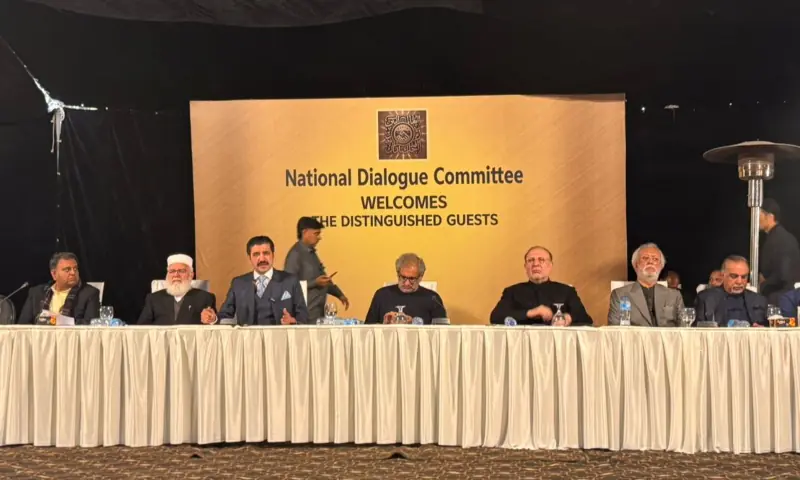
The idea took shape at a meeting in Islamabad put together by the National Dialogue Committee, a fresh outfit led by former members of Khan’s Pakistan Tehreek-e-Insaf like Fawad Chaudhry, the ex-information minister; Imran Ismail, who once served as Sindh’s governor; Dr. Shahzad Waseem; and Mahmood Moulvi.
The session brought together a mix of politicians, journalists, lawyers and thinkers worried about the country’s mounting troubles, from street unrest to a sputtering economy and fresh waves of terrorism. At the end, the group put out a statement laying out a path forward: each side should name a team to handle the talks. On the government’s end, they floated President Asif Ali Zardari, Nawaz Sharif of the Pakistan Muslim League-Nawaz and Prime Minister Shehbaz Sharif as the core figures. For the opposition, the committee would huddle with top leaders now behind bars to pick their lineup, once the government side was set.
To build some trust right away, the statement argued for quick moves like letting go of political detainees and dropping the charges against them. It singled out women in custody, urging the prompt release of Bushra Bibi, Khan’s wife, and Yasmin Rashid, a PTI stalwart, along with proper medical care. The group also wanted an end to the clamps on rallies and campaigns, insisting that everyone get full leeway to operate under the Constitution. They pointed to empty opposition slots in Parliament — the leader of the opposition in both the National Assembly and Senate have sat vacant since Aug. 7 — and said those needed filling fast.
Beyond that, the statement took aim at dragging the military into partisan fights, telling both sides to knock off any bad-mouthing of the armed forces. It demanded a rollback on press controls, too, including the muzzles on TV hosts and outright censorship. It expressed alarm over the country’s political instability, the economic hardships burdening its citizens, limitations on media and political expression, and the ongoing threat of terrorism. It praised the sacrifices of Pakistan’s military, police, Rangers and other security forces in combating extremism, offering prayers for the fallen and their families, while reaffirming national solidarity in defending the nation’s sovereignty and institutions.
Shahid Khaqan Abbasi, the former prime minister now running Awaam Pakistan, spoke up to say the mess belonged to everybody — no one in power, from politicians to institutions, could duck the blame. “Everyone shared responsibility for Pakistan’s deteriorating conditions,” Abbasi said. He tied the economic slump to cracks in the rule of law and media curbs, saying that “a country mired in chaos could not function.” Abbasi noted that hybrid governments had persisted for six decades and stressed that issues extended beyond any single person’s release.
He mentioned the $38 billion in remittances from Pakistanis abroad last year as a stark measure of what’s at stake, and called for a sit-down among leaders from politics, the army, the courts and business to hash things out. For all the talk of love for the country, he added, the powerful had basically seized control of the state.
Sher Afzal Marwat, pushed out of PTI not long ago, drew on history, arguing that Pakistan had never quite grasped what real national security meant. He brought up the Treaty of Hudaybiyyah, a pact from early Islam that showed how bending a little could pay off big in the long run. Talks, he said, were the route to lasting fixes, especially with grudges running so deep now. Marwat insisted that the military should serve as the nation’s strength, not a point of contention, and noted that PTI’s founding chairman had never rejected talks. He advocated focusing negotiations on systemic reforms rather than just freeing Mr. Khan or prisoners at Kot Lakhpat Jail, where figures like Shah Mahmood Qureshi, Mian Mahmoodur Rashid, Ejaz Chaudhry, Umar Cheema and Dr. Yasmin Rashid are held. Though he won his seat under PTI, Marwat admitted that stubbornness had done the party real damage.
Imran Ismail, another PTI veteran, traced the dialogue’s origins to informal efforts a month earlier, now formalised into the committee. He described Pakistan’s political climate as “abnormal” and called for collective action to steer the country toward development. Recalling years of terrorism’s toll, he said unity was vital to confront it.
The National Dialogue Committee’s initiative has gained attention amid recent moves by its leaders, including a November visit by Chaudhry, Ismail and Moulvi to Qureshi during his brief hospital release in Lahore. The committee extended an invitation to the Tehreek-i-Tahafuz-i-Ayin-i-Pakistan, an opposition alliance, but it declined to participate.
Copyright © 2021 Independent Pakistan | All rights reserved