By Staff Reporter
ISLAMABAD: India’s Bihar’s chief minister, Nitish Kumar, has drawn sharp condemnation from across India and Pakistan after a video showed him pulling down the niqab of a Muslim woman during a government ceremony, an act that critics described as a violation of her dignity and religious freedom.
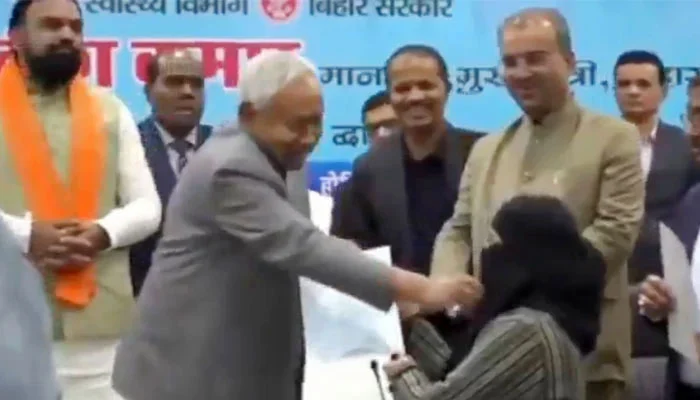
The incident occurred on Monday at the chief minister’s secretariat in Patna, where Kumar was distributing appointment letters to 1,283 newly recruited doctors. As Nusrat Parveen, a Muslim doctor, approached the stage to receive her certificate, Kumar gestured for her to remove her niqab. Before she could respond, he reached out and lifted it himself, exposing her mouth and chin.
The moment, captured on video and widely shared on social media, appeared to startle Parveen. Two men on stage, including Bihar’s home minister, Samrat Choudhary, made half-hearted attempts to intervene, while others laughed, treating the episode as an awkward jest. The 74-year-old chief minister’s actions have ignited outrage, with demands for his apology and resignation echoing from politicians, activists and ordinary citizens in both countries.
Many view the episode not as an isolated lapse but as emblematic of broader disrespect toward Muslims in India. The Human Rights Council of Pakistan issued a strong rebuke, calling Kumar’s behavior “highly shameful, reprehensible, and inhumane.” In a statement posted on X, the council demanded an “immediate, transparent and impartial investigation” by the Indian government. “This incident is not merely an insult to an individual but an open attack on human dignity, religious freedom, women’s personal autonomy, and fundamental human rights, which is unacceptable in any civilised, democratic, and so-called secular state,” the statement said.
The council urged the United Nations General Assembly and international human rights organisations to take notice and press India for accountability. It also called for a formal apology to Parveen at both personal and official levels, along with “robust legal and institutional measures to prevent such incidents in the future.”
In India, Amnesty International condemned the act as “an assault on this woman’s dignity, autonomy and identity.” Aakar Patel, chair of the board at Amnesty International India, said in a statement that “when a public official forcibly pulls down a woman’s hijab, it sends a message to the general public that this behaviour is acceptable.” Patel added that “no one has the right to police a woman’s faith or clothing,” warning that such actions “deepen fear, normalise discrimination and erode the very foundations of equality and freedom of religion.” He called for “unequivocal condemnation and accountability” and “urgent steps to ensure that no woman is subjected to such degrading treatment.”
Political figures joined the chorus of criticism. Zaira Wasim, a former Indian actor, demanded an “unconditional apology” from CM Kumar. “A woman’s dignity and modesty are not props to toy with.” Priyanka Chaturvedi, an Indian politician, highlighted the potential pressure on Parveen, saying she would not be surprised if the doctor claimed “she is okay about it,” as she would face consequences either way.
Aga Syed Ruhullah Mehdi, a member of the Indian Lok Sabha, described the act as “indefensible” and “deeply disturbing,” calling for Kumar’s apology and suggesting he step down due to “erratic” behavior that raised questions about his mental ability. Mehbooba Mufti, former chief minister of Indian occupied Jammu and Kashmir, said Kumar should resign immediately. Akhilesh Yadav of the Samajwadi Party called the move “shameful,” while the opposition Congress party labeled it “unforgivable.”
Indian journalist Mohammad Zubair remarked that if Kumar “had been in his senses,” he would not have done this. Academic Ashok Swain wrote on social media that Prime Minister Narendra Modi’s “rudeness and Islamophobia in India have received official approval.” Human rights activist Deepika Pushkar Nath termed it a serious incident of “sexual harassment.”
On social media platforms like X and Instagram, users condemned the episode as an “abuse of power,” “inappropriate” and “shameful,” emphasising that no authority has the “right to touch or humiliate a woman in the name of protocol or power.” One user likened it to forcefully pulling off a Hindu woman’s sari, while others criticised Bollywood for producing anti-Pakistan films amid domestic mistreatment of Muslims. Some pointed to past Bollywood depictions, such as in “My Name Is Khan,” where the forcible removal of a Muslim woman’s hijab illustrated post-9/11 Islamophobia as cruel and dehumanising.
The niqab, a face covering worn by some Muslim women for religious, cultural or personal reasons, represents a choice that demands respect. Critics noted that even if veiling stems from family or societal pressure for some, it does not justify violating bodily autonomy, especially by a leader in a position of authority. The incident unfolded casually on a formal stage, under state auspices, with laughter in the background, making it particularly jarring. It has fueled calls for a harassment case against Kumar and heightened anguish among minorities.
This comes amid rising concerns over religious discrimination in India. Hate crimes against minorities have increased during Modi’s tenure, according to critics. Last month, the United States Commission on International Religious Freedom recommended designating India as a country of “special concern” for severe violations of religious freedom. The commission’s report highlighted discriminatory policies aligned with the Hindutva ideology of the Bharatiya Janata Party, the political wing of the Rashtriya Swayamsevak Sangh, which has been linked to decades of violence against Muslims and Sikhs.
Copyright © 2021 Independent Pakistan | All rights reserved