By Staff Reporter
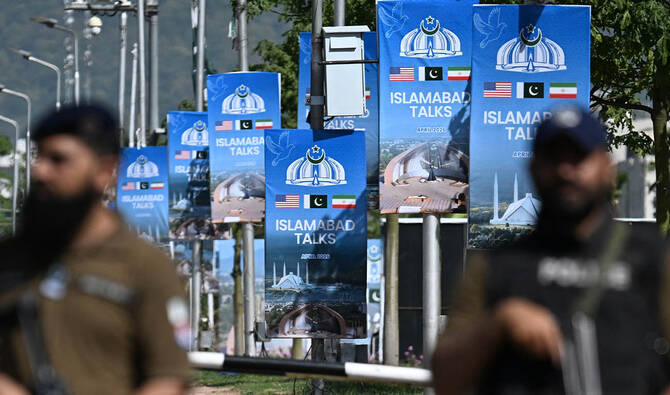
Eight weeks after the United States and Israel launched their war against Iran on February 28, the conflict has settled into precisely the kind of grinding, expensive impasse that Donald Trump once boasted he would never tolerate. American aircraft carriers patrol the Persian Gulf. Iranian ports are under naval blockade. The Strait of Hormuz — the narrow throat through which one-fifth of the world’s oil and liquefied natural gas once moved — is contested by both sides. Oil prices remain roughly 40 percent above prewar levels. Supply chains for fertilizer, petrochemicals, plastics, and agricultural goods are snarled from Asia to Europe. And this weekend, in the Pakistani capital of Islamabad, the two governments are once again circling each other through intermediaries, each insisting it is negotiating from strength while privately acknowledging that neither can prevail on the battlefield or in the marketplace.
The choreography is telling. White House press secretary Karoline Leavitt announced on Friday that special envoy Steve Witkoff and Jared Kushner would travel to Pakistan on Saturday “to engage in talks … with representatives from the Iranian delegation.” The Iranians, she said, had “reached out” and “some progress” had been made. Vice President JD Vance, who led the first round of talks two weeks ago, would remain on standby. Tehran’s response was immediate and pointed. Foreign Minister Abbas Araghchi had arrived in Islamabad the night before, the Iranian foreign ministry said, but there would be no direct meeting with Americans. Araghchi would convey Iran’s “observations” to Pakistani officials and then proceed to Oman and Russia. No Americans in the room. Pakistan would serve as the bridge.
This is not diplomacy in the classic sense. It is damage control wrapped in deniability. But the very fact that both sides have shown up — however obliquely — reveals a truth neither capital wants to admit aloud: the war of choice has produced a stalemate of necessity. Trump’s strategy of maximum pressure, first through sanctions, then through bombing, and now through naval blockade, has failed to break Iran. Iran’s strategy of asymmetric resistance and economic leverage has failed to break the American will. Both governments are bleeding money, prestige, and credibility. Both know the status quo is unsustainable. And both are now searching for a face-saving way to claim victory at home while making the concessions required to end the crisis.
The contradictions in their public statements are almost comic. Defence Secretary Pete Hegseth declared that Tehran still had a chance at a “good deal” if it would simply “abandon a nuclear weapon … in meaningful and verifiable ways.” Trump himself posted on Truth Social that Iran is “collapsing financially,” “starving for cash,” and losing $500 million a day, with its military and police unpaid. The administration has layered on fresh sanctions against 40 vessels and shipping firms in Iran’s so-called shadow fleet and even targeted a major Chinese refinery buying Iranian crude. The message is unmistakable: submit or starve.
Yet the economic data tell a more stubborn story. Before the war began, Iran earned roughly $115 million a day from its crude oil exports. In the month after fighting started — before the full weight of the American blockade imposed on April 13 — those revenues rose by at least 40 percent. Prices for Iranian crude often topped $100 a barrel. Even now, with the blockade in place, Tehran has between 160 million and 183 million barrels of oil already afloat on the world’s oceans, much of it loaded before the naval cordon tightened. Analysts believe the regime can sustain revenue flows into August. It has dragged 30-year-old supertankers out of retirement to serve as floating storage. Onshore inventories can absorb roughly 20 days of current production before cuts become unavoidable. The Revolutionary Guard’s economic reach and Iran’s willingness to sacrifice civilian welfare give the regime a pain threshold the United States clearly underestimated.
Iran’s leaders have responded to American claims of collapse with a disciplined display of unity that should give Washington pause. President Masoud Pezeshkian, First Vice President Mohammad Reza Aref, Foreign Minister Araghchi, and parliamentary speaker Mohammad Bagher Ghalibaf have all rejected any narrative of internal fracture. “There are no radicals or moderates,” Pezeshkian declared. “We are all Iranians and revolutionaries.” Aref insisted that in times of peril the nation becomes “a single hand under one flag.” Araghchi dismissed any notion that the military and political leadership are at odds. The message is consistent and deliberate: the war has not weakened the regime; it has hardened it. Past experience — negotiating with the United States while under pressure or attack — has only made hardliners more distrustful. The very strikes meant to weaken them have instead consolidated their grip. Militarily, Iran has shown surprising resilience. It has relied on asymmetric tools — cyberattacks, proxy pressure, mining the strait, and selective harassment of shipping — rather than direct confrontation with superior American and Israeli forces. It has targeted energy infrastructure across the Gulf and even threatened data centers. The Revolutionary Guard’s “revolutionary fervour,” as former US ambassador to Bahrain, Adam Ereli observed, allows Tehran to tolerate far more hardship than most American planners imagined. Iran is not collapsing. It is enduring.
The United States, by contrast, is operating on multiple clocks that are ticking louder by the day. The 60-day window for military operations without congressional approval expires on May 1. Domestic politics — always Trump’s true compass — will not long tolerate an open-ended naval operation that keeps energy prices elevated and disrupts global trade as midterm elections approach. Trump’s own rhetoric has repeatedly undermined his diplomats. When he claimed last week that Iran had already capitulated on all nuclear demands, Tehran ridiculed the assertion and dug in deeper. The president who tore up the 2015 nuclear accord in his first term now finds himself, after a costly war of choice, confronting the same strategic problem he once promised to solve decisively. The irony is not subtle. International pressure is mounting as well. European Council President Antonio Costa spoke for much of the world when he demanded that the strait “must immediately reopen without restrictions and without tolling.” China has already signalled that it views the interception of vessels carrying its cargo as unacceptable. Gulf allies are growing nervous. The global economy cannot absorb indefinite disruption to one of its most vital chokepoints. The blockade hurts Iran, but the closure of the strait hurts everyone else more.
This is the context in which the second round of talks in Islamabad must be judged. The first round, led by Vance two weeks ago, lasted 21 hours and produced no progress, nor was there any collapse. Since then, Iran has refused to negotiate or reopen the strait while its ports remain blockaded. The United States has insisted it will not lift the blockade without a nuclear deal that is “meaningful and verifiable.” The impasse was inevitable. Pakistan’s role as intermediary is therefore not a sideshow; it is the only practical mechanism available. Islamabad is trusted enough by both sides to create the necessary deniability. Araghchi’s meetings with Pakistani officials, followed by stops in Oman and Russia, show that Tehran is pursuing a multi-track strategy — testing leverage, shopping for support, and keeping its options open. The White House’s decision to send high-level personal envoys, with Vance on standby, signals seriousness even as officials continue to insist they feel “no pressure.”
What is possible in Islamabad? Not a grand treaty. Not even a joint communiqué. But something more modest and more realistic: a mutual recognition that the strait must reopen and that serious nuclear negotiations must resume. The framework is not mysterious. It would begin with simultaneous, verifiable steps — the United States eases its naval blockade while Iran lifts its restrictions on commercial shipping through the Hormuz. That immediate de-escalation would calm markets, restore some revenue flow, and buy breathing room for both economies. The harder nuclear bargain would follow: Iran would accept a lengthy moratorium on enrichment, transfer its stockpile of weapons-grade uranium to a third country, and submit to a strict international verification regime. The United States would have to accept that Iran retains a safeguarded civilian nuclear program rather than demanding zero enrichment or pursuing the chimaera of regime change. The resulting agreement would, in its essentials, resemble the 2015 Joint Comprehensive Plan of Action that Trump himself discarded. The irony is bitter, but it is also instructive. After thousands of air strikes, a naval blockade, and months of global economic pain, the United States has arrived at the same strategic destination it occupied before the war — only now the price of a deal is higher, and the regime in Tehran is more distrustful than ever. Trump’s bluster and volatile claims of Iranian surrender have made compromise harder, not easier. They have strengthened the very hardliners who argue that Washington cannot be trusted. Every maximalist demand from the American side only undermines the moderates in Tehran who might still favour a pragmatic exit.
But the alternative is worse. A prolonged uneasy ceasefire with contested shipping lanes, intermittent sanctions, and the constant risk of miscalculation serves no one’s interests. A tanker collision in the strait, a misinterpreted radar contact, or a proxy provocation linked to Hezbollah in Lebanon could reignite full-scale war in an instant. Hezbollah’s parliamentary leader has already warned against Lebanese concessions to Israel. Israeli Prime Minister Benjamin Netanyahu continues to frame the Lebanon track as vulnerable to sabotage. The same volatile dynamics exist with Iran. Trump’s extension of the ceasefire is indefinite only in name; without a deal, it is merely a temporary truce waiting to collapse.
Iran’s strategy is clear: play the longer game. It believes its higher pain threshold, its asymmetric capabilities, and its control of the strait give it leverage that the United States will eventually lack the political will to match. American analysts such as Frederic Schneider and Kenneth Katzman have noted that Tehran anticipated this siege. It has alternative storage, shadow-fleet workarounds, and a willingness to endure. It is signalling patience while Washington shows impatience. Trump, for his part, appears trapped by his own rhetoric. Having promised decisive victory, he cannot easily admit that the war has produced neither capitulation nor a better nuclear deal. The administration’s public insistence that it feels no pressure clashes with its frantic diplomatic maneuvering. A framework agreement is the only durable exit ramp. It requires both sides to abandon their maximalist positions and settle for the art of the possible. Pakistan cannot impose a solution, but it can create the face-saving space both governments need. If Araghchi’s “observations” include even a conditional willingness to discuss a nuclear moratorium in exchange for sanctions relief and blockade relief, and if the American envoys arrive prepared to listen rather than lecture, then this second round could produce the psychological breakthrough the first round lacked. Details would still require subsequent negotiations — perhaps with European and Chinese participation — but the barrier of mutual distrust would be breached.
The risks of failure are not abstract. They are immediate and potentially catastrophic. The longer the strait remains contested, the greater the chance of an incident that spirals beyond control. The longer the blockade persists, the deeper the economic damage and the louder the domestic political backlash in the United States. The longer the war of words continues, the more entrenched the hardliners on both sides become. Trump once prided himself on understanding the art of the deal. The deal now on offer is the one he rejected in 2018 — imperfect, unverifiable in the eyes of some, but grounded in realism rather than fantasy. After eight weeks of bombing, blockades, and bluster, enough blood, treasure, and credibility have been spent. The meetings in Islamabad this weekend will not produce a signed treaty. They may not even produce a joint statement. But if they produce a mutual recognition that the strait must reopen without preconditions and that detailed nuclear talks must resume without demands designed to guarantee failure, they will have succeeded where force has failed.
Copyright © 2021 Independent Pakistan | All rights reserved