
By Staff Reporter
Pakistan’s large-scale manufacturing (LSM) sector contracted by 0.74% in fiscal year 2025, falling significantly short of the government’s ambitious 3.5% growth target, according to data released by the Pakistan Bureau of Statistics on Friday.
The decline underscores persistent challenges in the industrial sector, which accounts for roughly 8% of the nation’s gross domestic product. The LSM sector, encompassing industries from textiles to automobiles, has struggled to regain momentum after a marginal contraction of 0.03% in FY24, which followed a modest expansion of 0.92% in FY23. The latest figures highlight uneven performance across key industries, with some sectors buoyed by monetary policy easing, while others grapple with structural headwinds.
In a silver lining, LSM output in June 2025 rose 4.14% year-on-year, marking the fourth consecutive month of positive growth. The uptick was largely attributed to the central bank’s decision to lower the key interest rate to 11% earlier in the fiscal year, which spurred demand in select industries. However, the sector’s performance weakened on a month-on-month basis, with a 3.67% decline in June, signaling volatility in the recovery.
The food sector, a significant contributor to LSM, saw a year-on-year decline of 1.83% in FY25. Within the segment, wheat and rice milling bucked the trend with a 6.38% increase, while starch production edged up by 0.59%. Meanwhile, vegetable ghee output fell by 0.94%, cooking oil by 0.33%, and tea production dropped by 2.76%, reflecting subdued consumer demand for processed goods.
Textiles, Pakistan’s largest industrial sector, posted a respectable 2.49% year-on-year growth. Cotton yarn production surged by 7.59%, and cotton cloth output grew by 0.68%, together accounting by weight for more than 80% of the sector’s production. Garment exports, a key foreign exchange earner, climbed by 5.70%, supported by recovering global demand.
The coke and petroleum products sector also contributed positively, expanding by 5.33%. Petrol production rose by 1.68%, high-speed diesel by 10.96%, and kerosene output soared by 23.88%. However, liquefied petroleum gas (LPG) production dipped by 1.59%, and jet fuel oil slumped by 10.19%, likely reflecting weaker aviation demand.
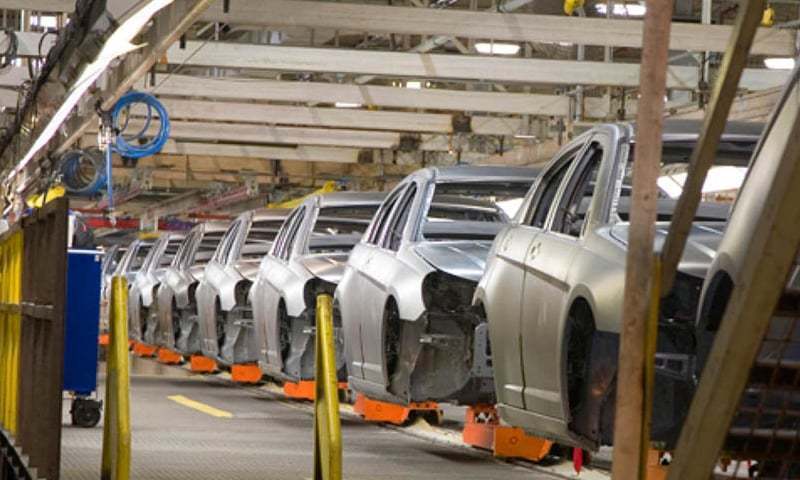
The automobile sector emerged as a standout performer, growing by an impressive 46.15% year-on-year. The surge was driven by a 41.99% increase in cars and jeeps, a 157.73% jump in light commercial vehicles, and a 100% rise in truck production. Bus manufacturing also expanded by 66.41%, though diesel engine output fell by 6.05%, tempering the sector’s gains.
Pharmaceuticals and fertilizers recorded modest growth of 2.74% and 1.69%, respectively, supported by steady domestic demand. However, the iron and steel sector faced significant pressure, contracting by 8.71%. Billets and ingots, critical inputs for construction, plummeted by 21.86%, while hot-rolled sheets, strips, coils, and plates saw a 1.98% decline.
Other sectors, including rubber products, non-metallic minerals, and electrical equipment, posted declines of 1.27%, 7.88%, and 11.65%, respectively, further weighing on the LSM index.
Copyright © 2021 Independent Pakistan | All rights reserved