By Staff Reporter
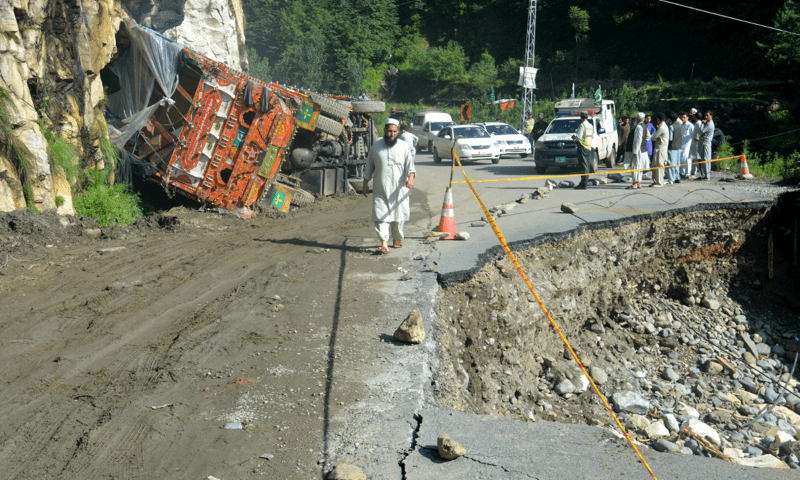
PESHAWAR: Flash floods and landslides triggered by heavy monsoon rains have killed 307 people in Khyber Pakhtunkhwa (KP) province, the Provincial Disaster Management Authority (PDMA) said Saturday, as rescuers struggled to reach isolated communities in the hardest-hit areas.
On Friday, cloudbursts and torrential rains caused devastating floods that claimed over 200 lives in a single day, including five crew members killed when a provincial government helicopter crashed during relief efforts in Mohmand district.
The PDMA reported 279 men, 15 women, and 13 children among the deceased. Buner district suffered the heaviest toll, with 184 deaths in the past 48 hours, including 93 male bodies recovered on Saturday, according to the agency’s daily situation report. Other districts reported significant losses: Shangla with 36 deaths, Mansehra 23, Swat 22, Bajaur 21, Battagram 15, Lower Dir five, and one child drowned in Abbottabad.
Buner Deputy Commissioner Kashif Qayum Khan confirmed the casualties, saying rescue teams were searching for 30 people missing in Chagharzai tehsil, with over 100 injured. “Helicopters are conducting rescue operations in remote areas. Floodwaters completely submerged Pir Baba Bazaar and nearby neighbourhoods,” Khan said.
The PDMA reported 74 houses damaged, 63 partially destroyed, and 11 completely razed, warning that heavy rains are expected to continue until August 21.
Some 2,000 rescue workers are recovering bodies and aiding survivors across nine affected districts, the provincial rescue agency said. “Heavy rainfall, landslides, and washed-out roads are severely hampering aid delivery, especially for heavy machinery and ambulances,” agency spokesman Bilal Ahmed Faizi said. “With most roads closed, rescue teams are travelling on foot to reach remote areas.” Faizi noted that many survivors were reluctant to evacuate due to loved ones trapped in debris or lost in the floods. “They are trying to evacuate survivors, but very few are relocating,” he said.
Floodwaters have destroyed homes, vehicles, and livelihoods, while damaged mobile towers have cut communications, isolating affected regions. Entire villages have been wiped out, with rescue teams racing to reach cut-off areas amid fears of a rising death toll. “The situation is dire, and rescue operations are ongoing to reach stranded residents and provide relief,” said Muhammad Sohail, media coordinator for Rescue 1122.
KP Chief Minister Ali Amin Gandapur declared a state of emergency, with relief efforts coordinated from a control room at CM House in Peshawar. “The Malakand and Hazara regions have been hit by terrible floods due to cloudbursts and rain, resulting in many lives lost,” Gandapur said in a video statement on Friday.
A provincial MI-17 helicopter carrying supplies to Bajaur’s Salarzai area crashed in bad weather over Mohmand, killing two pilots and three crew members. “Two helicopters were rescuing people, but one met a tragic accident. Five crew members were martyred,” Gandapur said, announcing a day of mourning on Saturday, with flags at half-mast and the victims to be buried with full honours. Another MI-17 helicopter reached Buner to evacuate survivors.
Gandapur said district administrations and provincial departments were fully mobilised, with heavy machinery deployed to clear roads. “All affected districts are on high alert, and safety measures are in place,” he added.
The KP Health Department declared a health emergency in Buner, Swat, Mansehra, Abbottabad, Bajaur, and Mohmand, setting up flood control rooms and disease data-sharing centres in hospitals. The move aims “to prevent the outbreak of communicable diseases and monitor health risks,” a notification said, cancelling staff leaves to ensure adequate medical support. Hospitals were ordered to maintain medicine supplies and functional equipment, with each district nominating a focal person for daily health updates.
Prime Minister Shehbaz Sharif ordered the National Disaster Management Authority (NDMA) to launch urgent relief operations in KP and Azad Jammu and Kashmir (AJK), prioritising tents, medicines, and food.
In an emergency meeting in Islamabad, NDMA Chairman Lieutenant General Inam Haider Malik briefed Sharif on the destruction. Sharif directed relief goods be sent by truck and stressed coordination with KP’s government. “In this hour of hardship, our heartfelt sympathies are with the affected people,” he said, pledging full federal support. The Pakistan Army is leading relief in Swat and Bajaur, airlifting residents and delivering supplies to cut-off areas.
In Gilgit-Baltistan (GB), flash floods damaged crops, orchards, homes, bridges, and water channels, particularly in Ghizer’s Yasin Thoi. A landslide on the Baltistan Highway killed a man travelling from Skardu to Gilgit, raising GB’s death toll to 12, government spokesperson Faizullah Faraq said. “This is a testing time for Gilgit-Baltistan. The government is mobilising all resources to assist affected communities,” Faraq said.
Landslides disrupted the Baltistan and Sadpara roads, while Thor in Diamer and Astore valley reported severe damage. The Karakoram Highway remains blocked, cutting links between Gilgit and Rawalpindi, though restored within GB. The Sadpara Dam’s destroyed water channel has shut down power stations, isolating valleys in Diamer and Skardu.
In AJK’s Neelum Valley, floodwaters destroyed six suspension bridges, and a cloudburst in Muzaffarabad killed eight, including six from one family. Landslides blocked the Kohala and Neelum highways, stranding tourists at Ratti Gali base camp. AJK authorities closed schools on August 15 and 16 due to ongoing risks.
Pakistan’s monsoon, delivering about three-quarters of South Asia’s annual rainfall, is vital for agriculture but often deadly. Landslides and floods are common from June to September. NDMA representative Syed Muhammad Tayyab Shah warned that this year’s monsoon started earlier and will last longer.
“The next 15 days will see intensified monsoon activity,” he said. Pakistan, contributing less than one percent of global greenhouse gas emissions, is highly vulnerable to climate change. This summer’s “unusual” rains have killed over 500 people, including 159 children. Punjab recorded 73 percent more rainfall in July than last year, with higher fatalities than the entire prior monsoon. The 2022 floods killed over 1,700 and caused $30 billion in damages. Scientists say rising temperatures are intensifying South Asia’s monsoon, heightening risks in mountainous regions like KP and Gilgit-Baltistan.
Copyright © 2021 Independent Pakistan | All rights reserved