By Staff Reporter
KARACHI: Pakistan’s Lucky Motor Corp. is counting on record fuel prices and widespread rooftop solar adoption to accelerate demand for electric vehicles, as the automaker begins rolling out models from China’s Guangzhou Automobile Group and targets local assembly by the end of 2026.
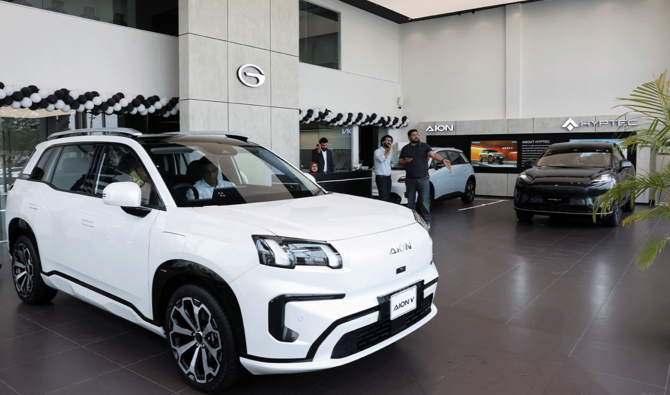
The company started displaying four Aion and Hyptec EV models from GAC across Pakistan this week, its chief executive officer said. Local manufacturing of the vehicles is scheduled to begin as early as December 2026 at Lucky Motors’ Karachi plant, Muhammad Faisal told Reuters in an interview. “Every crisis has an opportunity,” Faisal said. “This crisis has actually helped Pakistani consumers transition fast from conventional fuel vehicles to new energy vehicles.”
Pakistani drivers are facing the sharpest fuel-price increases in years, with pump prices now double the levels of four years ago. The surge stems from supply disruptions through the Strait of Hormuz linked to the US-Iran conflict. GAC becomes Lucky Motors’ third passenger-vehicle brand after Kia and Peugeot, both of which are already assembled at its Karachi facility. Lucky Motors is a subsidiary of Lucky Cement Ltd., one of Pakistan’s largest conglomerates.
Faisal said the initial batch of imported GAC vehicles — which he described only as a “sizeable order” — is expected to sell out within two months. Electric cars still account for only a tiny share of Pakistan’s annual passenger-vehicle sales, a market long dominated by Japanese and Korean brands. The shift toward electrification has moved faster in two-wheelers, where EV sales have nearly tripled to about 5% of total motorcycle sales, according to consultancy Renewables First.
Solar-Powered Charging
Faisal pointed to Pakistan’s rapid solar expansion as a key enabler for four-wheeled EVs. Solar power now accounts for roughly a quarter of the country’s electricity generation, making overnight home charging practical for the urban customers Lucky Motors is targeting. “A lot of people buying these products have solar on the rooftop,” Faisal said. “It makes it easy to charge overnight and use the car during the day.”
The company is also preparing to introduce battery-swapping technology — which would allow drivers to exchange depleted batteries for charged ones in minutes — marking what would be a first in Pakistan. The rollout is timed to coincide with the start of local EV assembly around December 2026. Lucky Motors and GAC are in early discussions about exporting vehicles assembled in Pakistan to other right-hand-drive markets where the Chinese automaker has limited presence, Faisal said.
Beyond vehicles, the company — which also assembles Samsung-branded smartphones at its Karachi plant — is studying the feasibility of local battery manufacturing. Progress depends on a government policy that Islamabad is expected to release soon.
The Pakistani government has set an ambitious target of 30% EV penetration in vehicle sales by 2030 and has pledged $400 million to build more than 3,000 public charging stations nationwide.
Copyright © 2021 Independent Pakistan | All rights reserved