By Staff Reporter
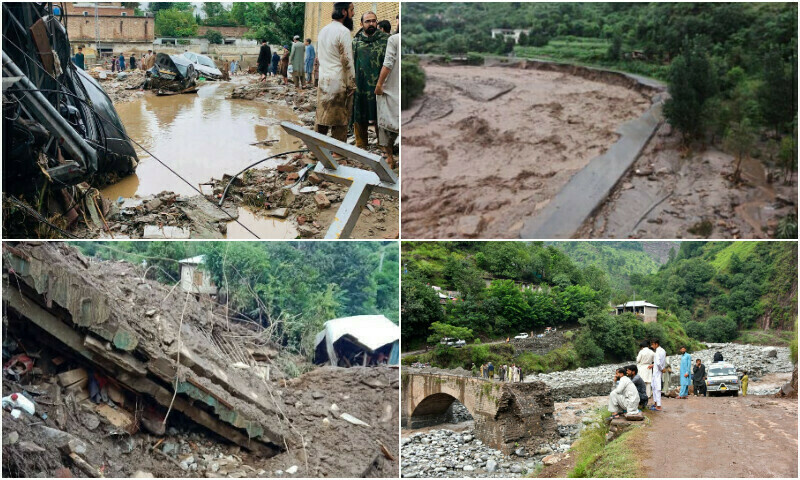
PESHAWAR: Devastating floods in Pakistan’s northwestern Khyber Pakhtunkhwa (KP) province have left more than 150 people feared missing and claimed at least 323 lives, provincial authorities announced Sunday, as the nationwide death toll from rain-related incidents since late June surged to 657.
With more heavy monsoon rains forecast, the government is scrambling to deliver aid to the hardest-hit regions amid fears of further destruction. As another two to three waves of heavy rain are expected in early September, Prime Minister Shehbaz Sharif has ordered federal cabinet members to personally oversee relief operations in KP, the province bearing the brunt of this year’s catastrophic monsoon season.
At a news conference in Peshawar, Khyber Pakhtunkhwa Provincial Disaster Management Authority (PDMA) Director General Asfandyar Khattak said revenue staff in the Buner and Shangla districts reported around 150 people still missing. “Rescue operations are underway, and five armed forces helicopters are at the disposal of the provincial government,” Khattak said, flanked by Barrister Muhammad Ali Saif and Director General Rescue-1122 Muhammad Tayyab Abdullah.
Khattak detailed the provincial government’s response, noting that Rs1.5 billion had been released for relief activities. From an initial Rs500 million tranche, allocations included Rs150 million for Buner, Rs100 million for Mansehra, Rs50 million for Bajaur, Rs40 million each for Batagram, Swat, and Shangla, and Rs10 million each for Upper Kohistan, Lower Kohistan, and Kolai Palas.
He added that 33 trucks of non-food items had reached Buner, eight were delivered to Swat, and seven arrived in Bajaur, with more supplies en route.
The National Disaster Management Authority (NDMA) reported that rain-related incidents across Pakistan since June 26 have killed 657 people and injured 929. Among the victims were 171 children, 94 women, and 392 men.
KP alone accounted for 390 deaths—288 men, 59 children, and 43 women—underscoring the province’s acute vulnerability to seasonal downpours. Punjab recorded 164 deaths, including 70 children, 63 men, and 31 women, while Sindh reported 28 fatalities, comprising 14 children, 10 men, and 4 women. Balochistan saw 20 deaths, including 11 children, 5 men, and 4 women, while Gilgit-Baltistan reported 32 fatalities—18 men, 8 children, and 6 women. Azad Jammu and Kashmir (AJK) recorded 15 deaths, evenly split among 5 men, 5 women, and 5 children, and Islamabad reported 8 deaths, including 4 children, 3 men, and one woman.
NDMA spokesperson Dr. Tayyab Shah warned that heavy monsoon rains, expected to persist until August 22, would likely intensify with two to three more spells in September. “This year, monsoon rainfall has been 50 to 60 percent heavier than last year,” Shah said. “This year’s monsoon season ranks among the most destructive in recent memory.”
In Gilgit-Baltistan, a cloudburst-triggered flood in Katishu village, Kharmang district, killed two people on Sunday. Police reported that a woman and her daughter went missing after the flash flood hit their village; the daughter’s body was recovered, but the woman remains missing. Two other women injured in the flood were evacuated to Skardu for treatment. The deluge also wrecked fields, water channels, agricultural land, and both public and private properties.
Elsewhere in Gilgit-Baltistan, rescue teams recovered the body of a four-year-old girl from flood debris in Khalti village, Gupis Valley (Ghizer district), and the body of an elderly man was retrieved Saturday night, both reported missing after Friday’s flash floods.
Blocked roads, including the Karakoram Highway, Baltistan Highway, Ghizer–Shandur Road, and Naltar Highway, have stranded thousands, including tourists. Residents face acute shortages of drinking water, prolonged power outages, and disrupted mobile and internet services. In Gilgit city, frustrated locals blocked main roads to protest days without basic utilities.
In response to the crisis in KP, Prime Minister Sharif has taken direct charge of relief efforts. “On the prime minister’s directives, federal ministers will participate in relief operations in the flood-hit districts of Khyber Pakhtunkhwa,” an official statement from the PM’s Office said.
Federal Minister for Kashmir Affairs and Gilgit-Baltistan Engineer Amir Muqam will oversee aid distribution in Shangla and Buner, the Federal Minister for Power Division will assist in Buner, Federal Minister for Religious Affairs Sardar Yousaf will supervise operations in Mansehra, and the PM’s Special Assistant Mubarak Zeb will manage relief in Bajaur. Under the PM’s Relief Package, additional truckloads of food rations, tents, and medicines are being dispatched to affected districts for distribution by local administrations.
In Punjab, the PDMA reported fluctuating water levels in the River Sutlej, with low-level flooding at Ganda Singhwala (70,000 cusecs) and Sulemanki (74,000 cusecs). Authorities are closely monitoring the situation, as flows are expected to range between 75,000 and 85,000 cusecs in the coming days.
PDMA Director General Irfan Ali Kathia warned that water flows exceeding 80,000 cusecs could trigger low-level flooding, 120,000 cusecs may cause moderate flooding, and 175,000 cusecs could lead to high-level flooding. The authority also forecast severe monsoon rains across most Punjab districts, with the seventh spell expected to continue until August 22 or 23.
Copyright © 2021 Independent Pakistan | All rights reserved