By Staff Reporter
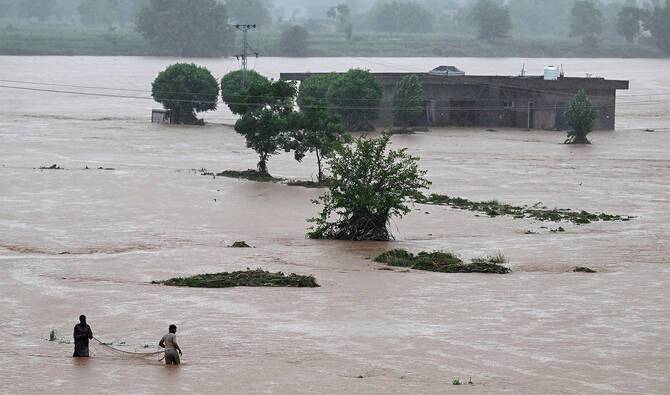
ISLAMABAD: Pakistan is on high alert as a fresh wave of monsoon rains, forecast to bring torrential downpours and thunderstorms until August 21, threatens widespread flooding and landslides, with authorities bracing for a repeat of the devastation that claimed over 350 lives in Khyber Pakhtunkhwa.
The Pakistan Meteorological Department (PMD) warned of intense weather conditions, with “widespread rain-wind/thundershower” and “scattered heavy falls, at times very heavy” expected in multiple regions, including Kashmir and Gilgit-Baltistan, from August 17 to 19.
The deluge is forecast to hit urban centres like Islamabad, Lahore, Peshawar, and Gujranwala, raising fears of urban flooding, while hilly areas face risks of landslides and mudslides that could block roads. This latest monsoon spell comes as the country reels from devastating flash floods in Khyber Pakhtunkhwa, where over 350 people perished in 48 hours due to torrential rains and glacial melt in the northern mountains. The fresh rains are expected to exacerbate the situation, particularly in Punjab, where rising river levels have prompted red alerts for multiple districts.
The PMD detailed the regions at risk, predicting heavy rainfall in Kashmir’s Neelum Valley, Muzaffarabad, Rawalakot, Poonch, Hattian, Bagh, Haveli, Sudhanoti, Kotli, Bhimber, and Mirpur, as well as Gilgit-Baltistan’s Diamer, Astore, Ghizer, Skardu, Hunza, Gilgit, Ghanche, and Shigar from August 17 to 19, with occasional gaps.
In Khyber Pakhtunkhwa, widespread rain-wind/thundershowers, with scattered heavy and at times very heavy falls, are expected in Dir, Chitral, Swat, Kohistan, Shangla, Battagram, Mansehra, Abbottabad, Haripur, Buner, Malakand, Bajaur, Mohmand, Kohat, Peshawar, Charsadda, Nowshera, Mardan, Swabi, Khyber, Orakzai, Kurram, Hangu, Karak, Bannu, Lakki Marwat, Waziristan, Tank, and Dera Ismail Khan over the same period.
In Punjab, widespread heavy rainfall is forecast for Islamabad/Rawalpindi, Murree, Galiyat, Attock, Chakwal, Jhelum, Mandi Bahauddin, Gujrat, Gujranwala, Hafizabad, Wazirabad, Lahore, Kasur, Sheikhupura, Sialkot, Narowal, Mianwali, Khushab, Sargodha, Jhang, Toba Tek Singh, Nankana Sahib, Chiniot, Faisalabad, and Sahiwal from August 17 to 19.
Scattered rain with isolated heavy falls is also likely in Dera Ghazi Khan, Bhakkar, Layyah, Multan, Bahawalpur, Bahawalnagar, Rajanpur, and Rahimyar Khan from August 18 to 20. In Sindh, heavy rain is expected to batter Mithi, Tharparker, Umer Kot, Mirpurkhas, Hyderabad, Shaheed Benazirabad, Karachi, Thatta, Badin, Sajawal, Tando Allayar, Tando Muhammad Khan, Sanghar, Jamshoro, Sukkur, Larkana, Khairpur, and Jacobabad from August 17 to 22, with occasional pauses.
Balochistan’s Barkhan, Musakhel, Loralai, Sibi, Zhob, Qilla Saifullah, Khuzdar, Lasbela, Awaran, Kech, Gwadar, and Panjgur are also set to experience rain-wind/thundershowers with isolated heavy falls from August 17 to 21.
The PMD cautioned that the intense rainfall could trigger flash floods in local nullahs and streams across Khyber Pakhtunkhwa, Punjab, and Kashmir from August 17 to 19, with hill torrents in Dera Ghazi Khan and eastern Balochistan at risk from August 18 to 21. Urban flooding is a major concern for cities like Islamabad, Lahore, Peshawar, Gujranwala, Karachi, and Hyderabad, while landslides and mudslides could disrupt roads in hilly areas like Khyber Pakhtunkhwa, Gilgit-Baltistan, Galiyat, and Kashmir.
In Punjab, the Provincial Disaster Management Authority (PDMA) issued red alerts for multiple districts, warning of severe flooding due to swelling rivers and reservoirs. The Indus River is at medium flood levels at Kalabagh and Chashma Barrage, with low-level flooding reported at Tarbela and Taunsa Barrage.
The Sutlej River is experiencing low-level flooding at Ganda Singh Wala, with a water flow of 68,000 cusecs, while low-level flooding persists in Nullah Palkho (Cantonment) and Nullah Basantar. The Jhelum and Ravi rivers are currently at normal flow levels at key points. Tarbela Dam is at 98 percent capacity, and Mangla Dam is 68 percent full, raising concerns about potential overflow. India’s release of 50,000 cusecs of water into Pakistani rivers has further heightened the risk.
The PDMA urged residents, particularly those near riverbanks, to relocate to safer areas immediately and cooperate with authorities during emergency evacuations. It also advised against recreational activities near rivers during flood conditions. “The seventh spell of monsoon rains is relatively stronger, with forecasts of severe downpours,” the PDMA said, highlighting the risk of torrential rains and cloudbursts, especially in northern Punjab.
The warnings come as Pakistan grapples with the devastating impacts of climate-driven extreme weather, with monsoon rains and glacial melt increasingly threatening lives and infrastructure. The loss of over 350 lives in Khyber Pakhtunkhwa underscores the urgency of the situation, as authorities scramble to mitigate the risks of further flooding and landslides.
Copyright © 2021 Independent Pakistan | All rights reserved