By Staff Reporter
KARACHI: Pakistani authorities have dismantled what they described as an international cyber fraud ring responsible for swindling victims out of an estimated $60 million through elaborate online investment schemes, arresting 15 foreign nationals and 19 Pakistanis in a series of raids last week, officials said on Thursday.
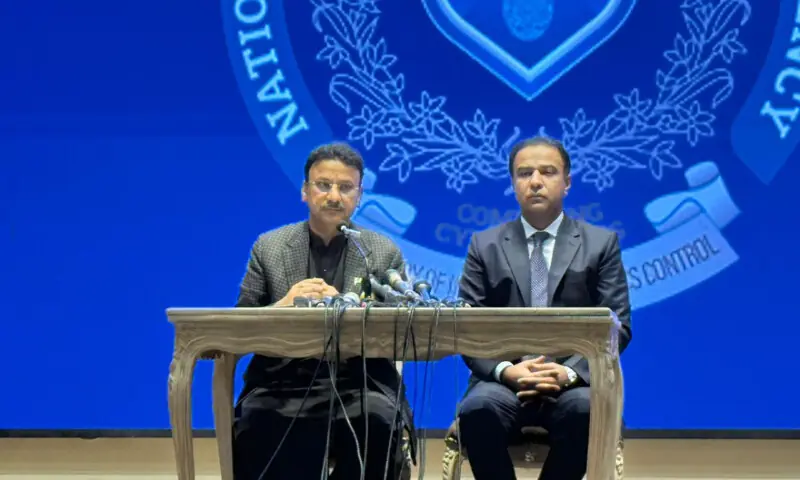
The operation, led by the National Cyber Crime Investigation Agency, targeted hideouts in Karachi’s upscale Defence Housing Authority, yielding a trove of evidence including more than 10,000 international SIM cards used to orchestrate the scams, Sindh Province’s home minister, Zia-ul-Hassan Lanjar, said at a news conference.
Flanked by Tariq Nawaz, the agency’s additional director, Lanjar detailed how the suspects preyed on victims worldwide by building trust over weeks or months via social media platforms, luring them into bogus investments in cryptocurrency and foreign exchange markets with promises of hefty returns. “The victims were lured into investment by creating a login on fake investment platforms (which the victims considered as legitimate due to the fake conversation and activity in telegraph groups) which were controlled and managed by these scammers where the victims were made to believe that this is their investment portal login and time to time they were shown high profits in that fake online portal,” Lanjar said.
The arrests unfolded during joint raids by the cyber agency and other intelligence and law enforcement units in the DHA’s Phase 1 and Phase 6 neighborhoods. Among the 15 foreigners detained were three women, though Lanjar repeatedly declined to specify their nationalities, citing diplomatic sensitivities. “We recovered 37 computers and 40 mobile phones, along with over 10,000 international SIMs and six unlawful gateway exchanges,” the minister said, explaining that the seized items were primarily deployed to fabricate accounts on social media and Telegram.
The goal, he said, was “to generate a fake audience and participants in groups mainly on Telegram.” Those foreign SIM cards enabled the scammers to receive verification codes and one-time passwords for setting up Telegram IDs, and occasionally for WhatsApp communications. The ring’s operations, he said, centered on “managing and creating Telegram accounts, groups and social media accounts using foreign SIMs to target convincing victims and luring them to invest.” Parallel elements involved funneling illicit funds through bank accounts in target countries, often converting them into cryptocurrency for cross-border transfers to the scheme’s masterminds.
Lanjar revealed that “the technical and financial investigation has led to a series of further developments which are being investigated,” underscoring the scam’s global reach. Outlining the fraudsters’ tactics, the minister said they dangled illusions of prosperity, displaying fictitious profits on sham portals to keep victims hooked. But “when the amount reached $5,000, the scammers started asking the victims/customers to submit a fee under different pretexts, and when the money was deposited, the suspects used to block the accounts.” The total haul from these deceptions amounted to $60 million, Lanjar estimated.
Pressed on why he had delayed the announcement, the minister said he awaited a “comprehensive” report from the cyber agency, given the case’s gravity and the involvement of foreigners from “two or three countries” with which Pakistan maintains key ties. The foreign and interior ministries, he added, have raised the matter with those nations. “The government and law enforcers tended to provide security and protocol to foreigners, but legal action would be taken against them if found involved in criminal activity,” Lanjar said.
He also fielded complaints from citizens about “illegal” call centers fueling fraud, narcotics trafficking and other crimes, noting that the agency’s outposts in Hyderabad and Sukkur have been inundated with similar reports. Such centers fall under federal oversight, he said, with the central government issuing no-objection certificates and regulations. “Things will not get resolved after these arrests; we need to work more,” Lanjar affirmed.
Nawaz, the cyber agency’s additional director, emphasised the scam’s transnational scope. “Foreign nationals and locals were involved in this, and the victims had not only been locals but foreign nationals, too,” he said. “Crime has no boundaries, and the cyber world has no specific geographical locations,” Nawaz added, calling the bust merely the “tip of the iceberg.” “We hope that after this action, there will be a significant decline in online fraud.”
On Sunday, a judicial magistrate remanded 22 of the suspects — including eight foreign nationals — to prison pending trial. The cyber agency has filed charges against them under the Prevention of Electronic Crimes Act and sections of the Pakistan Penal Code.
Copyright © 2021 Independent Pakistan | All rights reserved