By Staff Reporter
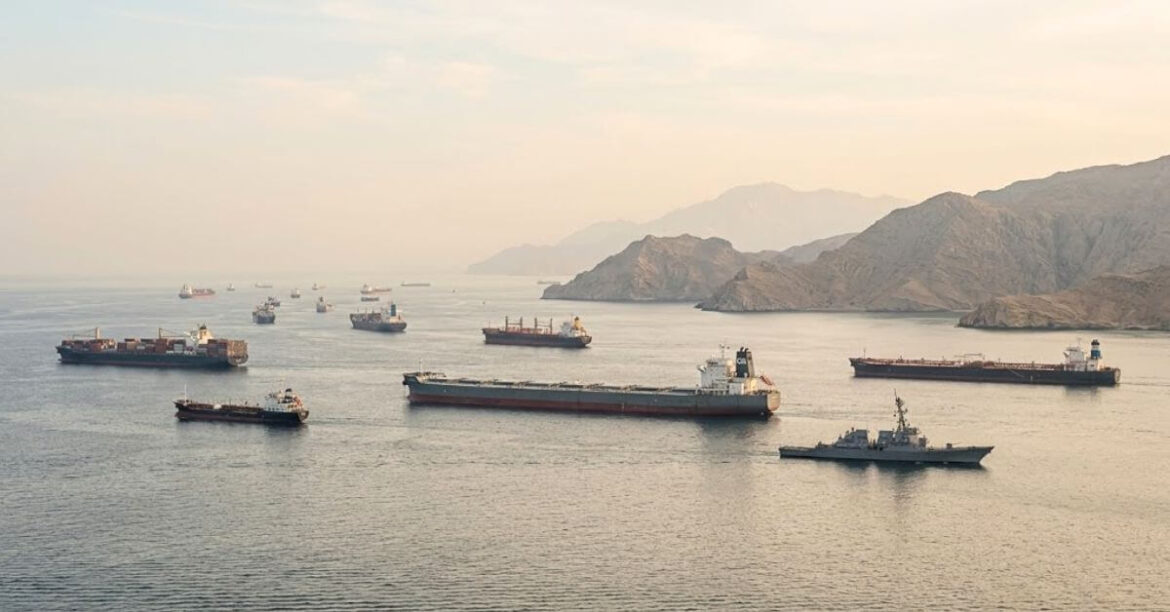
ISLAMABAD: President Donald Trump said on Thursday that he has directed the US Navy to “shoot and kill” any Iranian vessels attempting to lay mines in the Strait of Hormuz, a dramatic escalation that risks unraveling a tenuous cease-fire between the United States and Iran even as both sides maneuver for leverage in stalled peace talks.
In a pair of posts on his Truth Social platform, Trump also ordered a sharp increase in American mine-clearing operations in the narrow waterway, which carries about one-fifth of the world’s oil and liquefied natural gas. “I have ordered the United States Navy to shoot and kill any boat, small boats though they may be . . . that is putting mines in the waters of the Strait of Hormuz,” he wrote. “There is to be no hesitation.” He added that mine-sweeping efforts already underway would be “tripled-up.”
The remarks came as the Pentagon disclosed that US forces had conducted a “maritime interdiction and right-of-visit” aboard a tanker carrying Iranian oil in the Indian Ocean on Thursday. Earlier in the week, the military said it had seized one Iranian vessel and forced dozens of others to turn back. Iran, for its part, has seized foreign commercial ships in the same waters, asserting they violated naval regulations.
The dueling blockades have transformed the Strait of Hormuz — which had remained open without interruption for decades before the outbreak of hostilities — into the central flash point of a conflict that began with joint US-Israeli strikes on Iranian targets. Iran responded by closing the strait, a move that has sent global energy prices soaring and gasoline in the United States above $4 a gallon, up from about $3 before the fighting.
A two-week cease-fire took effect last month after intense diplomacy hosted by Pakistan in Islamabad. Trump extended the truce, which had been set to expire on Wednesday, but kept in place a naval siege on Iranian ports that he announced even after Tehran said it would reopen the strait in response to the inclusion of Lebanon in the agreement. Washington has continued to intercept Iran-linked shipping, and the White House said Trump remains “satisfied” with the pressure campaign.
Iranian officials have repeatedly warned that they will defend themselves against any US attack. On Thursday, the Foreign Ministry praised the Islamic Revolutionary Guard Corps, the hardline force leading Tehran’s military efforts, on the anniversary of its founding. “We salute the noble defenders and guardians of the homeland, and honour the memory of the crimson-shrouded martyrs of the IRGC,” spokesperson Esmaeil Baghaei wrote on X.
Iran’s leadership has presented a unified front in rejecting the American blockade. Parliament Speaker Mohammad Bagher Ghalibaf, who is also a chief negotiator, responded directly to Trump’s announcement on social media: “You did not achieve your goals through military aggression and you will not achieve them by bullying either. The only way is recognizing the Iranian people’s rights.” He said a full cease-fire would be possible only if the US naval blockade is lifted.
Trump, however, portrayed the situation as one of overwhelming American dominance. “The US has total control over the Strait of Hormuz,” he wrote. “It is sealed up tight.” He also repeated his assertion that Iran’s leadership is fractured, describing “infighting” between “Hardliners” who have “been losing BADLY on the battlefield” and “Moderates” who are “gaining respect.”
Earlier in the day, he amplified a post by conservative commentator Marc Thiessen that called for the assassination of Iranian officials opposed to a deal with the United States. There is no public evidence of such a rift in Tehran. US and Israeli strikes last month killed Supreme Leader Ali Khamenei and several top commanders. He was succeeded by his son Mojtaba Khamenei, who was wounded in the attacks and has not appeared publicly since. Despite the upheaval, senior officials including Foreign Minister Abbas Araghchi have maintained a consistent line: Iran will negotiate only when it believes its interests are protected and will not do so under the pressure of a blockade.
Pakistan has positioned itself as a mediator, hosting the first round of indirect talks on April 11. Interior Minister Mohsin Naqvi told US Chargé d’Affaires Natalie Baker on Thursday that he expects “positive progress” from Iran and welcomed Trump’s extension of the ceasefire. “This is an important step toward de-escalation,” Naqvi said, according to a statement from his ministry. He said Prime Minister Shehbaz Sharif and Chief of Army Staff Field Marshal Asim Munir were working “at all levels” to broker a resolution. Baker thanked Pakistan for its “constructive role.”
Iran’s Foreign Ministry has expressed gratitude for the Pakistani efforts while stressing that it will not negotiate while the blockade remains. Baghaei said Tehran is “closely monitoring developments” and will take “necessary and appropriate measures” to defend its security.
The economic stakes are high. The closure of the strait and the American counter-blockade have already disrupted global energy markets and maritime trade. Trump said Tuesday that Iran is “collapsing financially” and “starving for cash.” Treasury Secretary Scott Bessent warned that storage tanks at Kharg Island, Iran’s main oil export terminal, will soon be full, forcing a shutdown of some production.
Iranian oil output has already declined. According to energy intelligence firm Kpler, production fell by about 200,000 barrels per day in March to 3.68 million barrels per day and is projected to drop another 420,000 barrels per day in April. Yet analysts caution against overstating the immediate impact.
Saeed Laylaz, an economist at Shahid Beheshti University in Tehran, told the Agence France-Presse that any significant damage to Iran from the blockade would likely take two or three months to materialise — and that the Persian Gulf states enforcing the measures would suffer greater harm in the long run. Jamie Ingram, managing editor of the Middle East Economic Survey, said Iran could begin slightly reducing production within weeks but is unlikely to face acute storage constraints for “weeks rather than days.” Iran has diverted crude to other facilities in the past and has a proven record of resilience under sanctions.
Arne Lohmann Rasmussen of Global Risk Management noted that Iran was expected to run out of storage capacity within about a month but may already be forced to curtail output sooner. Ali Vaez, Iran project director at the International Crisis Group, described the situation as “mutually assured disruption.” Iran’s economy was already battered before the war, he said, but its leadership has historically demonstrated a high tolerance for pain, calculating that its own interference with Hormuz traffic imposes costs on its adversaries as well.
Copyright © 2021 Independent Pakistan | All rights reserved