By Staff Reporter
President Donald Trump’s decision to extend the US-Iran ceasefire indefinitely was presented as a gesture of strategic patience. Iran, he said, was “seriously fractured,” financially collapsing, and unable to produce a unified negotiating position. The naval blockade would stay in place as leverage. Vice President JD Vance’s bags were already packed for a second round of talks in Islamabad; the trip was quietly cancelled. White House Press Secretary Karoline Leavitt was more blunt: Iran is in a “very weak position,” the cards are in Trump’s hands, and the president will decide when — or whether — the war ends. It is a high-risk gamble dressed up as strength. The ceasefire extension buys time, but it also entrenches a volatile limbo — no war, no peace, no talks — in which both sides are doubling down on postures that make compromise harder. Iran’s military parades, missile displays, and ship seizures in the Strait of Hormuz are not signs of a regime about to crumble. They are calculated signals that Tehran will not negotiate under the gun. Trump’s blockade and open-ended truce are not masterstrokes of leverage. They are a bet that economic pain will force Iranian pragmatists to override hardliners — a bet that history suggests often backfires.
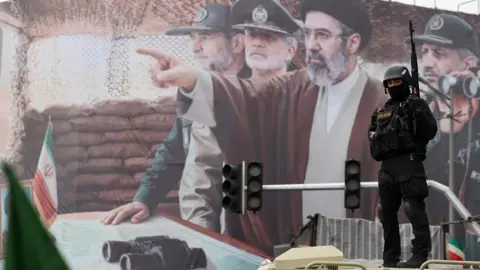
The immediate facts are stark. The two-week truce was due to expire on Wednesday. Iranian negotiators never showed in Pakistan. Instead, Tehran demanded the blockade be lifted first. The Islamic Revolutionary Guard Corps seized two cargo ships in the Strait of Hormuz, citing unauthorised passage. State media filled the airwaves with images of ballistic missiles rolling through cheering crowds in Tehran’s Enghelab and Vanak squares, women in combat gear, and wounded soldiers demanding revenge. IRGC commanders warned neighbours that any facilitation of attacks on Iran would end oil production across the region. Parliament Speaker Mohammad Bagher Ghalibaf, who led the first round of talks, posted that reopening the strait was “impossible” while the US held the global economy “hostage.” Still, Trump and his team insist the real story is Iranian disarray. The supreme leader’s son, Mojtaba Khamenei, installed after his father’s assassination in the opening strikes, has not appeared publicly and is reportedly communicating only by audio from a recovery bed. The traditional web of competing power centers has been replaced by a wartime military umbrella. US officials describe open rifts between IRGC generals and civilian diplomats, with the former rejecting concessions the latter appeared willing to explore. Trump’s claim that Iran cannot pay its military and police is meant to underscore the collapse.
Iranian officials and centre-right analysts reject this as propaganda. The leadership, they argue, has never been more cohesive precisely because the war has narrowed the circle and raised the stakes to existential levels. Different factions are more aligned now than before the conflict, one expert noted, because the smaller group shares a single overriding imperative: survival without surrender. Ghalibaf’s delegation to Islamabad deliberately included a broad political spectrum to project unity. President Masoud Pezeshkian, the relatively moderate, has ruled out capitulation but called repeatedly for “reason, dialogue and avoidance of more destruction.” A prominent Sunni cleric in Zahedan warned hardliners that they will one day have to answer to God and the nation for the devastation of the homeland. Both readings contain partial truth, but the American emphasis on fracture misses the larger point. Iran is not collapsing. It is battered — its oil facilities, power plants, factories, and transport network heavily damaged by 40 days of strikes — yet it retains the capacity to impose real costs. The Hormuz seizures and threats to seabed internet cables are reminders that Tehran can disrupt global energy flows and digital infrastructure with consequences far beyond its borders. The regime’s street rallies and state television claims that 87 percent of Iranians prefer war to concessions may be exaggerated, but they reflect genuine hardline support that cannot be ignored.
The deeper danger lies in the mutual miscalculation. Trump believes the blockade gives him decisive leverage without the domestic political cost of renewed bombing. Iran believes its defiance — military, rhetorical, and on the streets — will force Washington to blink first. Neither side appears prepared to make the face-saving concessions necessary for a deal. Tehran insists the blockade must end before talks resume. Washington insists Iran must present a unified proposal first. The result is paralysis. This is not how wars end. It is how they reignite. The Strait of Hormuz remains a hair-trigger flashpoint. Iran has kept the waterway closed in response to what it calls ongoing violations, including the blockade itself. Clashes involving commercial shipping continue. The US does not consider Iran’s ship seizures a ceasefire breach, but that semantic distinction will not matter if a tanker is sunk or a major incident escalates. Global markets are already feeling the strain; gas prices have risen. Inside Iran, the near-total internet shutdown, now in its 54th day, has isolated the population while the economy hemorrhages. The human and strategic stakes could not be higher. Thousands of munitions have already fallen. Civilian infrastructure — homes, hospitals, schools, universities — has been hit. Trump has threatened to strike still more critical targets and send Iran “back to the Stone Ages” if no agreement materialises. The IRGC has its “fingers on the trigger” for stronger responses. A return to full-scale war would not only devastate Iran further; it would risk drawing in proxies across the region, spiking already super high oil prices worldwide, and entangling the United States in yet another Middle East conflict that most Americans have grown weary of supporting.
There are, however, slender grounds for hope. Both sides continue to profess openness to diplomacy. Iran says it remains ready for talks in Islamabad once the blockade ends. Trump extended the truce rather than resume strikes, citing the need for a credible Iranian proposal. Small gestures matter: Iran halted the planned execution of eight female dissidents after Trump’s personal request. Ghalibaf has described negotiations as “a method of fighting” that can translate military resilience into political gains. Pezeshkian has emphasised that the solution lies in dialogue, not escalation.
The path forward is not capitulation. It is realism. Iran will not abandon its core interests — uranium enrichment, missile capabilities, support for its axis of resistance. The United States will not accept an unchecked Iranian nuclear program or regional aggression. But a workable agreement does not require either side to declare victory. It requires a formula that freezes the conflict, eases the most punitive elements of the blockade in exchange for verifiable steps to reopen the Strait of Hormuz, and establishes a structured negotiating process insulated from daily provocations.
The current extension is not a solution. It is a test. If Trump’s team uses the breathing room to explore serious Iranian counteroffers rather than simply tighten the economic screws, diplomacy may yet prevail. If Iran’s leaders recognise that their defiance, while understandable, cannot reverse the military damage already done, they may find room to manoeuvre without appearing to surrender. The alternative — letting the blockade bite indefinitely while parades and threats continue — is not strategy. It is the slow march toward a wider war that neither capital can afford and that ordinary Iranians and Americans will pay for in blood and treasure. The United States has the upper hand in raw power and economic pressure. Iran has the advantage of resilience born of necessity and a domestic base that rejects humiliation. Neither advantage is absolute. The real test of leadership in both capitals is whether they can move beyond the theatre of defiance and fracture narratives to the hard, unglamorous work of compromise. The ceasefire extension has given them that chance.
Copyright © 2021 Independent Pakistan | All rights reserved