By Staff Reporter
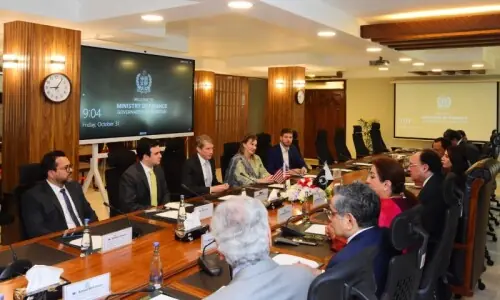
ISLAMABAD: A high-level American delegation arrived in Islamabad on Friday to court Pakistan as a potential partner in securing vital mineral supply chains, part of a broader Washington effort to loosen China’s stranglehold on the rare earths and other metals essential to everything from electric vehicles to fighter jets.
The talks, held with top Pakistani officials led by Finance Minister Muhammad Aurangzeb, centered on fostering “secure and transparent” cooperation in mining and minerals, according to an official statement from the Ministry of Finance. The visitors, headed by Robert Louis Strayer II, president of the United States government-funded Critical Minerals Forum, emphasised technology transfer, intellectual property safeguards and bolstering confidence among American private investors.
The meeting unfolded against a swirl of geopolitical manoeuvring: Just as the two sides conferred, the United States and India unveiled a landmark 10-year defence framework agreement, underscoring Washington’s push to diversify alliances in Asia.
For the United States, the stakes could scarcely be higher. China’s dominance over critical mineral supply chains, through government subsidies, vertical integration and lax environmental regulations, particularly in energy-intensive processing, poses “a well-known threat to U.S. national security, economic competitiveness, and long-term strategic objectives,” Strayer wrote in an article on the forum’s website, his only one there. “China’s dominance of critical mineral supply chains has become a well-known threat,” he added, a point echoed in reports from the Atlantic Council, a prominent Washington think tank.
Those minerals, the council warned, form the backbone of modern economies and military might: permanent magnets for warplanes, batteries for electric cars, components for renewable energy grids. Yet the global networks remain “increasingly brittle,” overwhelmingly refined in China and vulnerable to weather disruptions or Beijing’s export curbs, as seen recently with graphite and antimony, restricted in retaliation for American trade controls on advanced semiconductors.
Pakistan, with its untapped deposits of copper, antimony and other niche metals, emerged in the discussions as a promising counterweight. Strayer told his hosts that the forum was working worldwide to nurture reliable supply lines for American industry, especially in emerging markets. He spotlighted Pakistan’s “science, engineering, and mathematics talent” as a competitive edge and “acknowledged Pakistan’s potential to become a future hub for critical mineral development.”
Natalie Baker, the chargé d’affaires at the American Embassy in Islamabad, who joined the delegation, underscored Washington’s backing for commercial ties. “The Embassy’s support for American commercial engagement in Pakistan,” she said, while “emphasising the importance of ensuring strong investor confidence and enabling regulatory frameworks in the minerals sector.”
Aurangzeb, in turn, struck an optimistic note, framing Pakistan’s mineral riches as a “transformational opportunity” to pivot from “consumption-driven cycles to export-led growth.” A robust policy framework, he argued, would help shatter the nation’s “cycle of periodic balance-of-payments pressures and reduce future reliance on multilateral support.”
He disclosed that during a recent trip to Washington, he had met executives from the Development Finance Corporation and the International Finance Corporation, both expressing keen interest in ramping “Pakistan is working on significant legal and regulatory reforms,” the minister said. “We encourage you to return with a detailed framework for collaboration. Pakistan will evaluate it with a view to facilitating responsible investment and ensuring mutual benefit.”
Aurangzeb also situated the overture within Pakistan’s delicate balancing act. “Pakistan today stands at a constructive intersection of global relationships, renewed momentum in Pakistan-U.S. ties, time-tested relations with China, and forward-looking strategic cooperation with the Kingdom of Saudi Arabia,” he observed.
Strayer flagged a persistent hurdle: the “unusually high uncertainty of both production costs and mineral prices.” That volatility, he explained, exerts a “chilling effect on new investment by profit-seeking companies, as investors prefer to make investments in projects with higher risk-adjusted expected profits.”
Copyright © 2021 Independent Pakistan | All rights reserved