By Staff Reporter
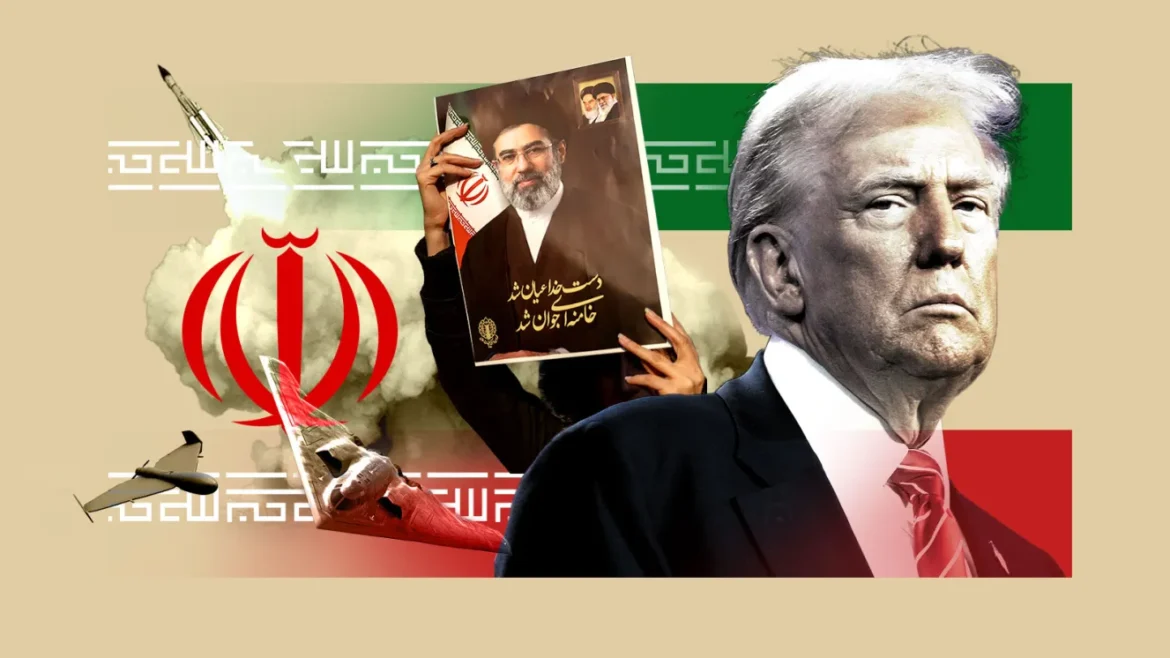
There is a particular kind of humiliation reserved for leaders who charge into war with maximalist ambitions and find themselves, months later, quietly renegotiating the terms of reality. Donald Trump is now living inside that humiliation — even as he works, with characteristic noise and misdirection, to ensure as few people as possible notice.
The broad strokes of where things now stand in the US-Iran conflict are not difficult to read. After launching a joint military campaign with Israel in late February — one openly framed around regime change, the “destruction” of Iran’s nuclear capability, and the dismantling of its regional influence — Trump finds himself presiding over a war that has achieved none of those goals in any definitive sense. What it has achieved, with considerable efficiency, is the transformation of the Strait of Hormuz from an unobstructed global artery into a bargaining chip that Tehran now holds with both hands.
The emerging deal — still unconfirmed at the time of writing, its edges contested and its details disputed between Washington and Tehran — would, in its reported form, trade an end to the US-Israeli military campaign for Iran reopening the strait. The thorniest questions: the future architecture of Iran’s nuclear programme, its enriched uranium stockpile, its ballistic missile capabilities, its support for Hezbollah, Hamas and the Houthis — would all be “deferred to later rounds of talks.”
In other words, the war Trump started to resolve these questions has resolved none of them. It has, however, added a brand new problem — a blockaded strait — that didn’t exist three months ago, and which now must be addressed before anything else can proceed.
The leverage problem no one in Washington wanted to admit
Trump famously wrote, with his ghostwriter, that “the worst thing you can possibly do in a deal is seem desperate to make it.” He also wrote that “leverage is having something the other guy wants.” It is worth sitting with both of those observations for a moment, because they describe, with unintended precision, the trap into which he has now walked.
Iran entered this conflict as a country under severe sanctions, with a weakened economy and a military facing the most powerful air force in history. It emerged, three months later, holding the key to roughly 20 percent of the world’s daily crude oil supply. The Hormuz closure has sent American petrol prices up by approximately 50 percent — to around $4.50 a gallon — created a shortage of fertiliser threatening food supplies, rattled global energy markets and driven down Americans’ real disposable income for consecutive months. Iran didn’t need to topple Washington to damage it. It just needed to shut a waterway.
A CIA assessment sent to Trump earlier this month found that Iran had retained roughly 70 percent of its prewar missile stockpile and around 75 per cent of its mobile launchers. The report further concluded that Iran was more resilient than US officials had publicly acknowledged, and could withstand a naval blockade for months. These are not the findings of a defeated adversary.
The Trump administration launched “Project Freedom” — a naval initiative to escort vessels trapped in the Gulf through the blockade. Two ships got out. The project was suspended the next day. American calls for European allies to help police the Strait went unanswered. Multiple publicly announced deadlines for Iran to comply with American demands passed without consequence. The threats kept coming; the follow-through mostly didn’t.
Meanwhile, Iran’s position in the negotiations has remained, by all credible accounts, essentially unchanged. Tehran has demanded the release of $12 billion in frozen assets before moving to substantive talks on the nuclear issue. It has insisted that any deal must include Lebanon, where Israeli forces are conducting what the Lebanese prime minister, Nawaf Salam, has called a “scorched-earth policy.” Iran’s foreign ministry has dismissed Trump’s use of the word “must” with pointed historical awareness: the Islamic Republic, its spokesperson noted, “said goodbye to the language of ‘must’ 47 years ago.”
The narrative gap between Washington and Tehran
One of the more instructive features of this negotiation is the degree to which the two sides appear to be reading entirely different documents. Trump announced on social media that Tehran had agreed ships would pass through Hormuz with “no tolls.” Iran’s Fars news agency responded that no such clause appeared in the agreement. Trump said the two countries would “coordinate on removing and destroying Iran’s enriched uranium.” Iranian state television described this as “fundamentally baseless.” The White House has dismissed as a “fabrication” Iranian reports of a US agreement to release $12 billion in frozen assets; Iranian state television broadcast what it described as an unofficial draft memorandum confirming exactly that.
This is not simply a communications problem. It reflects a fundamental asymmetry in what each side needs to show its domestic audience. Former Pakistani ambassador to the UN Munir Akram, whose country has played an important mediating role and remains the likeliest venue for any eventual signing ceremony, put it with admirable economy: “The differences are largely about narrative rather than substance. Both sides want an agreement they can present as a victory.”
That observation cuts to the core of why this negotiation keeps stalling even as both parties apparently accept its inevitability. The diplomatic consensus, as expressed by one senior envoy to Dawn newspaper, puts the probability of a final agreement at “nine out of ten.” The roadblocks are real, but they are increasingly about sequencing, messaging and face-saving rather than fundamental incompatibility of interests. Neither side, multiple sources with knowledge of the talks agree, wants an open-ended conflict whose costs continue to mount. The question is who can be seen to have conceded least.
The Lebanon complication and the regional picture
Any serious reading of this situation has to contend with Lebanon, which threatens to complicate a deal that is already complicated enough. Iran has insisted — and there is no sign it will retreat from this position — that a halt to Israeli military operations in southern Lebanon must form part of any regional settlement. Israel, meanwhile, has expanded its ground offensive past the Litani river, with Netanyahu declaring that forces have pushed more than 30 kilometres into Lebanese territory. A ceasefire nominally in place since April 17 has, by both sides’ admission, never been observed.
This matters because Lebanon is where Iranian leverage and Israeli military momentum are most directly in collision, and where the gap between what Washington wants and what Tel Aviv is doing is most exposed. The US and Israel may share strategic interests in the broader picture, but their negotiating timelines are not synchronised. Every week that Israeli forces consolidate their position in southern Lebanon, Iran’s incentive to sign a deal — and its ability to justify doing so to its own domestic constituency — diminishes. As Munir Akram noted, continued delays “are hurting Iran’s allies in Lebanon by giving Israel additional time to consolidate its position.”
The regional context is further complicated by the behaviour of Gulf Arab states, several of which have begun exploring closer ties with Tehran as a hedge against future instability — a development that has prompted Washington to reaffirm its military commitment to the Gulf with some urgency. The war that was meant to reassert American dominance in the Middle East has instead accelerated a hedging process among its closest regional partners.
The JCPOA ghost
There is an irony at the heart of this entire saga that is almost too obvious to state, and yet must be stated: the agreement now apparently taking shape bears an uncomfortable resemblance to the 2015 Joint Comprehensive Plan of Action that Trump tore up in 2018, setting in motion the chain of events that led directly to the current conflict.
The JCPOA offered Tehran sanctions relief in exchange for limits on nuclear enrichment. Iran was permitted to enrich at low levels — sufficient to run power plants but not to produce a weapon — and international inspectors judged, consistently, that Tehran was complying. Trump called it the worst deal in history. He pulled out unilaterally. Iran, freed from its constraints, ramped up enrichment to near weapons-grade levels. The stockpile now reportedly stands at around 970 pounds of highly enriched uranium — potentially enough material for ten bombs — dispersed across multiple underground locations.
The bombing of Fordow, Natanz and Isfahan that Trump declared had “obliterated” Iran’s nuclear stockpile did not, it turns out, obliterate it. And now Trump finds himself seeking to negotiate constraints on a programme that was far less advanced when he blew up the agreement that was constraining it.
Robert Litwak, an international relations professor at George Washington University, has described the bind with clinical precision: Trump is being “forced to embark on or implement a transactional deal that would be essentially a variant of the JCPOA, and indeed, he may not even get similar terms to the JCPOA because the Iranians have been adept at playing their hand.” The pro-Israel Republican senators — Lindsey Graham, Ted Cruz, Roger Wicker — who are already denouncing the emerging deal as a catastrophe, understand this dynamic, even if they bear some responsibility for the political culture that made Trump’s original JCPOA withdrawal seem like strength rather than recklessness.
The domestic economic reckoning
The political pressure bearing down on Trump is not solely international. The war’s economic consequences have been grinding and unequal in ways that stock market indices do not capture. The S&P 500 has recovered and risen; Americans who own substantial portfolios have done fine. But real disposable income has fallen for consecutive months, the personal savings rate has dropped to 2.6 percent, and first-quarter GDP growth has been revised down to 1.6 percent. Americans have spent an average of $447 extra on energy since the war began, according to Moody’s analysis. Low-income households in areas without viable public transport alternatives are simply absorbing the cost, because they have no choice.
This is the political time bomb ticking beneath the deal negotiations. Trump won his return to the White House substantially on the promise to control consumer prices. His base is filling up at $4.39 a gallon — down 16 cents this week as deal speculation circulated, and liable to rise again if talks collapse. November’s midterm elections are not far away, and 60 percent disapproval ratings are not a comfortable place from which to fight them.
The Chevron chief executive has noted that even if a deal is struck and mines cleared, it will take “weeks and weeks” to get the roughly 2,000 ships trapped inside the Persian Gulf moving, and months for global supply chains to readjust. The economic relief that reopening Hormuz would eventually provide will not arrive in time to reshape the electoral landscape cleanly. The damage, for many Americans, is already done.
Trust, and its absence
Perhaps the most penetrating analysis of why this negotiation keeps threatening to slip through Trump’s fingers comes from Vali Nasr, the Johns Hopkins international relations scholar, who points to something more fundamental than leverage calculations or domestic politics: Iran simply does not trust Trump to honour what he agrees to.
“The reason they don’t is because of his record,” Nasr has said. “One thing is agreed with the Pakistanis, and then he comes out on Truth Social and walks it all back again.” Iranian officials have spoken publicly of their concern that any deal could be used as a pretext to lure the leadership out of cover before a fresh assassination attempt. Their demand for sequential, verifiable actions — ceasefire in Lebanon, asset release, gradual lifting of the blockade, then the Strait reopening, with nuclear talks to follow only once trust has been established — is not irrational given the history. It is, in fact, a textbook description of how two parties with no diplomatic relations and a deep reservoir of mutual bad faith attempt to build a transaction on a foundation that barely exists.
Trump’s habit of floating new conditions — demanding that Iran and its neighbours sign the Abraham Accords, threatening to “blow up” Oman, announcing “Project Freedom” and then abandoning it within 24 hours — has not helped. Whether these are genuine demands or negotiating theatre is almost irrelevant, because Tehran cannot distinguish between the two and, after the JCPOA experience, has rational grounds to assume the worst.
The view from Iran’s streets
There is one voice conspicuously absent from the diplomatic calculus: ordinary Iranians who had hoped, when the war began, that it might finally dislodge the Islamic Republic’s grip on their country. That hope, for many, has curdled.
“We know that even if there is one [deal], we will not receive any benefits from it,” AFP reported a 43-year-old engineer from northern Iran as saying. “It would mostly serve to guarantee the survival of the Islamic Republic.”
That verdict is harsh, but not inaccurate. The emerging framework, whatever form it eventually takes, does not touch the authoritarian character of the Iranian state. The regime’s leadership, having survived an American-Israeli campaign designed to topple it, now views itself as vindicated and emboldened. Mojtaba Khamenei, who succeeded his assassinated father as supreme leader, has reportedly predicted that Israel will cease to exist by 2040. This is not the language of a government that has been chastened.
What comes next
The situation is not without a path forward, but it is a narrow one, strewn with obstacles and dependent on a degree of sustained good faith that neither party has yet consistently demonstrated.
A deal that reopens Hormuz, extends the ceasefire, releases frozen assets and establishes a framework for subsequent nuclear talks would stabilise global energy markets, reduce the immediate economic pressure on the world economy, including American and buy time for more substantive negotiations. Pakistan, which hosted the first direct Washington-Tehran talks and whose diplomatic role has been quietly significant, would likely host the signing. “Nine out of ten,” in the assessment of one senior diplomat, is a reasonable summary of the odds.
But deferring the nuclear question, the missile question, the Lebanon question, the Palestine question, and the regional militia question to future talks is not the same as resolving them. Obama’s administration deferred many of the same questions and was attacked relentlessly for doing so. Trump, who led that attack, now finds himself in the same position, facing the same structural constraints — only with less leverage, more damage done, and a counterpart that has emerged from three months of American bombing with its government intact, its strategic assets largely preserved, and its confidence in its own endurance substantially increased.
What this moment demands, from whoever is making decisions in Washington, is a sober reckoning with the gap between stated war aims and achievable outcomes — and the discipline to close a deal that stabilises the situation rather than holding out for a comprehensive victory that the military and political realities have rendered unavailable.
Whether Trump is capable of that discipline — the kind that requires accepting, publicly, that the outcome falls well short of what you promised — is the central question now hanging over the negotiations. His entire political identity is constructed around projecting dominance. The deal now on the table asks him to project something harder: pragmatism. History does not look kindly on leaders who start wars they cannot finish on their own terms. It is somewhat kinder to those who find a way to stop them.
Copyright © 2021 Independent Pakistan | All rights reserved